June Birthstone: Pearl, Alexandrite & Moonstone
Updated June 2026 | By Crystals.com
June is one of only three months that claims not one, not two, but three official birthstones: pearl, alexandrite, and moonstone. Each one is distinct in origin, appearance, and symbolism — yet all three share an unmistakable quality of light. From the soft luster of a pearl to the color-shifting magic of alexandrite to the ethereal glow of moonstone, June birthstones are about transformation, intuition, and quiet beauty.
Whether you were born in June or you are shopping for someone who was, this guide covers everything you need to know — the history, the meaning, and the best crystal alternatives you can explore right here at Crystals.com.
Pearl: The Original June Birthstone
Pearls are the only gemstone formed inside a living organism. When an irritant — a grain of sand, a parasite, or a fragment of shell — enters a mollusk, the animal coats it in layer after layer of nacre, the same iridescent material that lines the inside of the shell. Over months or years, those concentric layers build into the smooth, luminous sphere we know as a pearl.
History and Symbolism
Pearls have been treasured for over 4,000 years. Ancient Mesopotamian texts reference them as early as 2300 BCE. In Rome, pearls were considered the ultimate status symbol — Julius Caesar passed a law restricting pearl ownership to the ruling classes. In Hindu tradition, pearls are associated with the moon and are believed to bring calm and mental clarity.
The word "pearl" comes from the Latin perna, meaning "leg," a reference to the leg-of-mutton shape of certain bivalve shells. Today, pearls symbolize purity, wisdom gained through experience, and emotional balance.
Key Pearl Facts
- Mohs hardness: 2.5 to 4.5
- Composition: Calcium carbonate (aragonite) + conchiolin
- Major sources: Japan, China, Australia, French Polynesia, Indonesia
- Colors: White, cream, black, golden, pink, lavender
Because pearls are organic and relatively soft, they require gentle care — keep them away from chemicals, perfumes, and extreme heat. Their delicate nature is part of what makes them so meaningful: they remind us that beautiful things are often fragile.

Moonstone & Pearl Intuition Bracelet — available at Crystals.com
Alexandrite: The Color-Change Gem
If pearls are quiet elegance, alexandrite is pure spectacle. First discovered in Russia's Ural Mountains in 1830, alexandrite was named after Czar Alexander II. The stone appeared green in daylight and red under candlelight — the colors of Imperial Russia — and it instantly became the most coveted gem in the empire.
What Causes the Color Change?
Alexandrite is a variety of chrysoberyl that contains trace amounts of chromium. Chromium absorbs light in a very specific way: it allows both green and red wavelengths to pass through, and the balance between them shifts depending on the light source. In broad-spectrum daylight, green dominates. Under the warm, red-heavy spectrum of incandescent light, the stone appears reddish-purple. This phenomenon is called the "alexandrite effect," and no other gemstone displays it as dramatically.
Key Alexandrite Facts
- Mohs hardness: 8.5
- Composition: Chrysoberyl (BeAl₂O₄) with chromium
- Major sources: Brazil, Sri Lanka, East Africa (original Russian deposits are nearly exhausted)
- Rarity: Fine natural alexandrite is rarer than diamond and can sell for $10,000+ per carat
Because of its extreme rarity and price, natural alexandrite is primarily a collector's stone. Most June-born gem lovers will encounter lab-created alexandrite in jewelry, which faithfully reproduces the color-change effect at a fraction of the cost. For those drawn to natural stones and minerals, the crystal alternatives below offer a similar sense of wonder at a much more accessible price point.
Moonstone: The Collector's Favorite
Moonstone is the third official June birthstone, and it is the one we know best at Crystals.com. A member of the feldspar mineral group, moonstone is prized for its adularescence — a billowy, internal glow that appears to float just beneath the surface, like moonlight moving through a thin cloud.

Rainbow Moonstone Sphere — shop the Moonstone Collection
What Causes Adularescence?
Moonstone is composed of two feldspar species — orthoclase and albite — that form in alternating microscopic layers as the mineral cools. When light enters the stone, it scatters between these layers, producing that signature floating glow. The thinner the layers, the bluer the sheen. Thicker layers produce a white or silver adularescence.
Where Moonstone Is Found
The finest blue-sheen moonstone historically comes from Sri Lanka. Other notable sources include India (which produces the popular "rainbow moonstone" — technically a variety of labradorite), Myanmar, Madagascar, and Tanzania. Each source produces stones with slightly different body colors and flash qualities, which is part of what makes collecting moonstone so addictive.
Key Moonstone Facts
- Mohs hardness: 6 to 6.5
- Composition: Potassium aluminum silicate (KAlSi₃O₈)
- Major sources: Sri Lanka, India, Myanmar, Madagascar, Tanzania
- Varieties: Blue sheen, rainbow, peach, gray, cat's eye
Collectors love moonstone because every piece is unique. The position, intensity, and color of the adularescence varies from specimen to specimen, and the way the stone interacts with light changes depending on the angle you hold it. It is a stone that rewards close looking — and that makes it a perfect birthstone for the curious, introspective energy of June.
Crystal Alternatives for June at Crystals.com
While pearl and alexandrite are traditional gemstones that fall outside the mineral specimen world, moonstone is very much at home in a crystal collection. And if you love moonstone, there are several closely related minerals that carry a similar energy and visual appeal. Here are our favorites for June birthdays.
Moonstone
Your go-to June birthstone crystal. We carry moonstone in spheres, palm stones, raw pieces, and jewelry. Every piece is hand-selected for adularescence quality and overall beauty.
Labradorite
Labradorite is moonstone's cousin in the feldspar family, and it shares that mesmerizing play of light — except labradorite takes it further. Its labradorescence produces vivid flashes of blue, gold, green, and sometimes orange or purple across the stone's dark base. It was first identified in Labrador, Canada, in 1770, and has since been found in Madagascar, Finland, and Mexico.
If you love moonstone's glow but want something bolder and more dramatic, labradorite is the answer. It is also slightly harder (6 to 6.5 Mohs) and widely available in larger specimen sizes — freeforms, towers, and display pieces that make a real statement.

Labradorite Polished Flat — shop the Labradorite Collection

Labradorite Sphere — a collector favorite
Opal
Opal is the ultimate play-of-color stone. Like moonstone and labradorite, opal diffracts light internally — but opal does it through a lattice of microscopic silica spheres rather than feldspar layers. The result is a kaleidoscopic display of color that changes with every shift of the stone.
While precious opal (the kind with rainbow fire) is a gemstone in its own right, common opal and green opal are widely available as crystal specimens. Green opal, in particular, is a beautiful, calming stone with a soft translucency that pairs beautifully with moonstone in a June birthday collection.

Green Opal Sphere — shop the Opal Collection

Green Opal Freeform — a calming addition to any collection
Selenite
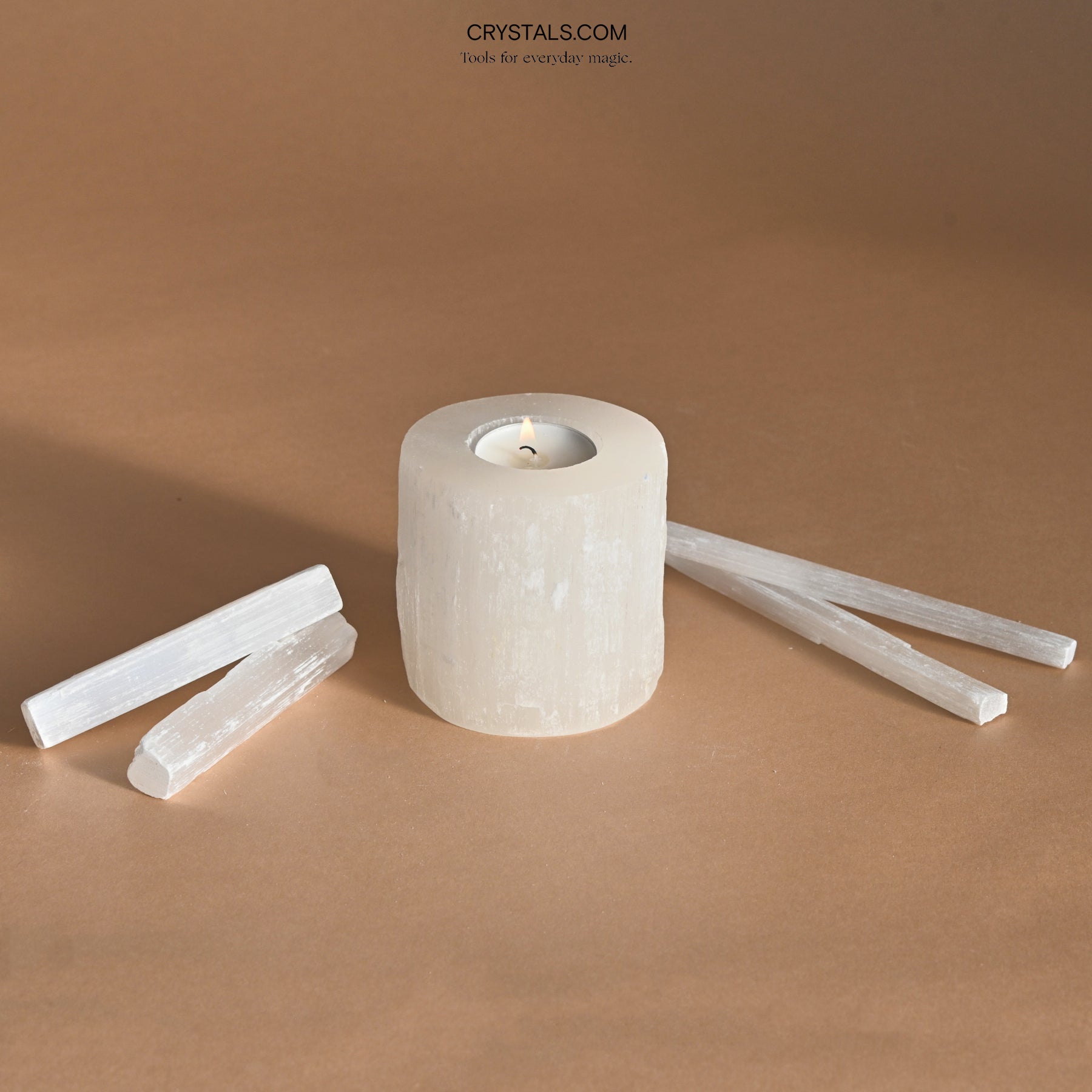
Named after Selene, the Greek goddess of the moon, selenite is a natural companion to moonstone. It is a crystallized form of gypsum that forms in evaporite deposits, often in long, striated wands or flat, blade-like crystals. Its glowing, translucent white body has an almost lunar quality that feels perfectly aligned with June's birthstone energy.
Selenite is widely used for cleansing other crystals and creating peaceful spaces. A selenite wand or bowl placed near your moonstone collection can help maintain a sense of clarity and calm throughout the month.

Selenite Moon Candle Holder — shop the Selenite Collection

Selenite Cleansing Wand — a must-have for any crystal collection
How to Choose Your June Birthstone Crystal
With three birthstones and several crystal alternatives to consider, choosing can feel overwhelming. Here is a simple framework to help you decide:
Start with what draws your eye. Birthstones are personal. If you keep coming back to the soft glow of moonstone, trust that instinct. If labradorite's bold flash speaks to you, go with it.
Consider the occasion. Giving a June birthday gift? A moonstone sphere or palm stone is a classic, universally loved choice. Building a personal collection? Branch out into labradorite, opal, and selenite to explore the full spectrum of June's energy.
Think about form. Spheres are beautiful display pieces. Palm stones are tactile and portable. Raw specimens show the mineral in its most natural state. Wands (like selenite) are practical tools. Choose the form that fits how you want to interact with the stone.
Do not overthink it. There is no wrong answer. The best crystal is the one you are drawn to — and the one you will actually hold, display, and enjoy.
June Birthstone FAQ
What are the three birthstones for June?
June has three official birthstones: pearl, alexandrite, and moonstone. Pearl is the traditional birthstone, alexandrite is the modern birthstone added in 1912, and moonstone is an additional birthstone recognized by the American Gem Trade Association.
What color is the June birthstone?
June birthstones span a wide color range. Pearls are most commonly white or cream but also occur in black, pink, and golden hues. Alexandrite shifts from green in daylight to reddish-purple under incandescent light. Moonstone displays a white or blue adularescent glow over a colorless to peach body.
Why does June have three birthstones?
June was originally assigned pearl as its birthstone. In 1912, the American National Retail Jewelers Association added alexandrite as a modern alternative. Moonstone was later included by the American Gem Trade Association to provide a more accessible and affordable option, since natural alexandrite is exceptionally rare.
Is moonstone a good alternative to pearl for June birthdays?
Absolutely. Moonstone is an official June birthstone and shares pearl's luminous, ethereal quality. It is durable enough for everyday wear at 6 to 6.5 on the Mohs scale, widely available, and beloved by collectors for its adularescence — the soft glow of light that appears to move across the stone's surface.
What crystals pair well with June birthstones?
Labradorite, opal, and selenite are excellent companions for June birthstones. Labradorite shares moonstone's feldspar family and displays its own iridescent flash. Opal echoes the play-of-color theme. Selenite adds a cleansing, high-vibration element to any collection.
Keep Exploring
June's three birthstones represent one of the most fascinating ranges in the entire birthstone calendar. Whether you gravitate toward the organic elegance of pearl, the scientific wonder of alexandrite, or the quiet glow of moonstone, there is something in this month's lineup for everyone.
At Crystals.com, we specialize in the mineral side of the equation. Our Moonstone Collection features hand-selected specimens with exceptional adularescence. Our Labradorite, Opal, and Selenite collections offer beautiful companion pieces that round out a June-inspired crystal display.
Explore, collect, and trust your instincts. The right stone has a way of finding you.
Free shipping on orders over $150
Related Guides
Discover Your Crystal Match
Select your sign and get personalized crystal recommendations delivered to your inbox.