Rose quartz is one of those minerals that earns its place in every serious collection — not for its rarity, but for its quiet authority.
In a world oversaturated with crystal content, rose quartz still holds its ground. It is the stone most people encounter first — in a gift shop, a friend's windowsill, a hotel lobby arranged with care — and yet most people know almost nothing about what they're actually holding. Its pink is not a coating or an enhancement. It is the product of microscopic silicate fibers aligned within the crystal lattice, a structural phenomenon so fine it cannot be seen with the naked eye. The result is that characteristic translucence: neither transparent nor opaque, but somewhere in between, like frosted glass lit from within.

This is the complete guide. Whether you are sourcing your first substantial piece, styling a collector-quality specimen for an interior, or selecting rose quartz as a meaningful gift, what follows is everything worth knowing — from geology to living room placement.
What Rose Quartz Actually Is: The Geology Behind the Pink
Rose quartz is a variety of quartz — silicon dioxide, SiO₂ — distinguished by its pink coloration. It belongs to the trigonal crystal system and registers a 7 on the Mohs hardness scale, making it durable enough for display, handling, and daily contact without significant risk of scratching or surface damage.
The color mechanism of rose quartz has been a subject of scientific debate for decades. According to the Gemological Institute of America, research has shown that most rose quartz owes its delicate pink hue to microscopic inclusions of aligned silicate mineral fibers — generally similar, though not identical, to the mineral dumortierite. These inclusions are so fine they create a characteristic cloudiness rather than visible inclusions, lending the stone its soft, almost atmospheric quality.
There is a second, rarer variety: crystalline rose quartz, which forms discrete, well-terminated crystals rather than the more common massive form. In crystalline specimens, the pink color is caused by irradiation-induced color centers based on aluminum and phosphorus substituting for silicon in the crystal lattice. Mindat.org notes that crystalline rose quartz is considerably scarcer than the massive form and commands significant collector interest when specimens display clear terminations and deep saturation.
Where Rose Quartz Forms
Rose quartz occurs primarily in pegmatites — coarse-grained igneous rocks that form in the final stages of magma crystallization, where mineral-rich fluids allow crystals to grow larger than in typical igneous environments. It also appears in hydrothermal veins. The finest-quality rough typically comes from Brazil, particularly from Minas Gerais. Madagascar, India, and Sri Lanka are secondary sources, each producing material with slightly different character: Madagascar specimens often show softer saturation, while Brazilian pieces tend toward the most consistent depth of color.
Grades and Forms: What to Look For When Buying
Not all rose quartz is equal. The market ranges from pale, nearly colorless material sold as rose quartz to deeply saturated specimens that approach a true rose-pink. Understanding the spectrum helps you buy with intention — and spend where it matters.
Color Saturation
The ideal rose quartz sits in the medium-pink range: enough color to read as distinctly pink without tipping into lavender or peach. Very pale material is common and inexpensive. Deep, evenly saturated rose quartz — particularly in large, uncarved forms — is considerably harder to source and prices accordingly.
Form
Rose quartz comes to market in several forms, each suited to different applications:
Raw/natural chunks: The most honest form. Irregular, often with natural termination points or cleavage faces. Best for collectors and those who want geological authenticity on display. Scale matters — a fist-sized piece has minimal visual presence in a room; pieces starting at two to three kilograms begin to anchor a space.
Polished spheres and eggs: The processing reveals the interior translucence and allows the stone to be viewed uniformly. A high-quality rose quartz sphere — particularly one sourced from Brazilian material — shows remarkable internal glow when light passes through it.
Towers and points: Carved from larger rough, towers amplify the visual impact of rose quartz by creating a tall, sculptural form. Quality varies significantly; prioritize pieces with consistent color throughout rather than pale cores with color concentrated at the surface.
Tumbled stones: Entry-level, affordable, and useful as gift accompaniments. Not suitable as statement pieces.
Clarity and Surface
Rose quartz is never truly transparent — its inclusions preclude that. But the best specimens have an even, glowing translucence rather than a milky opacity. Hold a piece up to natural light: quality material will show depth and internal luminosity. Flat, opaque pink with no internal glow indicates lower-grade material.
Styling Rose Quartz in Interiors: The Editorial Approach
Rose quartz occupies an interesting design territory. Its color is warm but not loud, its texture soft but substantial. It reads as feminine without being delicate, romantic without being sentimental — which makes it one of the most versatile crystals for interior use when handled correctly.
The mistake most people make is using pieces that are too small. A single rose quartz specimen under a kilogram disappears in any room of standard proportions. Scale up: a 3–5 kg raw cluster or a sphere of 12–15 cm diameter begins to command attention and function as the focal object it deserves to be.
Living Room Placement
Rose quartz works best when it has breathing room. A large raw specimen on a stone, marble, or raw wood surface — without clutter surrounding it — reads as sculpture. Pair it with other neutral tones: warm whites, natural linens, pale travertine. It also works against dark backgrounds, where the pink registers with greater clarity against deep charcoal or forest green.
Avoid placing rose quartz on surfaces with competing warm tones like terracotta or brick — the palette clash diminishes both elements. Instead, let it anchor a monochromatic pale scheme or serve as the only warm element in an otherwise cool-toned space.
Bedroom Placement
The bedroom is where rose quartz has always been most at home. On a bedside table, in a niche, or on a low dresser, a well-chosen specimen becomes part of the room's atmosphere rather than a decoration. Avoid overcrowding it with other objects — let the stone occupy its surface with authority.
Home Office
A rose quartz sphere on a desk introduces war
mth to what can be a cold, utilitarian space. The sphere form works particularly well here — it reads as considered, not casual, and the rounded form softens the hard lines of screens and furniture.
Browse our full rose quartz collection for curator-sourced specimens in every form and scale. New material is also regularly added to our new arrivals.
Rose Quartz as a Gift: When and How to Give It Well
Rose quartz is one of the few crystals with genuinely universal gift appeal — it transcends the crystal-curious demographic and lands well with people who would never identify as collectors. The color is universally appealing, the form is immediately beautiful, and it carries no esoteric baggage that might make a recipient feel like they've been given something to believe in rather than something to enjoy.
Occasions
Housewarming: A substantial raw rose quartz piece — at least 500g, ideally a kilogram or more — makes an exceptional housewarming gift. It's meaningful without being personal, beautiful without being perishable, and will remain in the home for decades. Frame it as a statement piece for the living room or bedroom.
Wedding gift: A large, curator-quality rose quartz specimen presented as a home object — rather than as a "love stone" — elevates the gesture. Choose a piece with natural form and genuine geological presence. Pair it with a card that mentions where the piece was sourced.
New baby: A tumbled or small polished rose quartz placed in a nursery is a thoughtful, safe gift. Its softness of color suits the room perfectly.
Valentine's Day and anniversaries: Rose quartz is an obvious but genuinely excellent choice here — provided the piece itself is beautiful enough. Avoid the small, pale, mass-market hearts and instead select a raw specimen or carved sphere that would hold its own in any interior. Quality makes the difference between a meaningful gesture and a forgettable one.
How to Present It
Rose quartz requires no elaborate packaging. A piece of cloth, a simple card with a brief note about its origin, and a suggestion for where it might live in the home is sufficient. The stone itself communicates everything — let it.
See our home decor collection for a curated selection of pieces appropriate for gifting at every price point.
Care and Longevity: Keeping Rose Quartz at Its Best
Rose quartz is low-maintenance by mineral standards. With a Mohs hardness of 7, it will not scratch from contact with most household surfaces, though it will scratch glass and most metals. A few guidelines ensure your piece remains in condition:
Light exposure: Extended direct sunlight will fade rose quartz over time. The silicate fiber inclusions that create its color can bleach under UV exposure. Display in bright ambient light, but not in a south-facing window with hours of direct sun daily. If you notice gradual paling, repositioning the piece typically stops further fading.
Cleaning: Dust regularly with a soft, dry cloth. For deeper cleaning, use lukewarm water and a soft brush. Avoid ultrasonic cleaners and steam — both can damage the surface of crystalline specimens and disturb inclusions in polished pieces.
Storage: If storing pieces that are not on display, wrap individually in soft cloth to prevent contact between pieces. Rose quartz will not scratch steel, but it will scratch softer stones.
Temperature: Avoid rapid temperature change. Moving a piece from a cold environment to direct heat — or vice versa — can, in theory, cause fracturing along existing internal stress lines. In practice, this is rare with quality specimens, but worth noting for any large investment piece.
The Collector's Perspective: What Makes a Piece Worth Keeping
From a collector's standpoint, most rose quartz on the market is decorative material — pleasing, abundant, and not particularly rare. The pieces worth acquiring with long-term intent share a different profile:
Crystalline rose quartz: Discrete, well-terminated crystals of rose quartz are genuinely rare. Unlike the common massive form, crystalline specimens form in pegmatite pockets and show distinct crystal faces. A cluster of crystalline rose quartz with clear terminations and good color saturation is a serious collector piece and becomes rarer and more valuable over time as the best localities are depleted.
Star rose quartz: When the silicate fiber inclusions are sufficiently aligned and dense, a polished rose quartz sphere will display asterism — a six-rayed star that moves across the surface as the viewing angle changes. Star rose quartz spheres of significant size (10 cm diameter and above) with well-defined stars are exceptional and command corresponding prices.
Origin-documented specimens: Rose quartz from documented Brazilian localities — particularly pieces that retain their original matrix or show an identifiable geological context — holds greater interest for serious collectors than anonymous commercial material.
The Smithsonian National Museum of Natural History's quartz collection provides useful context for understanding the full spectrum of quartz varieties and what constitutes genuine geological significance in specimen selection.
Frequently Asked Questions
What is the difference between rose quartz and pink quartz?
These terms are often used interchangeably, but they technically describe different phenomena. Rose quartz refers to the massive, translucent pink variety caused by silicate fiber inclusions. Pink quartz, in the strictest mineralogical sense, refers to the rarer crystalline variety where color comes from irradiation-induced color centers. In commercial contexts, both are sold as rose quartz. When buying collector-grade specimens, ask specifically whether the piece is massive or crystalline rose quartz.
Does rose quartz fade in sunlight?
Yes. Extended direct sunlight will bleach rose quartz over time. The color is not UV-stable. Display in ambient natural light or indirect light to preserve color depth. If you notice fading, move the piece out of direct sun exposure.
What size rose quartz should I buy for interior display?
For a meaningful visual presence in a standard room, look for pieces starting at 1 kg for a bedside table or shelf, and 2–5 kg or more for a living room surface. Smaller pieces work as accent objects when grouped, but a single small piece rarely achieves the presence it deserves in a room of scale.
Where does the best rose quartz come from?
Brazil, particularly Minas Gerais, produces the finest-quality massive rose quartz with the most consistent, deeply saturated color. Madagascar and India are secondary sources. For crystalline rose quartz specifically, Brazil and Madagascar are the most significant localities.
Is rose quartz rare?
Massive rose quartz is not rare — it is one of the more abundant colored quartz varieties. Crystalline rose quartz (discrete, terminated crystals) is genuinely rare and commands collector interest. Star rose quartz with clearly defined asterism is also uncommon and valuable.

How do I tell if rose quartz is real?
Genuine rose quartz has a characteristic translucent cloudiness and internal depth that glass imitations cannot fully replicate. It should feel cold to the touch and remain cool longer than glass or resin. It will not scratch with a fingernail but will scratch glass. The GIA's rose quartz reference provides detailed quality factors to guide evaluation.
Can rose quartz be placed in water?
Rose quartz is water-safe for short periods — it will not dissolve or degrade in water. However, prolonged submersion is not recommended for polished pieces as it can dull the surface finish over time. For raw specimens, occasional rinsing is fine; extended soaking is not.
What crystals pair well with rose quartz in an interior?
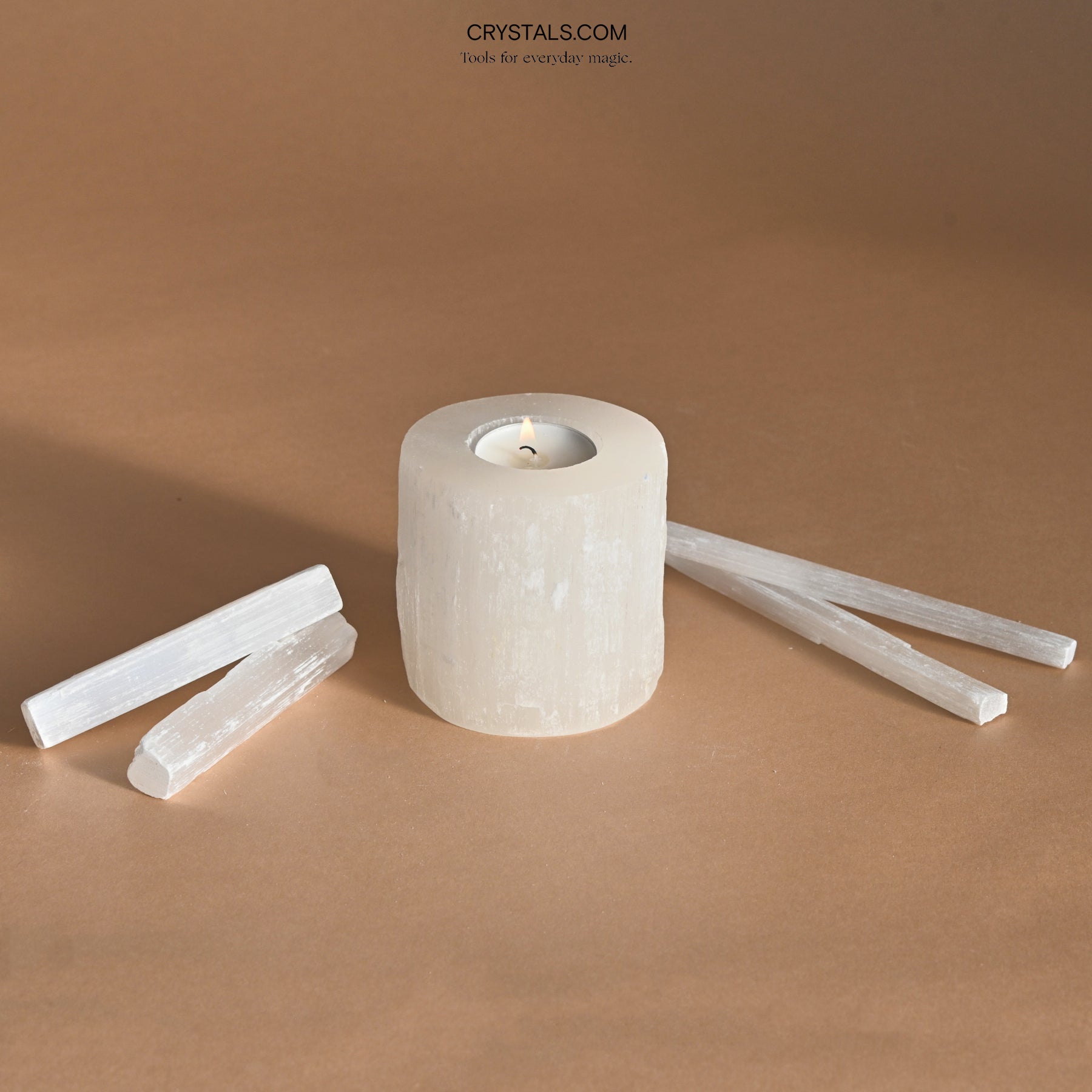
Rose quartz sits beautifully alongside white or grey minerals: selenite (for light contrast), smoky quartz (for a warm-to-dark gradient), and clear quartz clusters. Avoid pairing with other strongly colored minerals — the rose quartz will either compete or disappear. Let it be the color element in a composition of neutrals.
Discover Your Human Design
Crystals amplify energy — but do you know your unique energy type? Human Design reveals how you're wired to make decisions, work, and rest. It's the owner's manual you were born with.
Explore Human DesignGet 10% Off Your First Order
Plus early access to new arrivals, collector drops, and crystal guides. Join 15,000+ crystal lovers.
Rose quartz rewards patience and specificity. The right piece — properly scaled, thoughtfully placed, chosen for genuine geological character rather than surface appeal — has a presence in a room that persists over years, not seasons. It is not a trend. It is a mineral with a two-billion-year history and a color that earns its place in any serious collection.
Explore our full rose quartz collection and new arrivals → for curator-sourced specimens at every scale and investment level.
Explore our full Crystal Encyclopedia — meanings, healing properties, and chakra connections for 280+ crystals.
Not Sure Which Crystal Is Right for You?
Take our 60-second crystal quiz and get a personalized recommendation based on what you need right now.
Take the Crystal Quiz