Shop Crystals for This Energy
Free shipping on orders over $150

On February 20, 2026, two of the solar system's most consequential planets — Saturn and Neptune — met at exactly 0° Aries, the very first degree of the zodiac. This is not a minor transit. A Saturn–Neptune conjunction happens only once every 36 years. The last one coincided with the fall of the Berlin Wall. The one before that, the end of World War II. These are not moments to pass through casually.
What makes this particular conjunction extraordinary — even by the standards of a rare event — is the placement. The 0° Aries point is where the zodiac is born. A Saturn–Neptune conjunction at 0° Aries has not occurred in over 600 years. We are living in one of those moments. The natural world has been keeping time far longer than any of us, and certain minerals — formed under geological pressures and conditions just as ancient — feel particularly aligned with what this sky is asking of us.
What Is the Saturn–Neptune Conjunction?
The Saturn–Neptune cycle lasts approximately 36 years, marking long arcs of cultural, ideological, and structural change. Astrodienst, one of the most respected sources in contemporary astrology, describes it as the cycle concerned with the rise and fall of ideals — where structures either solidify around a vision, or dissolve under their own weight.
Saturn governs form, discipline, and time. It is the architect. Neptune governs the formless — dreams, collective feeling, the unconscious. Together, these two planets ask us to build with vision and dissolve what no longer serves. The conjunction is the seeding moment of an entirely new 36-year chapter in that negotiation.
For a deep astrological reading of the current cycle, astrologer Maurice Fernandez's analysis is among the most comprehensive available.
Why 0° Aries Changes Everything
Every zodiac degree carries meaning, but the 0° Aries point is in its own category. It is the vernal equinox degree — the point where the sun crosses the celestial equator on the first day of astronomical spring. Planets meeting here operate in public, world-stage energy. Nothing about 0° Aries is private or quiet.
Aries is the sign of initiations, of willpower, of the self stepping forward. When Saturn and Neptune meet here, the question they pose is magnificent in its difficulty: Can you build something real from a dream? Can you hold a vision steady long enough for it to take form?
Café Astrology notes that the February 20, 2026 perfection came just three days after a solar eclipse at 28° Aquarius — deepening the sense of threshold, of one chapter closing and another genuinely beginning.
The Historical Fingerprint: What the Last Conjunction Brought
The 1989 Saturn–Neptune conjunction coincided with one of the most significant restructurings of the modern world. The Berlin Wall fell. The Cold War began its end. Apartheid in South Africa began to officially unravel. Entire ideological structures — walls, literally and figuratively — came down under the pressure of a collective human dream of something better.
The Astrology Podcast offers an excellent deep-dive into the full historical timeline of these conjunctions. The difference in 2026 is the Aries ingress: in Capricorn (1989), the dissolution was institutional. In Aries, the rebuilding is personal — it is the individual's relationship to identity, autonomy, and purposeful action that is being reformed.
Nine Crystals for the Saturn–Neptune Conjunction 2026
These geological specimens are chosen for the specific energetic interplay this conjunction represents: structure and fluidity, vision and discipline, dissolution and becoming. Each one is a natural formation — formed across millions of years — that mirrors something the current sky is asking us to work with.
For the Saturn Current: Structure, Clarity, Accountability
1. Smoky Quartz (Smoky Quartz Palm Stone)

Smoky quartz forms when clear quartz is exposed to natural radiation over long periods — darkness transformed through time into something grounding and clear. This is the specimen for cutting through illusion, stabilizing overthought, and staying present in the actual work. It is not glamorous. It is reliable.
2. Pyrite (Pyrite Cluster)
Pyrite's cubic crystalline structure is among the most geometrically precise formations in the natural world. Saturn governs geometry, discipline, and resource. Pyrite placed in a workspace anchors the energetic conversation around disciplined effort and material focus. A serious mineral for serious intentions.
3. Black Tourmaline (Black Tourmaline Rough)
Formed in granitic pegmatites, black tourmaline is one of the most electrically complex minerals on earth. Where smoky quartz stabilizes, black tourmaline clears the field. Consider it essential for anyone doing active restructuring work in 2026.
For the Neptune Current: Intuition, Vision, Dissolution
4. Labradorite

On the surface, labradorite appears grey — almost unremarkable. Then light hits the internal layers of its feldspar structure and it erupts into electric blue, gold, and green. This is the Neptune paradox: what looks ordinary conceals something otherworldly. Labradorite holds the space between what is seen and what is sensed.

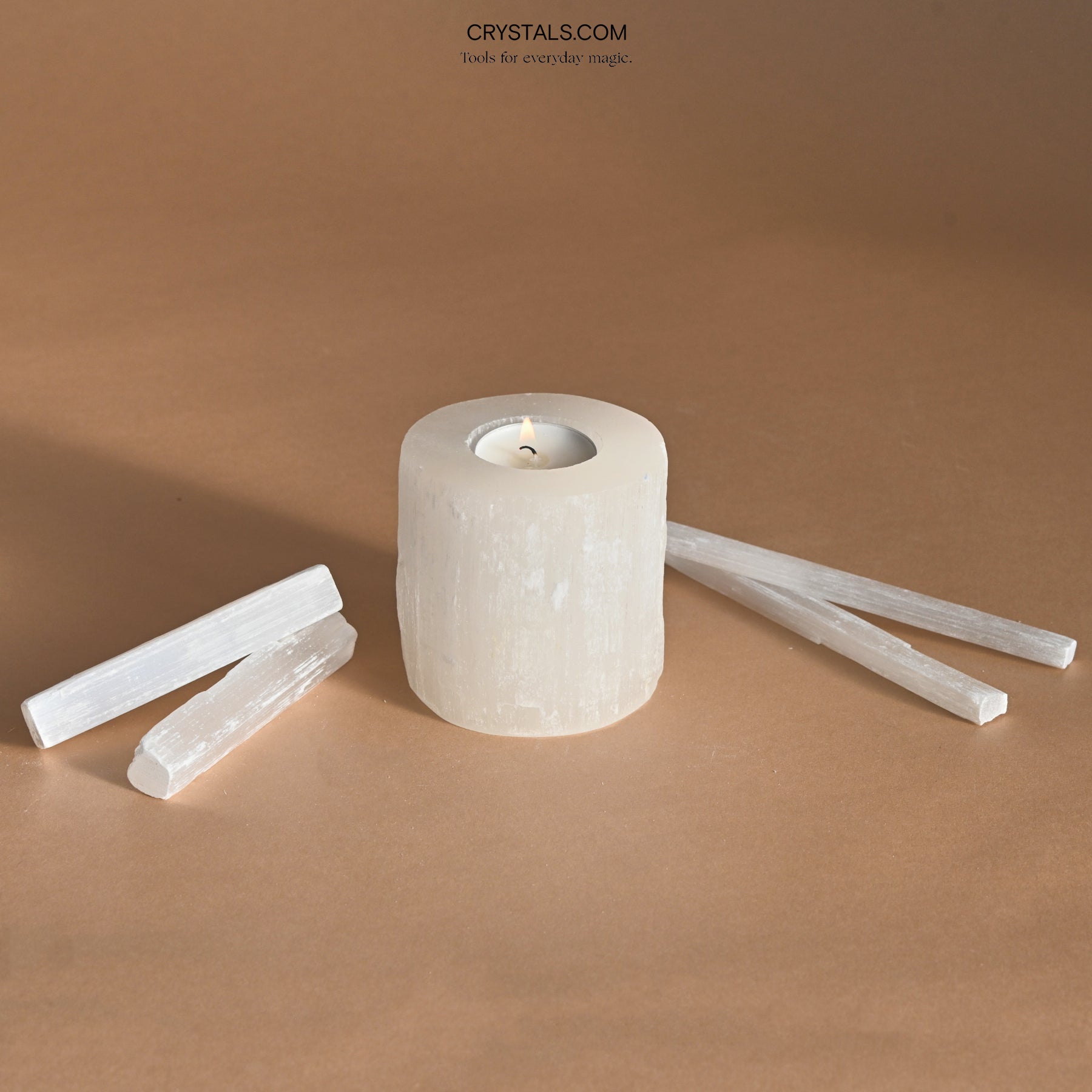
5. Selenite (Selenite Cleansing Wand)
Selenite is crystallized gypsum — one of the softest, most translucent minerals in the collector's vocabulary. It forms in evaporite deposits, often in caves, fibrous and luminous. Neptune governs the dissolution of barriers. Selenite is the mineral of that threshold.
6. Amethyst
Silicon dioxide colored violet by trace iron and natural irradiation — but its visual presence in a space is anything but simple. For a Saturn–Neptune year asking us to hold structure and dream simultaneously, amethyst is the specimen that holds both currents without conflict.

For the Aries Ignition: First Action, New Identity
7. Clear Quartz
The 0° Aries point is the absolute beginning. Clear quartz — silicon dioxide in its most pristine form — is the mineral equivalent of a clean slate. It amplifies what it is near, carries no agenda of its own, and its optical clarity makes it one of the most singular specimens in any collection.
8. Citrine
 ; height: auto; display: block; margin: 16px auto;" loading="lazy">
Natural citrine develops golden-amber color from iron impurities — in its genuine, unheated form, it is rarer than most people realize. Disciplined solar energy in mineral form — focused, luminous, and generative. For anyone who feels the call of this conjunction toward something they have never attempted.
9. Carnelian
Iron-rich chalcedony in bands of amber, rust, and deep orange — prized since ancient Egypt. Aries is the sign of the body in motion, of willpower expressed physically. Carnelian is the geological embodiment of that energy. Tactile, warm, and deeply beautiful.
How to Work With These Crystals During the Saturn–Neptune Conjunction
There is no ritual required. These are minerals — physical objects with visual presence and geological weight. Their value in this period is both aesthetic and intentional.
Place smoky quartz or pyrite near your desk or workspace during 2026 as a physical anchor for disciplined, structured effort. Keep labradorite or selenite in quieter spaces — a reading corner, a bedroom shelf — as a visual cue toward the interior work Neptune asks for. Use amethyst clusters as statement pieces in living areas. Choose clear quartz, citrine, or carnelian for spaces where new work begins.
For curated interior styling, visit our Home Decor collection or explore our Collectors Edition for rare one-of-a-kind specimens worthy of a once-in-600-years moment.
Frequently Asked Questions: Saturn–Neptune Conjunction 2026
When exactly is the Saturn-Neptune conjunction in 2026?
The conjunction perfects on February 20, 2026 at 0°45' Aries. The energy has been building since April 2025 and will remain potent through early 2027.
How rare is a Saturn-Neptune conjunction at 0° Aries?
Go Deeper Than Your Sun Sign
Astrology shows the sky at your birth. Human Design shows how your body is wired to move through the world. Discover your energy type, strategy, and inner authority.
Explore Human DesignExtremely rare. While Saturn-Neptune conjunctions occur every 36 years, a conjunction at 0° Aries — the first degree of the zodiac — has not occurred in over 600 years.
What crystals help with Saturn energy in 2026?
For Saturn's structuring, disciplining energy: smoky quartz for grounding and clarity, pyrite for focused material effort, and black tourmaline for clearing calcified patterns.
What crystals help with Neptune energy in 2026?
For Neptune's visionary, dissolving energy: labradorite for the space between seen and unseen, selenite for dissolving barriers, and amethyst for holding vision without losing structure.
Where can I buy crystals for the Saturn-Neptune conjunction?
Crystals.com carries individually sourced, museum-quality specimens for each stone mentioned in this guide. Browse the latest arrivals or explore the full crystal collection.
Shop New Arrivals for This Transit
The collection right now includes smoky quartz clusters, labradorite slabs, and high-grade amethyst formations — each piece individually sourced and photographed by Brittany.
A Note on What's Real
The irony of a Saturn–Neptune transit is that it asks "what is real?" more insistently than almost any other planetary cycle — and then leaves you to answer it yourself.
What we know: these minerals are real. Their formations took millions of years. Their geological structures are measurable, documented, and genuinely beautiful. Whether you bring them into your space for their geological character, their aesthetic presence, or the specific intention this year is asking you to hold, the minerals themselves don't change. They were here before any of this. They'll be here long after. That kind of time horizon has its own kind of medicine.
Get 10% Off Your First Order
Plus early access to new arrivals, collector drops, and crystal guides. Join 15,000+ crystal lovers.
Explore the full collection at Crystals.com. New arrivals added regularly — each piece individually sourced and photographed by Brittany. For interior designers and trade clients, our Trade Program offers access to select specimens for residential and commercial projects.
Sources & Further Reading:
The Great 2025–26 Saturn–Neptune Conjunction — Astrodienst
Saturn–Neptune Conjunction at 0° Aries — Maurice Fernandez
Saturn Conjunct Neptune — Café Astrology
Saturn–Neptune Conjunctions in History — The Astrology Podcast
How Saturn–Neptune Conjunctions Reshape Our World — CHANI
Saturn–Neptune Conjunction in Aries — Jessica Davidson
Explore our full Crystal Encyclopedia — meanings, healing properties, and chakra connections for 280+ crystals.
Not Sure Which Crystal Is Right for You?
Take our 60-second crystal quiz and get a personalized recommendation based on what you need right now.
Take the Crystal Quiz