Shop Crystals for This Energy
Free shipping on orders over $150
Interior Design & Home Decor
Crystal Furniture:
Where Natural Sculpture
Meets Interior Design
Millions of years in the making. A lifetime in your home. The complete guide to collecting, styling, and living with crystal furniture.
There is a moment, standing in front of a well-lit agate side table or a cathedral-sized amethyst coffee table, when the line between furniture and fine art simply disappears. Crystal furniture occupies a rare category: it is geological, sculptural, and functional all at once. Each slab of petrified wood carries a record of an ancient forest. Each geode slice was sealed underground while the dinosaurs still roamed. Bringing these objects into a home is not decorating — it is curating time itself.
Over the past decade, the interior design world has moved steadily away from the perfectly uniform and toward the irreducibly unique. Organic modern, biophilic, and maximalist-eclectic spaces have all converged on the same conclusion: nothing manufactured can compete with what the earth produces. Crystal furniture is now a fixture in the studios of leading interior designers — not as a novelty, but as a primary investment piece around which entire rooms are built. This guide covers everything you need to know to find, style, and live with crystal furniture at every price point.
Browse our home decor collection, explore geodes, or read the crystal home decor guide for more inspiration.
Crystal Tables: The Statement Piece That Earns Its Square Footage
Of all crystal furniture categories, tables carry the most functional weight. They are the pieces your guests will touch, gather around, and notice first — and they are where the geology is most viscerally on display.

Agate Side Tables
Agate is the great entry point into crystal furniture. Sliced into thin, backlit discs, banded agate reveals concentric rings of color — amber, rust, cream, indigo, moss green — that read like a topographical map of deep time. Agate side tables typically feature a single polished slab mounted on a brass, blackened steel, or hand-carved marble base. The translucency is the selling point: placed near a window or above a lamp, agate glows from within, shifting character as the light changes from morning to evening. Expect genuine artisan-made agate side tables to range from $800 to $4,000 depending on slab size, color saturation, and base material. Blue lace and moss agate command premium prices; natural brown and amber banding is more accessible.
Petrified Wood Consoles and Coffee Tables
Petrified wood occupies a singular position: it is simultaneously mineral and arboreal, fossil and sculpture. Over millions of years, silica-rich groundwater replaced organic wood cell by cell, preserving the grain structure of ancient trees in chalcedony, jasper, or opal. The result is a surface that reads as wood to the eye but behaves as stone under the hand — cool, hard, utterly permanent. Petrified wood console tables are some of the most coveted pieces in organic modern interiors. A cross-section slab mounted at console height brings warmth through its natural grain patterning while retaining the mineral credibility that distinguishes a serious collector's home from a generic one. Larger free-form petrified wood slabs are also used as coffee table tops, often with a steel or bronze waterfall base to keep the focus on the specimen. High-quality Indonesian and Arizona petrified wood pieces range from $2,000 to well over $15,000 for fully intact logs.
Amethyst Coffee Tables
Amethyst geode slices and cluster tops represent the boldest move in crystal furniture. A cathedral amethyst slice — sometimes three or four feet across — set under tempered glass and raised on a steel base becomes the visual center of gravity for an entire living room. The deep violet, the reflective crystal faces, the raw cave-like interior: nothing manufactured approaches this as a conversation object. More accessible amethyst coffee table options include smaller polished amethyst slab tops paired with minimalist brass legs, which work equally well in compact city apartments. Explore our amethyst collection to see the range of specimen quality available. The key distinction is druzy depth — geodes with deep, well-formed crystal points read as far more premium than shallow or cloudy specimens.
Geode Accent Tables
Geode accent tables are the most versatile format in this category: a halved geode, either free-standing on a custom base or wall-mounted at table height, doubles as both surface and sculpture. Citrine geode tables bring golden warmth to darker interiors. Ocean jasper rounds — cross-sections revealing orbicular patterns of green, cream, and pink — are coveted by collectors and increasingly difficult to source as Madagascar deposits thin. Amethyst, celestite, and quartz geode accent tables all have distinct design characters. Browse our full geode collection to understand the spectrum of available specimens.
Crystal Lighting: When the Mineral Becomes the Lamp
Crystal lighting is among the fastest-growing categories in the bespoke interior design market, and for good reason: when you backlight a translucent mineral, you reveal structure invisible to the naked eye under ambient light. A selenite (Selenite Cleansing Wand) column lamp glows like a softbox. An agate pendant throws colored shadows on the ceiling. Amethyst table lamps cast violet pools of light that no manufactured shade can replicate.
Geode Lamps
Geode lamps use a halved geode as the primary light-diffusing element. LED strips or Edison-style bulbs placed inside the geode cavity illuminate the crystal faces from within, creating a depth of sparkle impossible to achieve with a conventional shade. Amethyst and citrine geodes are the most popular choices; the warm yellow tones of citrine pair particularly well with brass hardware, while deep amethyst works in cooler, more dramatic interiors. Smaller geode bookend lamps — pairs of halved geodes wired as matching table lamps — are an accessible entry point at $200 to $600 per pair. Large feature geode lamps with custom iron bases can reach $3,000 to $8,000.
Selenite Fixtures
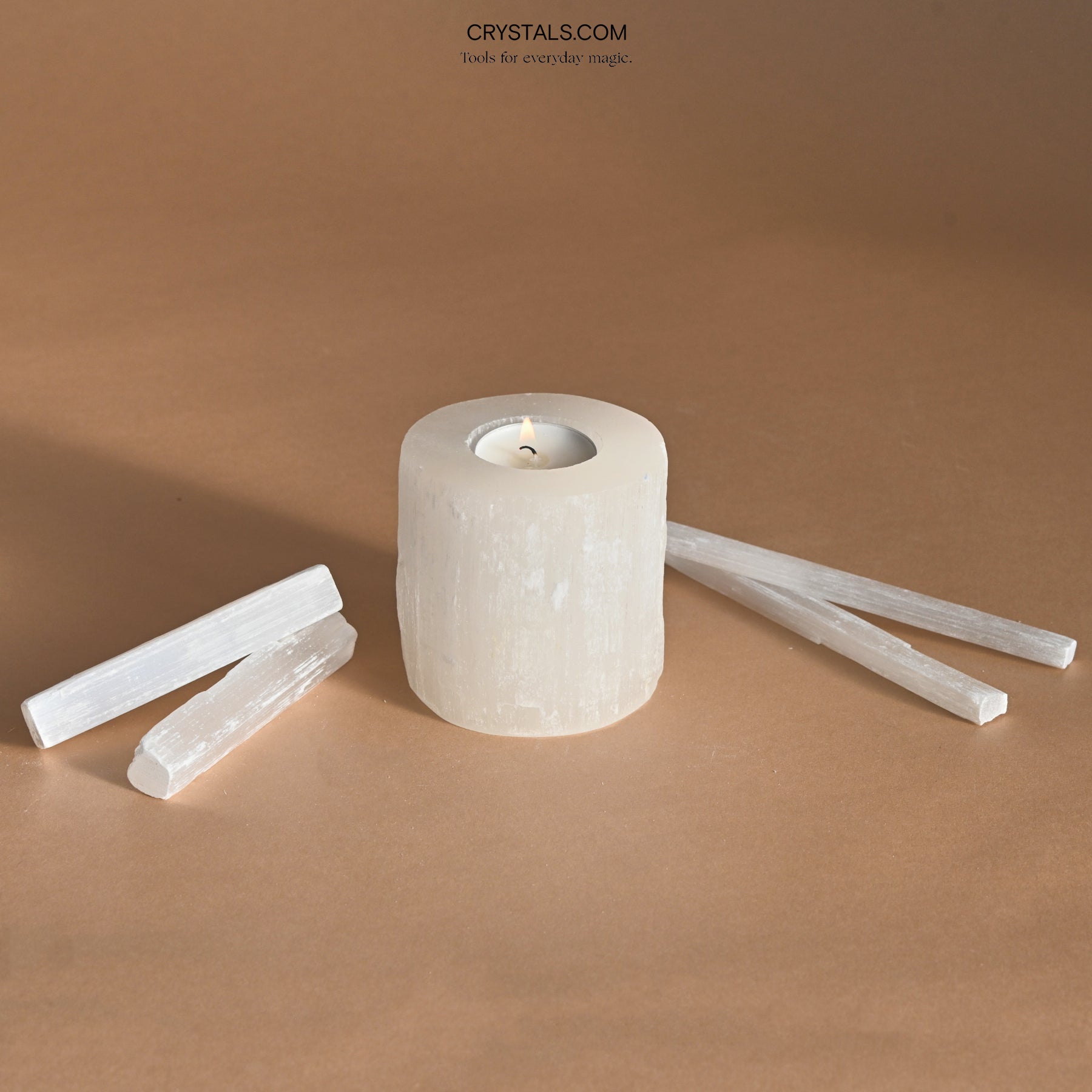
Selenite is gypsum in its most ethereal form: fibrous, translucent, and almost impossibly soft in character despite being a physical stone. Selenite towers used as lamp columns produce a diffuse, warm glow with none of the harsh edge of glass. Selenite pendant shades — hand-carved or naturally formed slabs wired as pendant lights — are a signature element in high-end organic modern kitchens and
dining rooms. One important practical note: selenite is water-soluble and among the softer minerals (Mohs 2). Selenite light fixtures must be kept away from humidity and should never be cleaned with water or damp cloths; a soft dry brush or compressed air is sufficient.
Amethyst Table Lamps
Amethyst table lamps bridge the collectible and the functional with particular elegance. A rough amethyst cluster wired as a base — with a linen or silk shade above — reads as both geological specimen and thoughtfully designed object. The crystal base grounds the lamp visually, while the shade redirects light upward and out. Designers frequently use these on bedside tables and reading nooks, where the combination of the mineral's visual weight and the lamp's warm cast creates an atmosphere that is simultaneously dramatic and intimate.
Crystal Bookends and Decorative Objects
Not every crystal furniture acquisition is a five-figure geode coffee table. The decorative object category — bookends, spheres, obelisks, towers, raw specimen clusters — represents the most accessible and stylistically versatile tier of crystal in the interior.
Crystal bookends are a particularly strong starting point. Matched pairs of labradorite, amethyst, pyrite, or obsidian (Black Obsidian Palm Stone) slice bookends bring mineralogical credibility to any shelf or console without requiring a structural commitment. Labradorite bookends — polished to reveal the blue-green schiller that makes this feldspar so celebrated — are a standard in designer interiors and pair as well with art books as they do with antique ceramics. Pyrite cluster bookends add industrial weight and flash; obsidian pairs read as sharp and architectural.
Beyond bookends, crystal decorative objects include: quartz spheres on brass stands (excellent on round side tables where the curved form echoes the round top), tall selenite or quartz tower clusters used as architectural verticals in built-in bookshelves, raw malachite chunks used as paperweights or objets on a desk, and specimen-quality single crystals — a large aquamarine on matrix, a spectacular calcite rhombohedron, a perfect fluorite octahedron — displayed in isolation as sculpture. The closer a decorative crystal object is to its natural state, the more it communicates rarity and intentionality.
Crystal Serving Pieces: Elevating the Table
Crystal and stone serving pieces occupy the productive overlap between interior design and the art of hosting. An agate coaster, a marble cheese board, an onyx wine chiller, a quartz salt cellar: these objects perform daily functions while remaining, undeniably, geological artifacts. They are the pieces that guests pick up, turn over, and ask about — and the pieces that photograph most compellingly for a styled table setting.
Agate coaster sets are the most widely available entry point. Polished agate slices of four to five inches diameter, set in a leather or felt-lined tray, are functional, durable, and stunning on a linen tablecloth. The color range is wide: natural grey-white banding reads as quiet and sophisticated; dyed blue or teal agate adds a stronger chromatic statement. Natural, undyed agate will always be more valuable and will not fade over time the way dyed pieces can.
Marble cheese boards — slabs of Carrara, Nero Marquina, or honey onyx with polished edges and rubber feet — are a staple of high-end kitchen styling. Onyx is the luxury tier here: the translucency of onyx, particularly green Pakistani onyx or amber Turkish onyx, reads as unmistakably premium. Agate slab serving boards are rarer and command higher prices; their irregular organic edges and banded patterning make them more sculptural than utilitarian marble alternatives.
Sourcing Crystal Furniture: Artisan vs. Mass-Produced
The crystal furniture market spans an enormous range — from specimen-quality artisan pieces that took months to bring to market, to mass-produced factory items assembled from dyed agate offcuts and generic steel frames. Knowing the difference is essential before you spend.
What to Look For
Provenance transparency. A reputable seller will tell you where a specimen was mined — Brazil, Madagascar, Morocco, Mexico, the American Southwest — and ideally when. Unnamed "natural stone" with no geographic detail is a flag.
Natural vs. dyed color. Much of the agate on the mass market is dyed: the neon blue, electric purple, and candy pink "agate" you see in discount home stores is natural grey chalcedony that has been pressure-dyed. Dyed agate is not without beauty, but it is not the same product as naturally banded agate, and it will fade. Naturally colored banded agate will show variation — no two bands will be perfectly uniform — while dyed pieces often show an artificial evenness.
Weight and structural integrity. Crystal furniture is heavy. A genuine petrified wood slab coffee table top may weigh 80 to 150 pounds. If a piece described as petrified wood or solid agate seems surprisingly light, ask questions. The base should be engineered to support the specimen weight; wobbly or underbuilt bases are a structural and safety concern with mineral tops.
Polish quality. Run your hand across the surfa
ce. A properly finished mineral top will be glassy-smooth with no visible tool marks. Rough edges on a piece marketed as polished are a sign of rushed finishing. The underside of a slab should show the natural unpolished face of the mineral — this is correct and expected — but the top should be mirror-flat.
Artisan Makers vs. Import Volume
Artisan crystal furniture makers — often small studios working directly with gem show suppliers or mining contacts in Brazil and Morocco — will custom-match a base to your specimen, use higher-quality hardware, and be able to discuss the geology of the piece in detail. They produce in small quantities; delivery times of eight to sixteen weeks are normal. Volume importers, by contrast, offer faster availability and lower price points but with correspondingly less character in the specimens and less flexibility in base options. Neither is categorically wrong — the question is what you are optimizing for. A $300 agate coaster set from a volume importer may be perfectly appropriate; a one-of-a-kind petrified wood dining table deserves an artisan relationship.
Styling Crystal Furniture by Room and Design Style
Crystal furniture is not a single-aesthetic proposition. Depending on how it is curated and contextualized, the same amethyst geode can read as maximalist, minimalist, bohemian, or high-modernist. The design style is set by everything around it.
Minimalist
In a minimalist interior, crystal furniture works because it provides extraordinary visual information in a single object. A lone amethyst geode on a polished concrete floor, or a petrified wood console against a white wall with nothing else on it: the restraint of the surrounding space amplifies the specimen's complexity. For minimalist rooms, choose one hero crystal piece and let it breathe. Avoid clustering multiple specimens; each piece should have ample negative space. Bases should be as quiet as possible — blackened steel hairpin legs, polished chrome, clear acrylic — to keep focus on the mineral.
Organic Modern
Organic modern is arguably the native habitat of crystal furniture. Linen upholstery, jute rugs, raw oak millwork, rattan, and hand-thrown ceramics all create a material language that crystal furniture speaks fluently. In organic modern spaces, warm-toned specimens thrive: honey calcite, petrified wood, desert rose selenite, amber agate, smoky quartz. A round petrified wood coffee table on a raw steel base, paired with a natural linen sofa and a terracotta jug, is a definitive organic modern composition. Layer brass hardware throughout to tie mineral warmth together.
Maximalist
Maximalism is where crystal furniture is most theatrically itself. A room with a full-cathedral amethyst geode as a coffee table anchor, paired with velvet seating, art-covered walls, layered vintage rugs, and specimen clusters on every shelf — this is the unabashed collector's interior. In maximalist rooms, the challenge is coherence rather than restraint. Group specimens by color family (all warm: citrine, amber calcite, yellow jasper; all cool: amethyst, celestite, blue agate) to create coherence within density. Lighting is critical: maximalist crystal interiors depend on thoughtful directed lighting — picture lights, uplights, and table lamps — to make every surface active.
Investment Value of Crystal Furniture
Crystal furniture is not a liquid investment in the way that equities are, but it is a durable-goods category with a track record of appreciation that few manufactured furniture categories can match. The logic is straightforward: a specimen is a finite object. The amethyst deposit that produced your coffee table top is either already exhausted or is producing materially different material as mining goes deeper. The specific combination of size, color saturation, crystal clarity, and formation that made your piece desirable cannot be replicated. As collector demand for natural specimens continues to grow — driven by the expanding global market for luxury natural materials and increasing visibility in design media — well-sourced, high-quality crystal furniture tends to hold and build value.
The strongest performers in resale tend to be: large-format amethyst cathedral geodes (demand consistently outpaces supply), high-quality petrified wood slabs from documented Arizona or Indonesian sources, rare species specimens (ocean jasper rounds, larimar, gem-quality rhodonite) used as table tops, and matched specimen pairs used as bookends or accent tables. Keep provenance documentation — any certificates of authenticity, photos of the piece at the mineral show where you bought it, or written provenance from the seller. This material becomes part of the piece's value as it ages.
Care and Maintenance of Crystal Furniture
Crystal furniture is more durable than most people expect, but each mineral has specific needs. General rules apply broadly; specific exceptions matter more.
Dusting. A soft, dry microfiber cloth is the standard tool for all crystal and stone furniture surfaces. Avoid anything abrasive. Compressed air is excellent for geode interiors and cluster formations where a cloth cannot reach.
Water. Most quartz-family minerals (amethyst, citrine, agate, jasper, petrified wood) are safe to wipe with a damp cloth and d
ry immediately. Selenite, malachite, pyrite, and halite (rock salt) must never be exposed to water. Selenite dissolves slowly in moisture; malachite and pyrite can oxidize and develop surface damage from prolonged water contact.
Chemicals. Do not use commercial cleaning sprays, bleach, or acidic cleaners (vinegar, citrus-based products) on any crystal or stone surface. Acids etch calcite, marble, and onyx permanently. Even mild detergents can dull polished finishes over time. Warm water and a drop of pH-neutral soap — rinsed immediately and dried — is the maximum you should use on any stone furniture surface.
Sunlight. Extended direct sunlight will fade the color of amethyst, rose quartz, and many other iron-stained minerals over years. This is a natural photochemical process, not a defect. Position amethyst and rose quartz pieces away from direct south-facing windows, or rotate their orientation seasonally.
Sealing. Polished agate, marble, onyx, and petrified wood table tops used as functional surfaces (serving, coffee table) benefit from periodic sealing with a stone-specific penetrating sealer. Reseal annually or when water no longer beads on the surface. Geode interior crystal formations should not be sealed — they need to breathe, and sealers can cloud crystal faces.
Discover Your Human Design
Crystals amplify energy — but do you know your unique energy type? Human Design reveals how you're wired to make decisions, work, and rest. It's the owner's manual you were born with.
Explore Human DesignFrequently Asked Questions
Are agate side tables durable enough for everyday use?
Agate is a form of microcrystalline quartz with a Mohs hardness of 6.5 to 7 — harder than most glass and resistant to everyday scratching. Polished agate tops are entirely appropriate for daily use as side tables or coffee tables. They are impervious to most household impacts, though like any stone they can chip if struck hard at an edge or corner. Use coasters for hot beverages, avoid dropping metal objects on them, and wipe up spills promptly. With those basic precautions, an agate side table will remain beautiful for generations.
How can I tell if an agate or crystal piece has been dyed?
The clearest signs of dyed agate are: color that is unnaturally vivid or uniform (brilliant royal blue, hot pink, or electric teal are almost always dyed), color concentrated along fracture lines (dye follows cracks), and color that fades in direct sunlight over months. Natural banded agate will show subtle color variation within each band and will not have color pooled around fractures. When in doubt, ask the seller directly whether the piece is natural color. A reputable seller will answer without hesitation. Dyed agate is not fraudulent if disclosed — it simply has different value and longevity characteristics than natural-color material.
What is the best crystal furniture for a minimalist interior?
For minimalist rooms, choose one strong specimen and give it space. Petrified wood rounds or slabs on simple steel hairpin legs are ideal — they bring geological warmth without visual complexity. Clear quartz clusters on a polished surface read as architectural and sculptural without the chromatic assertiveness of amethyst or citrine. Naturally banded grey or cream agate slice tables are another strong minimalist choice: the tonal neutrality fits a restrained palette, while the organic patterning keeps the piece from feeling cold. Avoid clustering multiple specimens in minimalist rooms; negative space is part of the design.
Does amethyst color fade over time?
Yes — amethyst's purple color is caused by iron impurities and natural irradiation within the quartz lattice. Extended exposure to direct UV light (particularly strong direct sunlight through a south- or west-facing window) will gradually bleach amethyst toward a paler lavender or creamy white, a process that can take years to become visible but is irreversible. Indirect natural light and interior ambient light will not cause meaningful fading over a normal lifetime. Position amethyst furniture pieces away from direct intense sunlight, or use UV-filtering window film in rooms where direct sun exposure is unavoidable. Amethyst maintained in appropriate light conditions will retain its color indefinitely.
How do I safely move a heavy crystal table or geode?
Crystal and stone furniture is significantly heavier than equivalent-size wood or composite furniture. A 36-inch petrified wood coffee table top can exceed 100 pounds; large amethyst cathedral geodes used as display pieces often weigh 150 to 400 pounds or more. Always move heavy crystal pieces with at least two people. Protect polished surfaces with moving blankets during transport. Do not drag stone-topped furniture across floors — the base hardware will gouge flooring and the stress on the base-to-top connection point can crack the stone. For very large geodes or specimen tables, consider a professional art handler for both moves and in-home placement, particularly up or down stairs.
What should I look for when buying crystal furniture online?
Buying crystal furniture online requires extra diligence because color, scale, and surface quality are difficult to convey in photography. Look for sellers who provide: multiple photos from different angles and light conditions, a scale reference (ruler, hand, or coin in the photo), specific weight and dimensions, clear disclosure of whether color is natural or enhanced, and a stated return or inspection window. Request additional photos or a short video if you are considering a significant purchase. Reputable mineral and crystal sellers will accommodate this without hesitation. Avoid listings with a single stylized photo, no measurements, and no provenance information — these are signs of a volume reseller with limited knowledge of what they are selling. Explore our home decor collection for pieces sourced with full transparency.
The Earth took millions of years to make what you are considering bringing home.
That timeline does not diminish when the piece crosses your threshold — it intensifies. A crystal table, a geode lamp, a petrified wood console: these are not furniture in the conventional sense. They are geological events suspended in functional form, permanent records of a planet in process, brought into a room where human life unfolds around them. Buy carefully, buy well, and they will outlast every other decision you make about your interior.
Browse: Home Decor | Geodes | Amethyst | Crystal Home Decor Guide
Get 10% Off Your First Order
Plus early access to new arrivals, collector drops, and crystal guides. Join 15,000+ crystal lovers.