The living room is the axis of the home. It is the room where conversations linger, where guests form their first impressions, where the end of a long day finally exhales. The energy a living room holds — its warmth, its ease, the way light moves through it — is not accidental. It is curated. And increasingly, discerning decorators and design enthusiasts are turning to an ancient material to shape that atmosphere: mineral specimens and crystals.
This is not about mysticism. It is about materiality. A cathedral-sized amethyst geode anchoring a corner commands attention the way great sculpture does. A cluster of pale rose quartz on a coffee table softens a space in the same way a bouquet of peonies does. A tower of selenite on a shelf catches afternoon light and diffuses it like frosted glass. Crystals are, at their core, extraordinary natural objects — formed over millions of years, unique in form, endlessly varied in color and texture. Bringing them into your living room is a design choice as considered as choosing your textiles or your lighting.
Below is a complete guide to the best crystals for living room display, how to place them, how to style them across different interior aesthetics, and how to build a collection that grows with your space.
The 10 Best Crystals for Living Room Energy
1. Amethyst Geode — The Statement Anchor
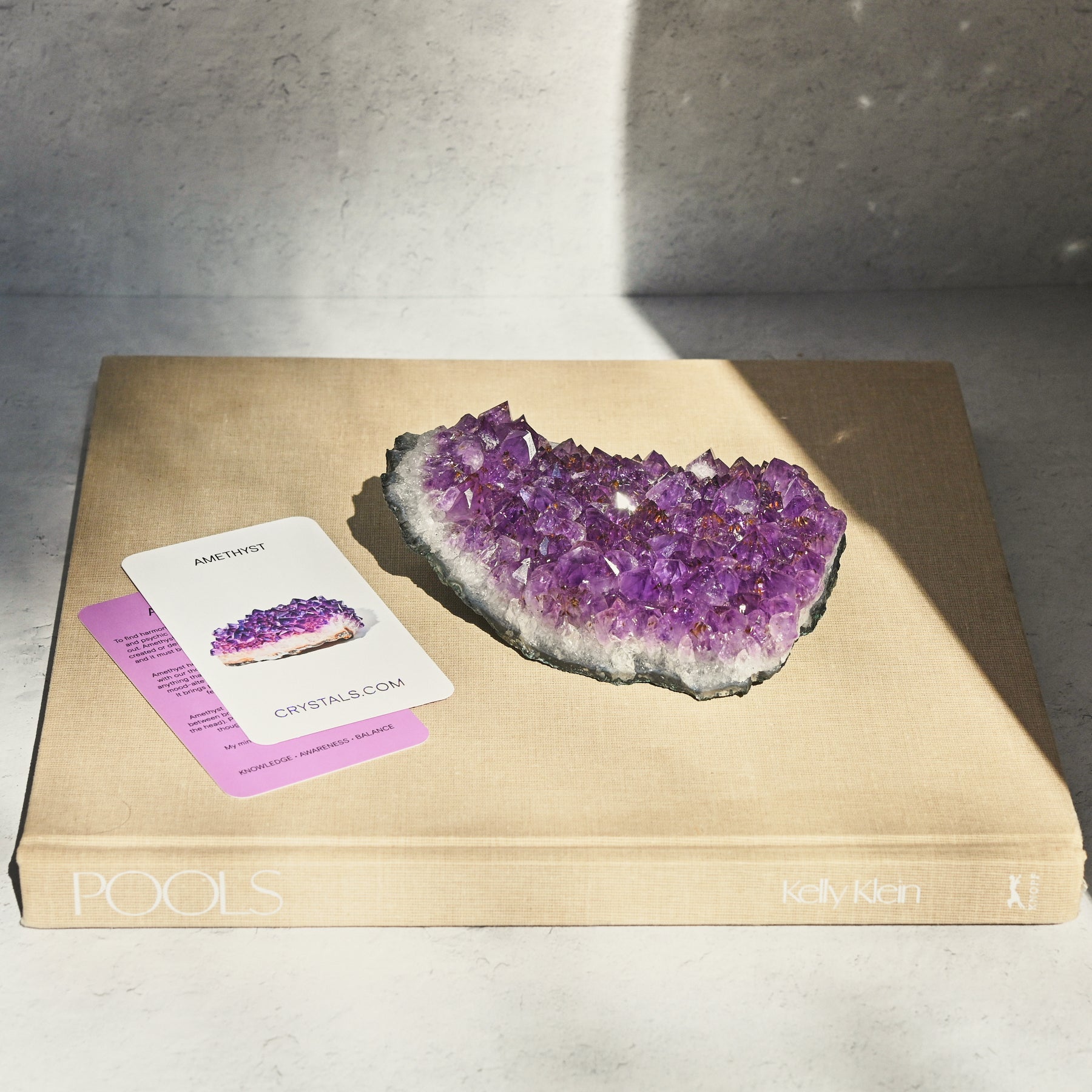
If there is one crystal made for the living room, it is amethyst — and specifically, the cathedral geode. These towering formations of deep violet quartz crystals, born inside volcanic cavities in southern Brazil and Uruguay, are among the most visually arresting natural objects in existence. A cathedral geode standing two or three feet tall in the corner of a living room functions as living sculpture: organic, irreplaceable, and impossible to ignore.

The color range within amethyst is remarkable. Uruguayan specimens tend toward deep royal purple with bright crystal points. Brazilian geodes run a wider spectrum from pale lavender to rich plum. Choose based on your room's palette — deep purples anchor jewel-toned rooms, while pale lavender amethyst suits more neutral, Scandinavian-inspired interiors.
Smaller amethyst clusters work equally well on coffee tables and mantels. A bookended pair of matching geode halves on a console creates instant symmetry and visual drama. Explore amethyst specimens in every size, from tabletop clusters to room-defining cathedrals.
2. Rose Quartz — Warmth and Welcome
Rose quartz is the interior decorator's crystal. Its color — a gentle blush that ranges from barely-there pink to a warm peach-rose — is inherently inviting. In a living room context, it functions like a warm lamp versus a cool overhead light: it shifts the mood of an entire space simply by being present.
Large raw rose quartz chunks work beautifully on coffee tables and floor displays. Polished rose quartz spheres are among the most elegant tabletop objects available — they catch light in a diffuse, soft way and look as at home in a modern apartment as they do in a more traditional setting. Towers of polished rose quartz on a bookshelf offer height and color without visual heaviness.
From a purely design perspective, rose quartz is one of the most versatile stones in the collector's toolkit — it bridges warm and cool color palettes, suits every aesthetic from coastal to maximalist, and photographs beautifully. Browse rose quartz for the home to find the right scale for your space.
3. Citrine — Warmth, Light, and Joy
Citrine is yellow quartz, and it carries all the visual warmth of afternoon sunlight captured in mineral form. Natural citrine is relatively rare — most citrine on the market is heat-treated amethyst that has shifted from violet to golden amber. Both are beautiful; natural citrine tends toward pale yellow-green, while heat-treated specimens read as warm amber to deep burnt orange.
In a living room, citrine works as a mood lifter in the visual sense — it adds warmth and golden luminosity that reads as inherently inviting. A cluster of citrine points on a coffee table, a geode half on a side table beside a lamp, or a raw citrine cathedral in a corner all bring a luminous warmth that pairs especially well with earth tones, warm woods, and brass fixtures.
Citrine is also one of the few yellow-to-amber natural materials available in significant scale at a reasonable price, making it an excellent investment for impactful living room display.
4. Selenite Towers — Ambient Illumination
Selenite is one of the most architecturally interesting minerals available for home display. A form of gypsum, it grows in massive translucent formations and can be carved into smooth, luminous towers that stand anywhere from six inches to over three feet tall. The material is striking: pearl-white, slightly translucent, with a silky striated surface that catches and diffuses light in the same way frosted glass does.
Selenite towers placed near a lamp or in a spot that catches late afternoon light seem to glow from within. A grouping of three selenite towers of varying heights creates a powerful, elegant focal point on a shelf or console — architectural in feeling, quiet in color, with significant visual presence. They work especially well in rooms that skew white, cream, or pale natural tones.
One care note: selenite is water-soluble, so keep it away from humidity and never clean it with water. A dry microfiber cloth or soft brush is all it needs.
5. Clear Quartz — The Amplifier
Clear quartz is the chameleon of the mineral world. Utterly transparent when polished, it reads differently depending on what surrounds it. On a dark shelf, it glints and sparkles. In a sunny window, it throws rainbows across walls. Beside other colored stones, it picks up and reflects their hues. This optical adaptability makes clear quartz one of the most versatile display stones available.
A large natural cluster of clear quartz points is a serious design object — angular, complex, and refractive. Polished clear quartz spheres are among the most beautiful objects in any crystal collection, particularly in large sizes where the optical depth becomes extraordinary. Crystal balls of three to four inches diameter placed on a wooden or brass stand on a coffee table command attention in the most understated way.
Use clear quartz to brighten a dark corner, amplify the visual effect of nearby colored stones, or simply as a sculptural element that responds dynamically to changing light conditions throughout the day.
6. Black Tourmaline — Near the Entrance
If your living room opens directly from the front entrance — a common layout in apartments and open-plan homes — black tourmaline belongs near the threshold. As a design object, raw black tourmaline has an appealingly rough, matte-black, striated texture that reads as both natural and refined. It bridges the gap between industrial and organic.
Pair a chunky raw black tourmaline specimen with a small selenite tower beside the entryway for a striking contrast in color and texture. Black tourmaline also pairs beautifully with natural materials — linen, jute, dark walnut, matte black ceramic — making it a natural fit for Japandi, wabi-sabi, or modern industrial interiors.
Large, well-formed raw tourmaline specimens are impressive display objects. Look for pieces with visible columnar striations and strong crystal structure. The material is durable and requires minimal care.
7. Smoky Quartz — Grounding and Sculptural
Smoky quartz is quartz in its most moody, atmospheric form — ranging from pale grey-brown to a deep, almost opaque chocolate black. Its transparency means it still catches and plays with light, but in a more subdued, contemplative way than clear quartz. It is the stone of twilight hours and thoughtful rooms.
Large smoky quartz points are among the most elegantly sculptural of all natural crystal forms — the hexagonal tapering tower shape, in deep grey-brown, looks as if it could have been designed by a modernist architect. A grouping of three or four smoky quartz points of varying heights on a wooden tray is a genuinely sophisticated tabletop display. Smoky quartz also pairs beautifully with leather, linen, raw wood, and matte brass.
For maximum design impact, look for large, well-terminated smoky quartz points — specimens where the crystal ends in a sharp, clean point rather than a broken or abraded tip.
8. Celestite — Calm and Color
Celestite (also called celestine) is strontium sulfate — a fragile, pale blue mineral that grows in tabular or prismatic clusters with a color that is genuinely difficult to describe: it is blue, but also grey, but also somehow luminous, like the sky at 6am before full daylight. It is one of the most subtle and sophisticated of all display minerals.
In a living room, a celestite cluster on a low shelf or coffee table introduces color in the most restrained way — it doesn't shout, it whispers. This makes it ideal for rooms that already have a strong color story and need something that adds without competing. It pairs beautifully with pale blue, white, cream, and soft grey interiors, and also provides an unexpected counterpoint in warmer, more saturated rooms.
Note that celestite is relatively soft and fragile — it should be displayed somewhere it won't be jostled or handled frequently. Keep it away from prolonged direct
sunlight, which can fade its delicate color over time.
9. Labradorite — The Conversation Piece
Labradorite is magic made mineral. A feldspar stone from Labrador, Canada (and Madagascar, and Finland), its most defining feature is labradorescence — an optical phenomenon that causes it to flash iridescent blues, greens, golds, and occasionally purples when light strikes it at different angles. The effect is impossible to reproduce in photography. You have to be in the room with it, moving, to understand it.
This makes labradorite perhaps the single greatest conversation piece in any crystal collection. A large polished labradorite freeform on a coffee table — grey and matte from one angle, suddenly electric blue when your viewing angle shifts — will stop guests mid-sentence. A polished labradorite sphere is equally mesmerizing.
From a design perspective, labradorite has the advantage of working in virtually every color story — its base color is a dark grey that recedes, while the flash colors change depending on the light source. Natural light, lamplight, and candlelight all reveal different facets of the stone's character.
10. Pyrite — The Modern Metallic Accent
Pyrite is iron sulfide — and it is, unambiguously, one of the most visually remarkable minerals that forms on Earth. Natural pyrite crystals grow in perfect cubes, as dramatic sun-shaped discs (the famous pyrite suns of Illinois), and as interlocking masses of mirrored metallic faces that catch and throw light like a disco ball designed by a geologist.
In a contemporary living room, pyrite functions as the equivalent of a metallic accent piece — but with more personality than any manufactured object could provide. A cluster of cubic pyrite crystals on a dark stone tray is a genuinely striking display. Pyrite cubes — where individual crystals have grown in near-perfect geometric form — are extraordinary objects that sit at the intersection of nature and mathematical precision.
Pyrite suits modern, industrial, and masculine-leaning interiors especially well, pairing naturally with steel, concrete, dark leather, and matte black finishes. It also adds unexpected edge to more traditional rooms.
Crystal Placement Guide: Where Each Stone Belongs
Placement is everything. A beautiful crystal specimen in the wrong spot disappears; the same stone in the right position anchors an entire room. Here is how to think about each zone of your living room.
The Coffee Table
The coffee table is the most-used display surface in the living room — it is where guests look, where eyes rest during conversation, where the design of a room is felt at close range. Crystals here should reward examination. Consider a polished rose quartz sphere on a wood or brass stand as a centerpiece, flanked by a small amethyst cluster and a rough pyrite piece on a tray. The goal is a curated grouping — odd numbers, varied heights, a mix of raw and polished — that looks intentional rather than accumulated. Keep scale appropriate: tabletop crystals should be significant enough to register but not so large they dominate the seating area.
The Mantel
The mantel is the living room's most architectural display surface — it has height, symmetry, and the fireplace below it as a natural focal point. Use it accordingly. A pair of matching selenite towers creates elegant symmetry. A large amethyst geode half centered on the mantel becomes a piece of sculpture. Labradorite freeforms flanking a mirror catch and throw light in ways that enhance the entire room. On the mantel, err toward larger, more statement-making pieces — smaller objects get lost at mantel height.
Bookshelves
Bookshelves are where crystals get to live as part of a larger composition. Tuck a small citrine cluster between books. Place a smoky quartz tower at the end of a row of spines. Nestle a celestite cluster in a display niche. The key is restraint — use crystals as punctuation within the shelf composition, not as the primary content. One or two specimens per shelf section, thoughtfully placed, reads as considered and design-forward. Too many reads as a crystal shop.
Windowsills
Natural light transforms translucent and transparent crystals. Clear quartz points on a windowsill catch direct sunlight and scatter prismatic rainbows. Amethyst and rose quartz glow with internal color. Selenite turns incandescent. A deep windowsill is one of the best display surfaces in any room for crystals specifically because of how dramatically light activates these materials. Be thoughtful about extended direct sunlight on fade-prone stones like amethyst and rose quartz — morning or late afternoon light that doesn't linger all day is ideal.
Floor Specimens
Large floor specimens — amethyst cathedrals, calcite formations, massive quartz clusters — operate as furniture-scale objects. They need space around them to breathe. A cathedral geode in a corner beside a floor lamp creates a composition that rivals any piece of furniture for design impact. If you are going to invest in a floor specimen, give it the room it deserves: clear a zone, consider its relationship to natural light sources, and let it stand alone rather than competing with other objects at floor level.
Crystals by Living Room Aesthetic
The best crystal for your living room is the one that fits your existing design language. Here is how to match stone selection to interior style.
Modern Minimalist
Choose sculptural single specimens with strong geometric character. A tall selenite tower, a perfect clear quartz sphere, a cube of natural pyrite, or a polished obsidian sphere all work with the restrained vocabulary of minimalism. Keep quantities low — one to three pieces, maximum. Display on concrete, marble, or raw steel bases. Avoid clusters and geodes, which read as visually complex in a way that conflicts with minimalist editing.

Bohemian
Bohemian interiors are the natural home of crystal collections. Lean into abundance — geodes, clusters, towers, raw chunks, and polished pieces can coexist happily. An amethyst cathedral in the corner, a coffee table laden with rose quartz and citrine, bookshelves populated with an eclectic mix of specimens. Add dried botanicals, textiles, and woven trays to ground the collection in warmth. Color mixing is welcome here: amethyst purple beside citrine gold beside rose quartz pink creates the layered, sun-drenched richness that defines the aesthetic.
Coastal
Coastal living rooms call for stones that echo the ocean's palette. Celestite in its soft blue-grey is the obvious choice. Pale blue or white-to-grey agate slices, sea-glass-green fluorite, moonstone, and white selenite all feel natural in a coastal context. Display on natural driftwood, woven jute, or light oak. Keep arrangements open and airy rather than dense. Let specimens breathe beside natural shells, sea glass, and linen textiles.
Traditional and Classic
Traditional interiors benefit from crystals that have the gravitas of antiques or natural history museum specimens. Large amethyst geodes, significant smoky quartz points, and well-formed calcite specimens all fit the register of a room furnished with dark wood and heirloom pieces. Display on carved wood pedestals, marble bases, or under glass domes. Think of crystals in this context as natural history — objects with provenance and scale that deserve serious presentation.
Crystal Clusters vs. Single Specimens
This is one of the most common questions for new collectors, and the answer is that both have important roles — the key is knowing which to use where.
Crystal clusters — like a druzy amethyst geode half, a celestite cluster, or a quartz point cluster — are naturally complex objects. Their surface is an aggregate of many individual crystals growing together, creating depth, texture, and visual richness that a single specimen cannot replicate. They are ideal as focal point objects: on a coffee table centerpiece, on a mantel as the primary piece, or as a floor specimen. Their complexity rewards close examination.
Single specimens — a polished sphere, a tower, a terminated crystal point, a carved freeform — have a clarity and sculptural elegance that clusters do not. They read clearly from a distance in a way clusters do not, making them better choices for shelves, windowsills, and groupings where you want visual variety without visual chaos.
The most sophisticated collections use both: a large cluster as the anchor piece, surrounded by complementary single specimens that create a layered, curated composition. Think of the cluster as the sofa and the single pieces as the accent chairs — different scales and forms working together as a unified composition. Browse our home decor crystal collection for curated pairings.
Lighting Your Crystal Display
Light is inseparable from crystal display. The same specimen looks dramatically different under natural daylight, warm incandescent lamplight, cool LED, and candlelight. Understanding how to light your crystals is as important as choosing the right specimens.
Natural light is the most flattering light source for most crystals. It reveals true color, activates the internal fire in transparent stones, and — for clear quartz and leaded crystal — creates rainbow refractions that move through the room as the sun tracks across the sky. North-facing natural light is soft and consistent; south and west light is dramatic and changes throughout the day.
Warm incandescent or warm LED light (2700-3000K color temperature) enhances the warmth of amber, gold, and orange-toned stones — citrine, pyrite, and topaz — and adds richness to purple amethyst. It is the most flattering light for most crystals in an evening setting.
Directional spot lighting — a small picture light above a mantel, a focused LED puck under a shelf, or an adjustable track light aimed at a floor specimen — creates dramatic, gallery-like presentation that transforms a crystal from decorative object to statement piece. This technique is especially effective for amethyst geodes, labradorite, and pyrite.
Candlelight is magic with selenite. A selenite tower placed near a candle seems to absorb and redistribute the light with an inner warmth that no other light source can replicate. If you light candles in your living room, place a selenite tower nearby and watch what happens.
Seasonal Crystal Rotation: Keeping Your Space Alive
One of the most underrated aspects of building a crystal collection is that it gives you the ability to rotate your living room's atmosphere with the seasons — without furniture moves or major redecorating.
Spring and Summer: Bring forward lighter, brighter specimens. Rose quartz, citrine, clear quartz, and pale agate all feel naturally aligned with longer days and warmer light. Move them to sun-catching positions. Celestite and aquamarine are ideal for the humid, oceanic feeling of a summer room.
Fall and Winter: Rotate toward deeper, richer specimens. Amethyst deepens in lamplight. Smoky quartz feels exactly right against the darkness of early sunsets. Pyrite catches firelight and candlelight in a way that reads as inherently wintry and luxurious. Labradorite, in winter's lower, raking light, shows its full color spectrum.
Rotation keeps your relationship with your collection fresh and prevents visual habituation — the phenomenon where objects you see every day become invisible because your brain stops processing them as novel. Swapping stones every season means you are always seeing something with new eyes. It also means your collection can grow with purpose: each season is an opportunity to add one significant piece to the rotation.
For guidance on building a home crystal collection that works as a cohesive design system, see our crystal home decor guide.
Frequently Asked Questions

What crystals are best for a living room?
The best crystals for a living room include amethyst geodes as statement anchor pieces, rose quartz for warmth and a welcoming atmosphere, citrine for brightness and positivity, selenite towers for ambient glow, and clear quartz to amplify the effect of surrounding stones. The right choice depends on your aesthetic goals and the feeling you want the space to evoke.
Where should I place crystals in my living room?
Ideal placement spots include the coffee table as a centerpiece, the mantel for visual height and symmetry, bookshelves tucked between books and objects, windowsills where natural light can illuminate translucent stones, and floor placement for large statement specimens. Experiment with groupings of odd numbers for the most visually balanced arrangements.
How do I style crystals with modern or minimalist decor?
For modern minimalist spaces, choose sculptural single specimens with strong geometric forms — a tall selenite tower, a polished obsidian sphere, or a raw pyrite cube. Keep the palette restrained. One or two well-chosen pieces make a stronger statement than a collection. Use neutral risers, concrete trays, or raw stone slabs as display bases to maintain the clean aesthetic.
Do I need to do anything to maintain crystals in my home?
Crystals benefit from occasional dusting with a soft, dry brush. Some stones — particularly selenite, halite, and certain calcites — should be kept away from moisture. Extended direct sunlight can fade color in stones like amethyst and rose quartz. Rotating your display seasonally keeps the space feeling fresh and lets you interact with different pieces throughout the year.
Is a crystal cluster or a single specimen better for living room display?
Both have distinct advantages. Crystal clusters have natural texture and depth that creates visual complexity, making them ideal focal points. Single polished specimens offer clean, sculptural elegance that suits modern and minimalist spaces. A layered room benefits from mixing both: a large raw cluster as the anchor and refined single pieces as accent objects.
Which crystals work best near a fireplace or mantel?
The mantel is a high-visibility focal point, so choose crystals with strong visual presence. Large amethyst geode halves, paired selenite towers, or a centered citrine cluster work beautifully. Labradorite freeforms catch firelight and shimmer dramatically. Avoid placing selenite directly above a working fireplace, as prolonged heat and smoke can affect the surface over time.
Discover Your Human Design
Crystals amplify energy — but do you know your unique energy type? Human Design reveals how you're wired to make decisions, work, and rest. It's the owner's manual you were born with.
Explore Human DesignGet 10% Off Your First Order
Plus early access to new arrivals, collector drops, and crystal guides. Join 15,000+ crystal lovers.