Shop Crystals for This Energy
Free shipping on orders over $150
Walk into any considered interior right now — a curated boutique hotel lobby, a well-photographed living room on Architectural Digest, a designer's own studio — and you will almost certainly find a crystal. Not tucked away on a shelf beside incense, but front and center: a towering amethyst cathedral on a plinth, a raw quartz cluster anchoring a coffee table book arrangement, a slab of agate sliced thin and backlit like stained glass. Crystals have crossed fully into the design conversation, and they are not leaving.
This is not a trend in the fleeting sense. It is a return to something older — the human instinct to surround ourselves with objects that feel alive, that carry geological time, that cannot be manufactured. In an era of flat surfaces and identical finishes, a crystal is irreducibly itself. No two are the same. That rarity, combined with an increasingly sophisticated understanding of how to style and scale them, is why they keep appearing in the work of the designers and tastemakers worth following.
This guide is for anyone who wants to bring crystals into their space with intention — whether you are starting with a single accent piece or building a full gallery-style display. We will cover how to choose crystals by color palette, how to match them to design styles, how to think about scale, how to light them, and how to work them into functional objects that earn their place in a room. Browse our home decor crystal collection to see what is currently available.
Crystals as Design Objects: A Shift in How We See Them
For decades, crystals in the home existed in a specific visual language: a small cluster on a windowsill, a tumbled stone on a dresser, objects that announced a particular set of beliefs about wellness and the metaphysical. That context has not disappeared, but it has been joined by something different — a purely aesthetic, object-forward approach that treats crystals exactly as a gallery would treat sculpture.

The shift happened gradually, then all at once. Interior designers began sourcing large-format specimens as statement objects. Luxury hotels commissioned custom crystal installations. High-end home goods retailers started stocking museum-quality pieces alongside furniture. And social media amplified all of it, creating a visual shorthand: a raw amethyst cluster means something about the kind of room it is in, the kind of person who lives there.
What makes crystals so compelling as design objects is precisely what makes them difficult to manufacture: their irregularity. A well-chosen geode has an energy that a perfectly machined marble sphere does not. The surface catches light differently at every hour of the day. The form is never predictable. For designers working against the flattening effect of mass production, that unpredictability is the point.
The best interior crystal placements treat specimens as they would treat any collected object of significance — with space around them, with lighting that respects their form, with surrounding objects chosen to complement rather than compete. That curatorial thinking is what separates a considered crystal moment from an afterthought.
Choosing Crystals by Color Palette
The most practical starting point for using crystals in design is color. Before thinking about meaning or type, think about how a specimen will sit within the palette you are already working with. Crystals cover a remarkable range — from the near-transparent clarity of quartz to the deep ink of black tourmaline, with every warm, cool, and neutral tone in between.
Warm neutrals and earthy palettes. If your space runs toward warm whites, linen, terracotta, and wood tones, look to desert rose selenite, honey calcite, citrine clusters, peach moonstone, and the warm golden tones of tiger's eye. Raw sandstone-colored specimens like aragonite read as geological extensions of the palette — they feel found rather than placed.
Cool and moody interiors. Spaces built around charcoal, navy, slate, and forest green call for crystals that hold their own against dark backgrounds. Labradorite — with its dramatic blue and green flash — is extraordinary against dark walls. Deep purple amethyst reads regal in low-light rooms. Black tourmaline and obsidian have a graphic quality that suits rooms with strong architectural lines. Explore the full range in our amethyst collection.
Bright, gallery-white spaces. White rooms are where crystal color reads most purely. A single piece of vivid malachite against a white wall is as arresting as a painting. Rose quartz in a white room is soft and textural. Clear quartz towers in a minimal white space have an almost architectural quality — they add form without adding color, which is exactly what the room needs.
Maximalist and jewel-toned rooms. When a room already commits to richness — deep velvets, gilded frames, layered rugs — crystals can go equally bold. A large malachite sphere, an azurite-malachite specimen, or a cathedral amethyst all hold their own in high-contrast environments. In these spaces, go bigger than you think you need to.
One reliable rule: choose one crystal type as the anchor of a space and let smaller secondary pieces pick up its tones. A large amethyst cluster as the hero, with smaller pieces of lepidolite or fluorite as supporting notes, reads as a collected whole rather than a random accumulation.
Thinking About Scale: From Sculpture to Accent
Scale is where most people go wrong with crystals in interiors. The instinct is to buy small — it feels safer, less committal. But small crystals in large rooms disappear. They read as clutter rather than intention. The rule of thumb borrowed from traditional interior design applies directly here: scale objects to the space, not to your comfort level with spending.
There are essentially three scales to work with, and the most successful interiors use all three in deliberate proportion.
Large-format specimens as sculpture (12"+ / 30cm+)
These are the room-anchoring pieces — cathedral geodes on custom stands, large quartz clusters on coffee tables, slab agate panels mounted on walls. At this scale, a crystal functions exactly as a sculpture does: it organizes the space around it, creates a focal point, and justifies empty space in its vicinity. These pieces need room to breathe. Do not crowd them. A large amethyst cathedral on a plinth in the corner of a living room, with two feet of clear space around it, is a design statement. The same piece jammed between a bookshelf and a lamp is just an object.
Mid-scale clusters and points (4"–12" / 10–30cm)
This is the working scale for most interior applications — the pieces that go on shelves, mantels, coffee tables, and console tables. At this size, a crystal is in conversation with the objects around it. Think about grouping: a raw amethyst cluster, a stack of art books, and a ceramic vessel make a composed vignette. These pieces should be grouped in odd numbers, at varying heights, with a mix of rough and smooth textures. Browse our geode collection for mid-scale options.
Small accents and tumbled pieces (under 4" / 10cm)
Small crystals work best when they are part of a deliberate grouping, not scattered individually. A collection of tumbled stones in a shallow ceramic dish reads as a composed still life. Small points arranged in a row along a window sill have a clean, intentional quality. A single small tumbled stone on a bedside table is fine — but three of them in a small dish is better. The distinction is always between curation and accumulation.
Crystals by Design Style
Different design vocabularies call for different crystals, and the way you display them matters as much as which ones you choose. Here is how crystals translate across the major interior design languages.
Minimalist Interiors
Minimalism is actually the most demanding context for crystals, because every object has to justify its presence completely. The right approach: one significant piece, given real space, on a surface that shows it off. A large, well-formed clear quartz point on a raw wood pedestal. A single polished malachite sphere on an otherwise empty side table. In minimalist rooms, the crystal becomes the room's sole concession to ornament — which means it carries enormous visual weight and needs to be extraordinary. Avoid clusters of multiple pieces; let one specimen do the work. The rougher the form, the better — raw surfaces read as intentional choice rather than decoration.
Organic Modern
Organic modern — the design language of warm neutrals, natural materials, and clean-but-not-cold spaces — is where crystals feel most native right now. This aesthetic is built around the idea of nature distilled: travertine, live-edge wood, woven textiles, handmade ceramics. Crystals belong here in exactly the way an interesting stone found on a beach belongs: as geological specimens, evidence of the natural world brought inside. Lean into tonal harmony: selenite wands and desert rose cluste
rs for warm palettes, smoky quartz and labradorite for cooler ones. Raw, unpolished surfaces read best. The goal is "collected" rather than "decorated."
Bohemian and Eclectic
Bohemian interiors are the most permissive context for crystals — which means the discipline has to come from within the collection itself rather than from the room. The risk in boho spaces is crystal overload: too many pieces, too many sizes, competing colors, no hierarchy. The fix is to choose a dominant type — say, amethyst — and build the collection around it. Use related purple and lavender tones in secondary pieces. Give each vignette a clear focal point. In eclectic rooms, crystals work beautifully in unexpected pairings: a rough amethyst cluster alongside a vintage brass lamp, a collection of fluorite towers on a kilim-covered ottoman. The eclecticism is in the objects around the crystal; the crystal itself should feel anchored.
Modern Glam
Modern glam rooms — marble, brass, velvet, mirrored surfaces — are where polished, high-contrast crystals come into their own. Selenite towers have an alabaster elegance that suits glam interiors perfectly. Pyrite clusters read as sculptural gold. Clear quartz on a mirrored tray doubles its own reflection. In glam rooms, presentation matters enormously: display crystals on polished stone platforms, in gilded trays, under glass cloches. The raw geological wildness of crystals plays beautifully against the controlled luxury of glam interiors — the contrast is the point.
Styling Crystals on Shelves, Mantels, and Tables
The principles of vignette styling apply to crystals exactly as they apply to any curated grouping. The goal is a composition with visual movement — the eye should travel through the group, not land on it flatly.
Varying height is non-negotiable. A grouping where every piece is the same height reads as a lineup, not a composition. Use books, wooden blocks, or small pedestals to lift some pieces. A tall selenite tower alongside a mid-height amethyst cluster alongside a low, flat agate slice gives the eye three different stopping points.
Mix textures intentionally. Rough next to smooth, opaque next to translucent, geometric next to organic. A raw tourmaline cluster next to a polished quartz sphere creates visual interest precisely because the surfaces are so different. This same principle governs the objects you pair with crystals: a rough ceramic vessel next to a smooth crystal, or a matte book spine next to a glassy mineral surface.
Use the rule of odd numbers. Three pieces, five pieces, seven — odd groupings feel more natural and less symmetrical. Two pieces of anything looks like a pair and reads formally. Three reads as collected.
Leave white space. The most common mistake in shelf styling is filling every
inch. Give your best crystal room to breathe. Empty space around a specimen is not wasted space — it is the space that makes the specimen visible.
Ground the grouping. A flat base — a stone slab, a wooden board, a tray, a piece of marble tile — unifies a vignette and signals that the grouping is intentional. Everything sitting on the same base plane reads as a composed still life. Everything sitting directly on a shelf at random heights does not. For more inspiration on displaying specimens, read our guide on how to display large crystals.
Lighting and Crystals: The Difference Between Dull and Extraordinary
The single most underrated element of displaying crystals is light. A well-lit crystal and a poorly lit crystal of the same quality look like completely different objects. Understanding how to light specimens transforms them from decorative objects into something genuinely spectacular.
Directional light from the side. Crystals with natural faces and planes — quartz points, tourmaline columns, pyrite cubes — come alive under directional light that rakes across their surfaces at an angle. Side lighting throws the facets into sharp relief, making the geometry visible. This is exactly how museum cases light mineral specimens, and for good reason.
Backlighting for translucent pieces. Thin-sliced agate, selenite panels, and some quartz formations are extraordinary when backlit. Even placing a small LED panel or a simple backlight behind a slab agate piece transforms it into something that reads like stained glass. This technique works particularly well in niches, on floating shelves with built-in lighting, or even against a window during the day.
Warm versus cool light temperature. Warm-toned crystals — citrine, honey calcite, amber specimens — sing under warm (2700K–3000K) light. Cool-toned specimens — blue kyanite, aquamarine, labradorite — read better under slightly cooler, daylight-balanced light (4000K). This is a subtle distinction but a real one, particularly for high-quality display pieces.
Natural light as a design tool. Position translucent crystals near windows to take advantage of changing natural light throughout the day. A clear quartz cluster on an east-facing windowsill catches morning light differently than afternoon sun. Labradorite placed where it catches shifting daylight will flash its spectral colors at unexpected moments — one of the most effective lighting effects in crystal display, and it costs nothing.
Avoid overhead fluorescent light. Flat overhead lighting flattens crystals entirely. If a specimen looks dull on a shelf, the most likely culprit is overhead ambient light with no directional component. A small, well-aimed spot or a table lamp positioned nearby will transform the same piece.
Crystals as Functional Objects
One of the most sophisticated moves in crystal design is to blur the line between specimen and object — to use crystals in ways that are simultaneously decorative and functional. This approach sidesteps the "decoration shelf" quality that can make crystal displays feel self-conscious, because the object clearly belongs where it is.
Crystal bookends. Large matching quartz clusters, amethyst geode halves, or bookmatched agate slabs make extraordinary bookends. Functionally, they hold books. Visually, they frame a library shelf and elevate every volume between them. Geode half-pairs are particularly effective — the split face facing inward shows the interior crystal formation, while the rough outer rind faces the room.
Agate coasters and serving boards. Polished agate slices make functional coasters — they are durable, heat-tolerant, and each one is unique. Grouped on a tray, they are a design statement. Larger agate slabs, particularly polished Brazilian agate, work as serving boards or bar cart surfaces. These objects justify their presence immediately — they are doing a job — which makes them feel more integrated than a piece that sits solely for display.
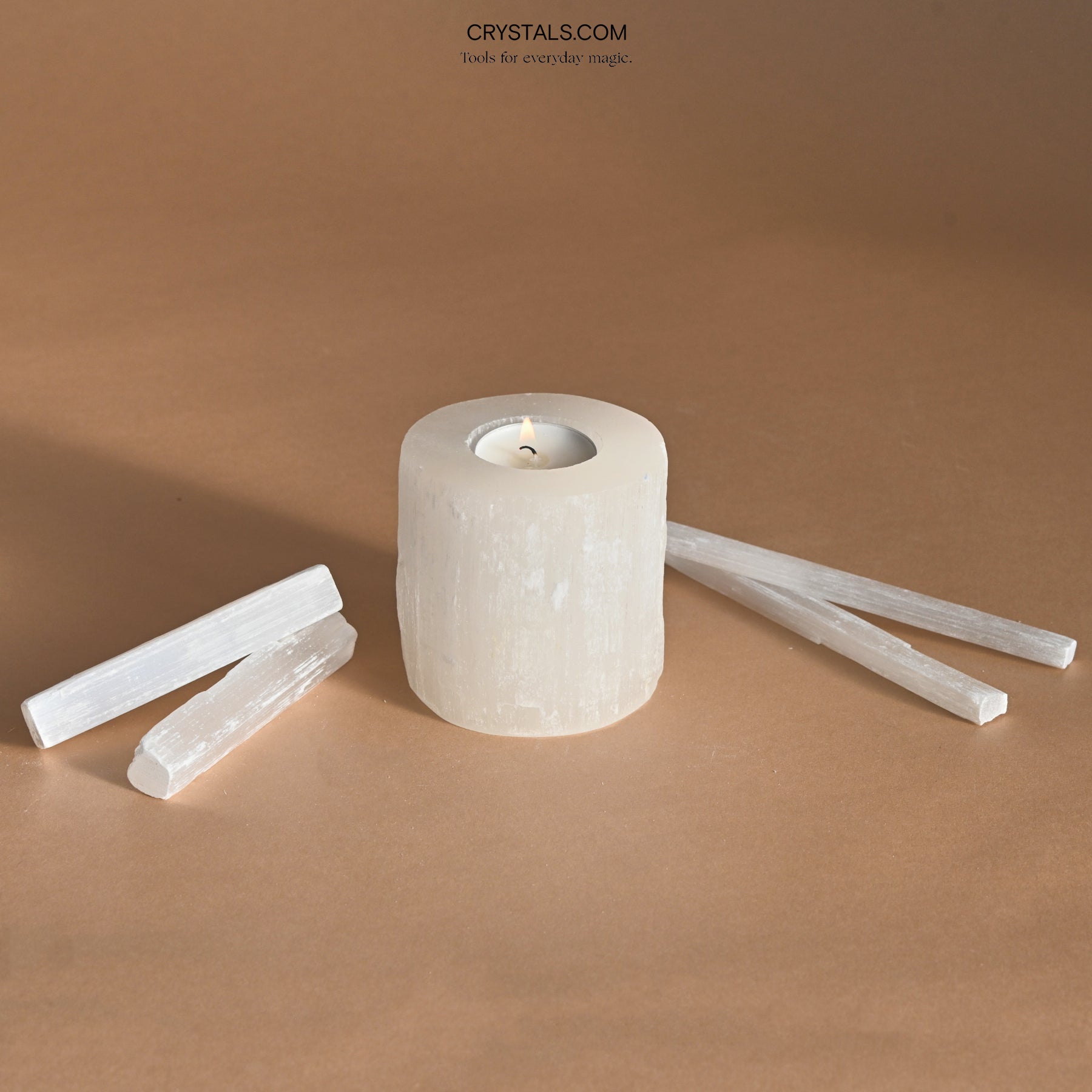
Selenite charging plates and trays. Flat, polished selenite slabs have become a staple of high-design surfaces as display trays. They provide a luminous, slightly translucent base for jewelry, small objects, keys, and other daily items. In a bedroom or entry, a selenite tray is both beautiful and practical — a place to set things down that makes the act of setting them down feel considered.
Crystal hardware and accent pieces. The forward edge of crystal in design right now is hardware: drawer pulls in polished agate, door knobs in rose quartz, cabinet handles in selenite. This is where crystals move from furniture to architecture — and it is where the most interesting design work is happening. Even without custom hardware, a crystal paperweight, a quartz sphere as a drawer pull alternative, or a cluster used as a sculptural door stop brings this same energy to existing furniture.
Crystal vessels and holders. Hollow geode halves make extraordinary vessels — a deep amethyst geode half as a fruit bowl, a small quartz-lined geode as a ring dish, a carved selenite bowl for keys. The geological form doing the job of a manufactured object creates exactly the productive tension that makes interiors feel alive rather than decorated. See our crystal home decor guide for more functional styling ideas.
Working with Interior Designers Who Use Crystals
If you are working with an interior designer on a larger project, crystals are increasingly a conversation worth having early. Designers who work with natural materials — stone, wood, plaster, handmade ceramics — are often already thinking in terms of geological objects and are open to incorporating significant crystal pieces into their sourcing.
The most productive framing is to approach crystals as you would any collected artwork: as objects with provenance, character, and specificity that a mass-produced alternative cannot replicate. A designer who would happily source a hand-thrown ceramic jar from a specific studio is likely to be equally interested in a specific museum-quality amethyst specimen — if you frame it that way.
For designers sourcing crystals for clients, the key considerations are scale, stability, and consistency of quality. Large specimens need proper structural support — a cathedral geode weighing 50 pounds needs a surface engineered for it, not a decorative console. Quality matters more at large scale: the veiling, color saturation, and formation quality of a large piece are visible in a way that minor flaws in a small piece are not.
Collectors and collectors-adjacent designers are also worth noting here. The overlap between the serious mineral collector world and the interior design world is growing — people who started buying crystals as geological specimens have discovered that museum-quality pieces are also extraordinary interior objects. The approach that comes from collecting — source carefully, display generously, know what you have — is exactly the right approach for crystals in interiors.
If you are building a crystal collection for a specific interior project, our team can help identify pieces that suit the space. Reach out through our home decor collection to see current inventory.
Building a Gallery-Style Crystal Display
The highest expression of crystals in interior design is the gallery-style display — a dedicated wall, shelf system, or room where a crystal collection is presented as you would present a collection of significant art objects. This is not a mineral collection in the hobbyist sense; it is a curated presentation of geological objects chosen for their visual quality, arranged to be seen.
Gallery-style crystal displays share certain characteristics with well-designed gallery walls and display cases:
- Consistent presentation logic. All pieces on individual stands, or all pieces on a continuous shelf — not a mix of ad hoc arrangements. The consistency of the presentation is what signals that this is a collection, not an accumulation.
- Edited scale range. A gallery display works best when it has a clear anchor — one or two large significant pieces — supported by a considered selection of mid-size pieces. Avoid too many small pieces at the gallery scale; they read as filler.
- Negative space as part of the design. The space between pieces is as important as the pieces themselves. Overcrowded gallery displays lose the impact of individual pieces. Give each specimen room to be seen as a singular object.
- Dedicated, appropriate lighting. Gallery-style displays deserve track lighting or dedicated picture lights aimed at individual pieces. This is where the investment in proper lighting pays off most visibly.
- A coherent visual story. The most memorable crystal displays have a thread — a color story, a geological theme (all quartz-family minerals, all purple minerals, all banded stones), or a geographic provenance (minerals from one specific region). This is what a gallery curator would call the concept of the show, and it is what makes a display feel intentional rather than assembled.
Building a gallery-style display is a long-term project. The best collections grow over time as exceptional pieces become available, rather
than being assembled all at once from whatever is in stock. If this is your goal, prioritize quality over quantity at every stage — one extraordinary specimen is worth more to a gallery-style display than ten average ones.
Room-by-Room Crystal Placement Guide
Living Room. The living room is the primary space for large-scale crystal statements. A coffee table geode, a mantel display with a significant cluster as the anchor, or a console table with a curated vignette are all natural fits. In living rooms, crystals benefit from the scale of the space — what looks too large in a bedroom often looks exactly right in a living room. Large amethyst cathedrals, oversized quartz clusters, and bookmatched geode pairs all work here.
Entryway. The entry is where first impressions are made, and a significant crystal piece makes an immediate statement. A selenite tower flanking a console table, or a large specimen on a dedicated pedestal, reads as confident and considered. The entry is also where functional crystal objects — selenite trays for keys, agate coasters for dropped items — make the most practical sense.
Bedroom. The bedroom calls for a more intimate scale. Bedside clusters, selenite wands on the nightstand, a rose quartz piece on a dresser. In bedrooms, the visual softness of pink, white, and lavender crystals — rose quartz, amethyst, lepidolite, selenite — feels particularly appropriate. Keep the scale human rather than architectural.
Home Office. The home office is where crystals work particularly well on desk surfaces — a crystal cluster at the corner of a desk, a small point collection on a windowsill, a pyrite cube as a bookend for reference books. The tactile quality of handling crystals throughout the day is part of their appeal in a workspace. A striking desk specimen also reads well on video calls, where a composed background matters.
Bathroom. The bathroom is an often-overlooked opportunity. Selenite and quartz are water-safe for display (though not submersion), and a crystal specimen in a well-designed bathroom — on the vanity, on a freestanding shelf, on the edge of a freestanding tub — elevates the space immediately. The humidity-controlled environment of a bathroom is actually ideal for many specimens. A large amethyst cluster on a marble bathroom shelf is one of the most visually effective crystal placements in residential design.
Sourcing Crystals for Your Interior
The quality of the source matters. Museum-quality specimens — the kind that are worth displaying as the design objects they are — come from dealers and curators who understand minerals as specimens, not just as product. What to look for: clear provenance information, honest representation of origin and quality, a range that includes significant large-format pieces alongside mid-size and smaller accents.
The difference between a piece worth anchoring a room and a piece that disappears on a shelf is often quality of formation, saturation of color, and the specific character of the specimen. These are things that photographs approximate but cannot fully represent — which is why building a relationship with a trusted source, where you can ask questions and understand what you are buying, matters more than convenience.
Our home decor collection is sourced with interior use in mind — pieces chosen for their visual impact, their scale, and their quality as design objects. Whether you are starting with a single statement piece or building out a gallery-style display, start there.
Frequently Asked Questions
What crystals are best for interior design?
Amethyst, clear quartz, selenite, labradorite, agate, and pyrite are among the most versatile crystals for interior design. Choose based on your color palette, the scale of the space, and the design aesthetic you are working with. Large amethyst cathedrals and quartz clusters work particularly well as statement pieces.
How do I choose the right size crystal for my space?
Scale to the room, not to your comfort level. In a living room or large open space, pieces under 8 inches tend to disappear. For a significant design statement, look for pieces 12 inches or larger. Mid-size pieces (4–12 inches) are the workhorses of most vignettes. Small accent pieces work best in curated groupings, not scattered individually.
How should I display crystals on a shelf?
Vary heights using books or pedestals, mix textures (rough next to smooth, opaque next to translucent), group in odd numbers, leave white space around significant pieces, and ground the grouping on a unified base like a tray or stone slab. The goal is a composed vignette, not an accumulation.
What is the best lighting for displaying crystals?
Directional side lighting reveals crystal faces and planes best. Backlighting transforms translucent pieces like agate slabs and selenite panels. Avoid flat overhead lighting, which flattens crystals and removes their visual interest. Natural window light is excellent for translucent pieces — the changing light throughout the day creates different effects.
Can crystals be used as functional objects in home design?
Yes, and this is often the most sophisticated approach. Agate slices as coasters, geode halves as bookends, selenite slabs as display trays, large slabs as serving boards, and carved selenite bowls as jewelry dishes all blur the line between specimen and object in a way that feels genuinely designed rather than merely decorated.
How do I build a gallery-style crystal display?
Start with one or two large anchor pieces and build around them. Use consistent presentation — all pieces on similar stands or a continuous shelf. Leave significant negative space around each piece. Invest in directional lighting. Choose a coherent theme — a color story, a mineral family, a geographic provenance — that gives the display a curatorial concept rather than an assembled look. Build the collection over time, prioritizing quality over quantity at every stage.
Discover Your Human Design
Crystals amplify energy — but do you know your unique energy type? Human Design reveals how you're wired to make decisions, work, and rest. It's the owner's manual you were born with.
Explore Human DesignGet 10% Off Your First Order
Plus early access to new arrivals, collector drops, and crystal guides. Join 15,000+ crystal lovers.