Shop Celestite
Free shipping on orders over $150
There is a color in the mineral world that belongs almost entirely to one stone. Not the blue of sapphire — that's too saturated, too imperial. Not aquamarine's cool watery clarity. This is something closer to the sky at a specific hour: early morning, when the atmosphere is still pale and the day hasn't declared itself. That color is celestite, and once you've held a piece of it — a dusty, almost powdery blue cluster balanced on your palm, its tiny orthorhombic crystals catching light like frost — you understand why collectors go quietly obsessive over it.

What Is Celestite? Geology and Mineral Origins
Celestite (also called celestine) is a strontium sulfate mineral — SrSO₄ — belonging to the barite group. It forms in sedimentary rocks, particularly evaporite sequences, where strontium-rich waters deposit their mineral load in cavities and voids over tens of thousands of years. The result is often a geode: a rough limestone shell concealing a hollow interior lined with pale blue crystals pointing inward, their tabular to prismatic forms creating a cathedral effect in miniature.
The mineral was first described scientifically in 1791 by A.G. Werner, who named it from the Latin caelestis — of the sky, or heavenly — a reference to the color of the first specimens studied. It was later recognized as an important industrial mineral: strontium, derived primarily from celestite mining, is used in fireworks (producing a red flame), cathode ray tubes, and specialty alloys. The celestite mined for industrial use typically comes from Mexico and China. The material that reaches collectors is something else entirely.
For a deep dive into the mineralogy of other collector-grade stones, explore our Crystal Index 101 — a comprehensive reference for collectors at every level.
The Color of Sky: What Gives Celestite Its Blue
The blue of celestite is one of geology's more serendipitous accidents. Pure strontium sulfate is colorless to white; the pale blue hue results from trace element substitutions and lattice defects during crystal growth. Rare earth elements, particularly europium and cerium, along with radiation-induced color centers (similar to the mechanism that colors fluorite (Rainbow Fluorite Flame)), are thought to contribute to the distinctive blue. Unusually for a mineral color, celestite's blue can fade with prolonged UV exposure — a detail that matters enormously for display placement.
The color range within celestite is wider than most people realize. Specimens from Madagascar — the primary collector-grade source today — tend toward a cool, almost lavender-tinged blue. Material from Ohio's Put-in-Bay deposits, historically important and now largely depleted, showed a slightly deeper blue-gray. Specimens from Sicily, once celebrated among 19th-century European collectors, had a particular brilliance. The rarest celestite runs toward pale lavender or near-colorless with just a blush of blue at crystal tips.

Where Celestite Is Found: The Key Localities
Madagascar is the dominant source of collector-quality celestite today, producing the large blue geodes that have become defining objects in the contemporary crystal market. The deposits occur in the Sakoany region in northwestern Madagascar, where paleogene marine sediments host massive geode beds. Specimens range from small tabletop geodes to cathedral-sized pieces measuring over a meter across. The quality from this source is remarkably consistent — pale, clean blue, well-formed crystals, and a characteristic dusty surface texture that photographs beautifully.
Other Notable Localities
Ohio's Lake Erie islands — particularly Put-in-Bay on South Bass Island — were historically famous for producing fine American celestite in tabular crystals of exceptional clarity. The Crystal Cave at Put-in-Bay, discovered in 1897 during well-drilling, contains celestite crystals among the largest ever found, some exceeding a meter in length. Today it operates as a tourist attraction. The Smithsonian Institution's Mineral Sciences department holds significant reference specimens from these historic deposits.
Sicily produced fine celestite historically, as did deposits in Gloucestershire, England, and various sites across Germany and Poland. For contemporary collectors, Madagascar remains the practical source of choice for quality at accessible price points. Locality data on celestite specimens worldwide is catalogued by the Mindat.org celestite database — the gold standard for mineralogical provenance research.
Celestite Geodes vs. Clusters: Form Vocabulary for the Collector
Celestite arrives in two primary collector forms, and understanding the difference shapes both purchasing decisions and display options.
Celestite Geodes
The geode form — a rough exterior shell concealing an interior lined with crystals — is the most widely available and the most visually dramatic. Geodes are typically cut in half to reveal their contents, creating a pair of matching "books" that display well together on a shelf or credenza. The larger the geode, the more imposing the presence; pieces over 20cm across have genuine sculptural weight. Browse our Collector's Edition for museum-quality geode specimens.
Celestite Clusters and Freeforms
Free-standing clusters — matrix pieces where crystals grow from a base of rock — offer a more organic, dimensional aesthetic. Some specimens are polished into freeforms that emphasize the color while smoothing the sometimes-dusty exterior. For those building a styled interior display rather than a scientific collection, freeforms and clusters offer versatility. See our rough crystal specimens and home décor collection for current inventory, and check new arrivals for the freshest pieces.

The Fragility Question: Caring for Celestite Crystal
Celestite earns its reputation as a delicate stone honestly. At Mohs hardness 3 to 3.5 — comparable to calcite, harder than gypsum but softer than most household surfaces — it scratches easily and can cleave along three planes if struck or dropped. The crystal points in a geode are particularly vulnerable: a knock against a hard surface can snap them cleanly. This is not a stone to place where it might be regularly handled by curious visitors or children.
Light and Fading
The single most important care factor for celestite crystal is light exposure. Celestite's blue is photosensitive — prolonged direct sunlight will fade it toward white or pale gray, irreversibly. Keep celestite away from south-facing windowsills and from any display where it receives hours of direct sun daily. Ambient room light poses no meaningful risk; it's direct UV that causes fading. Many collectors display their finest pieces under warm artificial light specifically to protect the color long-term.
Water and Cleaning
Strontium sulfate is slightly soluble in water — do not submerge celestite or clean it with running water. Dust with a soft, dry brush only. For stubborn deposits, a barely-damp cloth applied briefly and dried immediately is acceptable; soaking is not. This also means celestite should never be used in crystal-infused water preparations.

Styling Celestite at Home: The Editorial Approach
Few crystals occupy a more specific aesthetic niche than celestite. The pale blue-gray-white color palette sits naturally alongside bleached linens, aged plaster, concrete, and pale oak — the material vocabulary of contemporary minimalist and Scandinavian interiors. A celestite geode on a raw concrete shelf, or balanced on a stack of large-format books on a linen-covered coffee table, reads as instinctively right in a way that requires no further explanation.
Pairing Celestite With Other Minerals
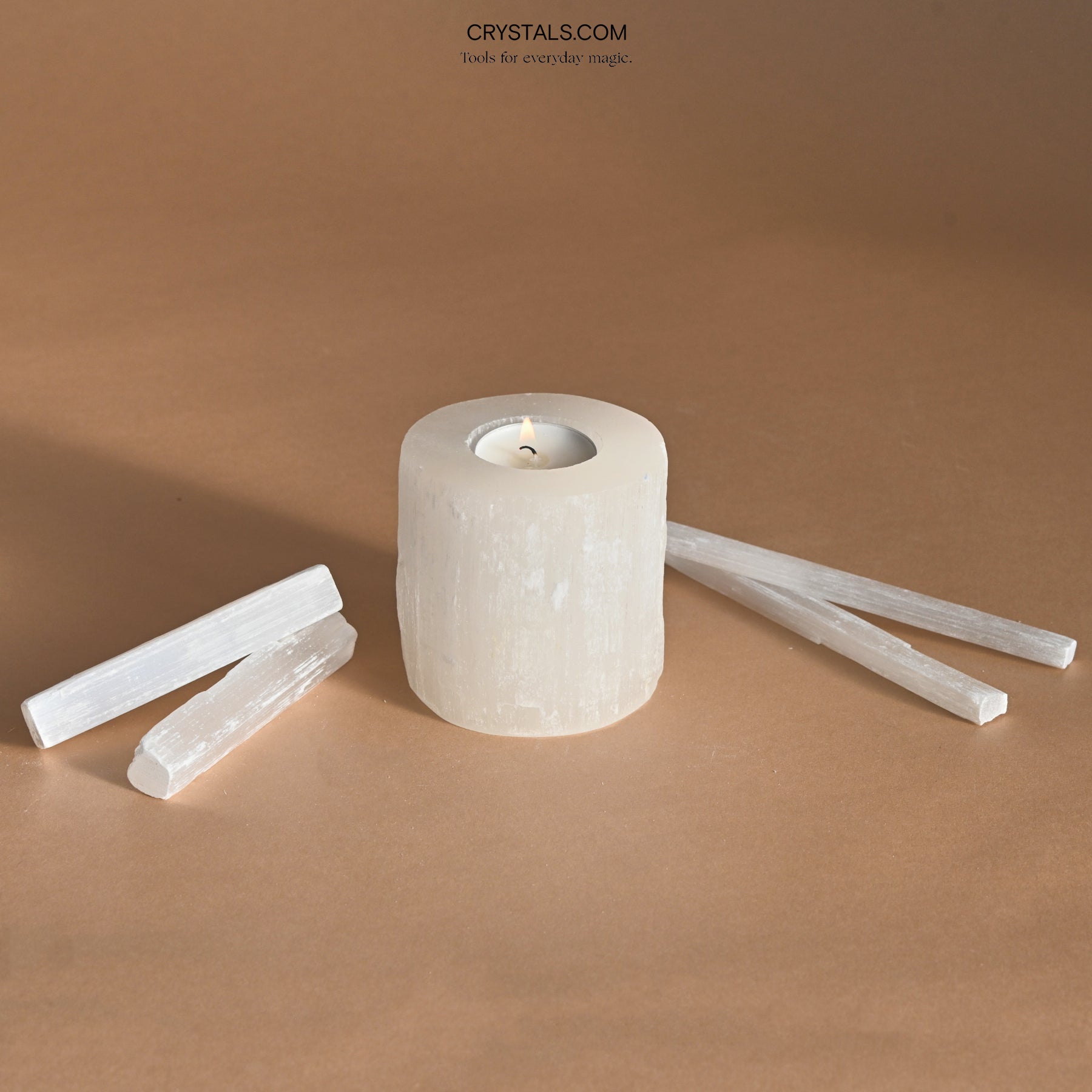
Celestite pairs beautifully with minerals that share its restrained palette: selenite (Selenite Cleansing Wand) in white satin-spar form, pale smoky quartz (Smoky Quartz Palm Stone), and soft rose quartz (Rose Quartz Tower) all work in the same tonal register. A grouping of pale-colored minerals on a shelf — celestite geode, selenite tower, rose quartz sphere — creates a styled moment that reads as considered without becoming precious. Interior designers working on residential projects regularly incorporate celestite as a focal point. Our Trade Program offers sourcing support and designer pricing for exactly this kind of curated display work.
Scale and Proportion
Size matters significantly with celestite. Small specimens under 10cm tend to disappear in interior contexts. Medium to large geodes (20–40cm across) command presence without overwhelming the room. Cathedral-size pieces become furniture-level objects that anchor a space the way sculpture does. When in doubt, go larger: celestite's delicate color absorbs scale without becoming aggressive. Browse the Home Décor collection for available large-format pieces.

Celestite and the Throat and Crown Chakras
Within the framework of crystal energetics, celestite is consistently associated with the throat chakra — the energetic center linked to communication, expression, and authentic speech — and the crown chakra, which governs connection to expanded states of awareness and clarity. Its pale blue coloration (blue being the color frequency most associated with the throat in traditional chakra frameworks) makes it a natural companion for practices of vocal expression, meditation, and stillness work.
Celestite's association with angelic realms is persistent across both New Age and traditional metaphysical literature. Whether that framing resonates or not, the experiential quality many users report — a sense of spaciousness, quietude, and mental lightness in celestite's presence — is consistent across traditions and worth considering for contemplative spaces. Take our chakra quiz to identify which energy centers you're currently working with, or take our crystal quiz to discover which stone most resonates with where you are right now.
Zodiac Associations
Celestite is most commonly associated with Gemini — whose dual nature benefits from celestite's calming influence on mental chatter — and with Pisces, drawn to celestite's ethereal, dreamy quality. Aquarius also claims celestite within some traditions, for its associations with higher mind and collective awareness. Libra finds affinity with celestite's ability to clarify communication and ease relational friction.
What Makes a Fine Celestite Specimen: The Collector's Checklist
For those building a serious collection, evaluating celestite quality comes down to five factors.
Color saturation: The finest specimens hold a clear, consistent blue throughout the crystal depth. Look for color that penetrates fully rather than sitting only at tips. Very pale, near-white material is less desirable unless the crystal form is exceptional.
Crystal clarity and luster: Individual crystals should be translucent to transparent at the tips, with a vitreous (glassy) luster. Cloudy or chalky crystals indicate lower grade material.
Formation completeness: In geodes, the completeness of the crystal lining matters — gaps in coverage, matrix intrusions, or damaged points all reduce value. Natural undamaged terminations are strongly preferred over cleaved or broken faces.
Provenance: Madagascar material dominates the current market. Historic pieces from Ohio, Sicily, or England command premium prices among knowledgeable collectors due to their documented localities. Provenance adds both scientific and investment value to a specimen.
Scale: Larger pieces at equivalent quality are exponentially rarer. A 30cm celestite geode with excellent color is not merely ten times more valuable than a 3cm cluster — it is far rarer, because size and quality rarely scale together in mineral specimens. Explore our Collector's Edition for premium large-format pieces.
Celestite Crystal FAQ
Is celestite the same as celestine?
Yes. Celestine is the official IMA (International Mineralogical Association) mineral name for strontium sulfate (SrSO₄). Celestite is the older, widely used trade name that remains common among collectors and in the crystal market. Both terms refer to the same mineral.
Can celestite go in water?
No — celestite should not be submerged in water. Strontium sulfate has a slight solubility, and prolonged water contact can damage the crystal surface over time. Clean with a dry soft brush only. Celestite is not suitable for crystal water infusions or gem elixirs.
Will celestite fade in sunlight?
Yes. Celestite's blue coloration is photosensitive and will fade with prolonged UV exposure, turning toward white or pale gray irreversibly. Keep it away from direct sunlight. Ambient indoor lighting poses no meaningful risk.
How hard is celestite on the Mohs scale?
Celestite registers 3 to 3.5 on the Mohs hardness scale — softer than most household surfaces. It will scratch against metal, glass, and most stone. Handle carefully and display where it won't be knocked or abraded.
What chakra does celestite work with?
Celestite is primarily associated with the throat chakra (Vishuddha) and the crown chakra (Sahasrara) within crystal healing frameworks. It is used in practices related to communication, clarity, and expanded awareness.
What crystals pair well with celestite?
Celestite pairs well with other high-vibration, pale-colored minerals: selenite for clarity and light, rose quartz for heart-centered warmth, and clear quartz as an amplifier. For grounding to balance celestite's upward energy, combine it with black tourmaline or smoky quartz.
Where should I display celestite in my home?
Celestite thrives in calm, contemplative spaces: a bedroom, meditation room, reading nook, or home office. Avoid direct sunlight. Pair it with soft, diffused light — warm lamp light brings out the subtle blue without the UV fade risk. For professional interior design applications, our Trade Program offers sourcing and guidance.
Shop Celestite at Crystals.com
We source celestite directly from trusted suppliers in Madagascar, selecting individual pieces for color saturation, crystal completeness, and dimensional presence. Every specimen in our inventory has been evaluated in person — not ordered by the kilogram from a catalog. Browse our New In Stock page for current celestite availability, explore our Collector's Edition for premium pieces, or if you're designing a space and need sourcing support, learn more about our Trade Program for interior designers. Not sure where celestite fits into your collection? Take our crystal quiz to discover which stone belongs in your life right now, or explore the full Crystal Index 101 for deeper mineralogical context on every stone we carry.
Explore our full Crystal Encyclopedia — meanings, healing properties, and chakra connections for 280+ crystals.
Discover Your Human Design
Crystals amplify energy — but do you know your unique energy type? Human Design reveals how you're wired to make decisions, work, and rest. It's the owner's manual you were born with.
Explore Human DesignGet 10% Off Your First Order
Plus early access to new arrivals, collector drops, and crystal guides. Join 15,000+ crystal lovers.