Crystals for Focus and Concentration: A Mineralogist's Desk Guide
Workspace Design • Mineralogy • Interior Styling
The minerals most associated with mental clarity are not chosen by accident. Their visual geometry, their optical properties, and even their chemical structure all contribute to why they have long been placed in spaces dedicated to thought, study, and creative work.
A well-designed workspace is not just about ergonomics and lighting. It is about the quality of the objects around you, the way they invite your attention or release it, the visual rhythm they create. Minerals are among the most compelling objects you can place on a desk, because each one is a record of the earth's chemistry, formed under conditions of heat, pressure, and time that dwarf any human timescale.
This guide covers the four minerals most suited to a workspace, with full mineralogical context, desk styling principles, and notes on pairing them with the materials and tools that characterize a serious working environment.
Fluorite: Geometry as Focus
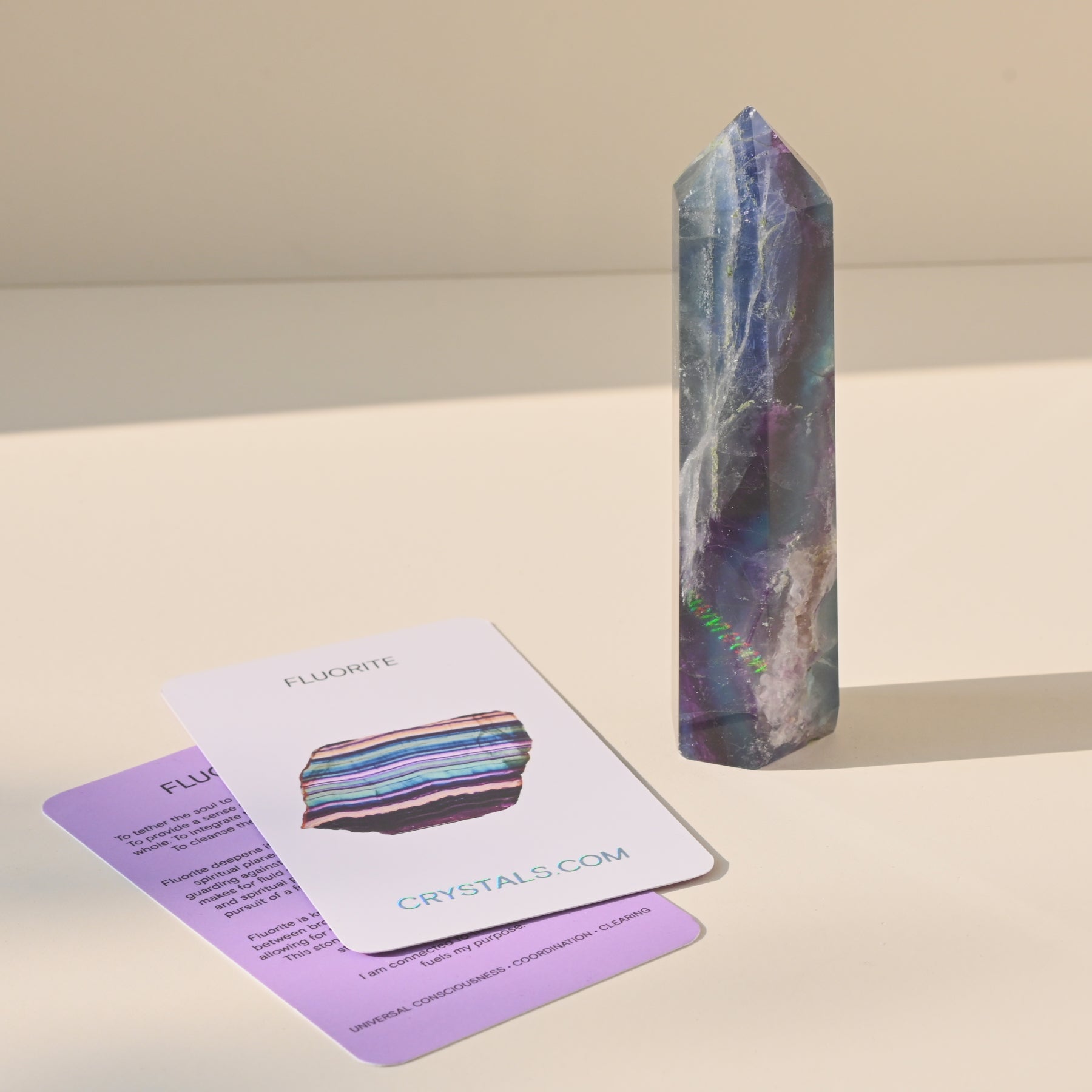
Fluorite is calcium fluoride, a halide mineral that crystallizes in the isometric system. This means its natural crystal habit produces perfect cubes and octahedra, geometric forms so precise they seem manufactured rather than grown. The Mohs hardness of fluorite is exactly 4, which is actually used as one of the benchmarks in the hardness scale itself.
What makes fluorite mineralogically extraordinary is its optical behavior. It is the source of the word "fluorescence": many fluorite specimens emit visible light under ultraviolet illumination, typically a vivid blue-violet. The cause is the presence of rare earth element impurities within the crystal lattice. Under natural light, fluorite displays a phenomenon called diaphaneity, ranging from transparent to translucent, with colors spanning purple, green, yellow, blue, and banded combinations of all of these.
The Romans called it "murrhine" and carved drinking vessels from it, believing it prevented intoxication. Renaissance scholars kept it on their desks. Contemporary designers use fluorite points and spheres as objects that reward sustained attention: the longer you look, the more internal structure you discover.

For a workspace, fluorite points and towers are ideal. Their vertical form takes up minimal desk surface while providing visual height. A banded green and purple fluorite point beside a monitor, catching morning light, creates a focal point that draws the eye without demanding it. This is the design goal: something beautiful that does not compete with your work but grounds the space around it.
Fluorite has perfect octahedral cleavage in four directions, which means it will fracture cleanly if dropped. Handle it with care and keep it on a stable surface away from the edge of the desk.
Citrine: Iron, Heat, and the Color of Sunlight
Citrine is a variety of quartz, silicon dioxide, colored golden to amber-brown by trace amounts of ferric iron within the crystal lattice. Natural citrine is relatively rare; most commercial citrine is amethyst or smoky quartz that has been heat-treated to convert the iron into its ferric state, shifting the color from purple or grey to golden. The mineralogy is identical, the chemistry is equivalent, only the oxidation state of the iron has changed.
The name comes from the Latin citrus, for lemon, which speaks to the clear yellow of fine natural specimens. Brazilian citrine, from the state of Rio Grande do Sul, tends toward amber. Bolivian material, sold as "Bolivianite" or sometimes branded as Ametrine when it contains both amethyst and citrine zones, is among the rarest and most collectible.

On a desk, citrine brings warmth. The golden tones of a natural citrine cluster or tower pair exceptionally well with warm-toned materials: brass, natural oak, tan leather, cream linen. If your workspace tends toward the cold and minimal, a piece of natural citrine introduces a visual temperature shift that makes the space feel less clinical.
One styling note: citrine, like amethyst, is sensitive to prolonged UV exposure. Both minerals are colored by iron, and the iron's oxidation state can be altered by sustained sunlight, causing the color to fade or shift. Keep citrine out of direct sun if you want the color to remain stable over years.
A raw citrine cluster placed beside a notebook or on the corner of a standing desk creates the feeling of a workspace that belongs to someone who pays attention to things. It is a signal, to yourself as much as to anyone else, that the work environment is considered.
Smoky Quartz: The Grounding Anchor
Smoky quartz is silicon dioxide colored a translucent grey-brown to near-black by natural irradiation. The color mechanism is distinct from amethyst or citrine: in smoky quartz, aluminum impurities within the silica lattice are irradiated by the radioactive decay of surrounding rock, creating color centers, technically called F-centers, that absorb certain wavelengths of light and produce the characteristic smoky color.
The finest smoky quartz comes from Brazil, Colorado, and the Swiss Alps, where large gem-quality crystals have been found since the 18th century. Cairngorm, a brown variety named for the Scottish mountains, was highly prized for Victorian jewelry and is technically a variety of smoky quartz.

For a workspace, smoky quartz towers serve as the visual anchor in a grouping. Their neutral, desaturated color works with virtually any palette, and their translucency catches light without the dramatic color saturation of amethyst or fluorite. They are the most versatile of the focus minerals, complementing rather than competing with other stones.
A tall smoky quartz tower at the back of the desk, slightly taller than the monitor riser, frames the screen without obscuring it. Paired with a raw citrine cluster in front, the visual pairing of warm gold and cool grey creates a sophisticated neutral palette that many interior designers use in study spaces.
Desk Styling Principles for a Serious Workspace
The difference between a desk that inspires work and one that simply contains it is largely a question of curation. Minerals, like all objects on a work surface, function best when they are selected and positioned with the same intention you bring to the work itself.
The peripheral placement rule. Objects on a working desk should occupy the periphery, not the center. Your actual working area needs to be clear. Minerals belong at the back corners, beside the monitor, or on a shelf directly above the desk rather than in the primary work zone.
Vary the heights within your grouping. A single tall tower, a medium cluster, and a small tumbled or polished piece create a skyline that is more visually engaging than three objects of equal height. This applies to any styled surface, not just desks.
Material contrast amplifies beauty. Crystals on raw wood surfaces look naturalistic. Crystals on white marble look minimal and crisp. Crystals on dark leather look collected and deliberate. Choose the surface your minerals live on as carefully as you choose the minerals themselves.
One dominant specimen, not many small ones. A single impressive fluorite tower will always look more intentional than a dozen small tumbled stones scattered across the desk. Collect the best piece you can afford in each variety and build outward from there.
Consider the light source. Morning east light is soft and warm, ideal for citrine and smoky quartz, which glow in amber tones. North light is cool and consistent, better for fluorite and selenite, which show their internal structure most clearly under even illumination. Know which direction your desk faces and choose accordingly.
For more on how to care for these minerals, including water safety and sunlight sensitivity, read our crystal care guide. And if you are building a home office from scratch, our complete crystal styling guide covers every room.
Discover Your Human Design
Crystals amplify energy — but do you know your unique energy type? Human Design reveals how you're wired to make decisions, work, and rest.
Explore Human DesignGet 10% Off Your First Order
Plus early access to new arrivals, collector drops, and crystal guides. Join 15,000+ crystal lovers.