January 2025 opened the year with a Cancer full moon on January 13 and an Aquarius new moon on January 29 — an emotional opening followed by an intellectual reset. Here's how each phase worked and which crystals supported the energy.
Full Moon in Cancer: January 13, 2025
The Cancer full moon is the most emotionally charged lunation of the year. Cancer rules home, family, roots, and emotional security. Under this full moon, feelings you've been storing — about family dynamics, living situations, or your sense of belonging — rise to the surface for examination.
Cancer is cardinal water: it initiates emotional processes. This isn't a passive moon. It actively pushes suppressed feelings into your awareness, which can feel uncomfortable but is ultimately clarifying.
Cancer full moon crystals:
• Moonstone — Cancer's ruling body is the Moon itself, making moonstone the most resonant crystal for this event. Its adularescent glow mirrors the full moon's light, and its energy supports emotional processing without overwhelm.
• Rose Quartz — When the Cancer full moon surfaces old wounds around love and belonging, rose quartz provides gentle, steady comfort.
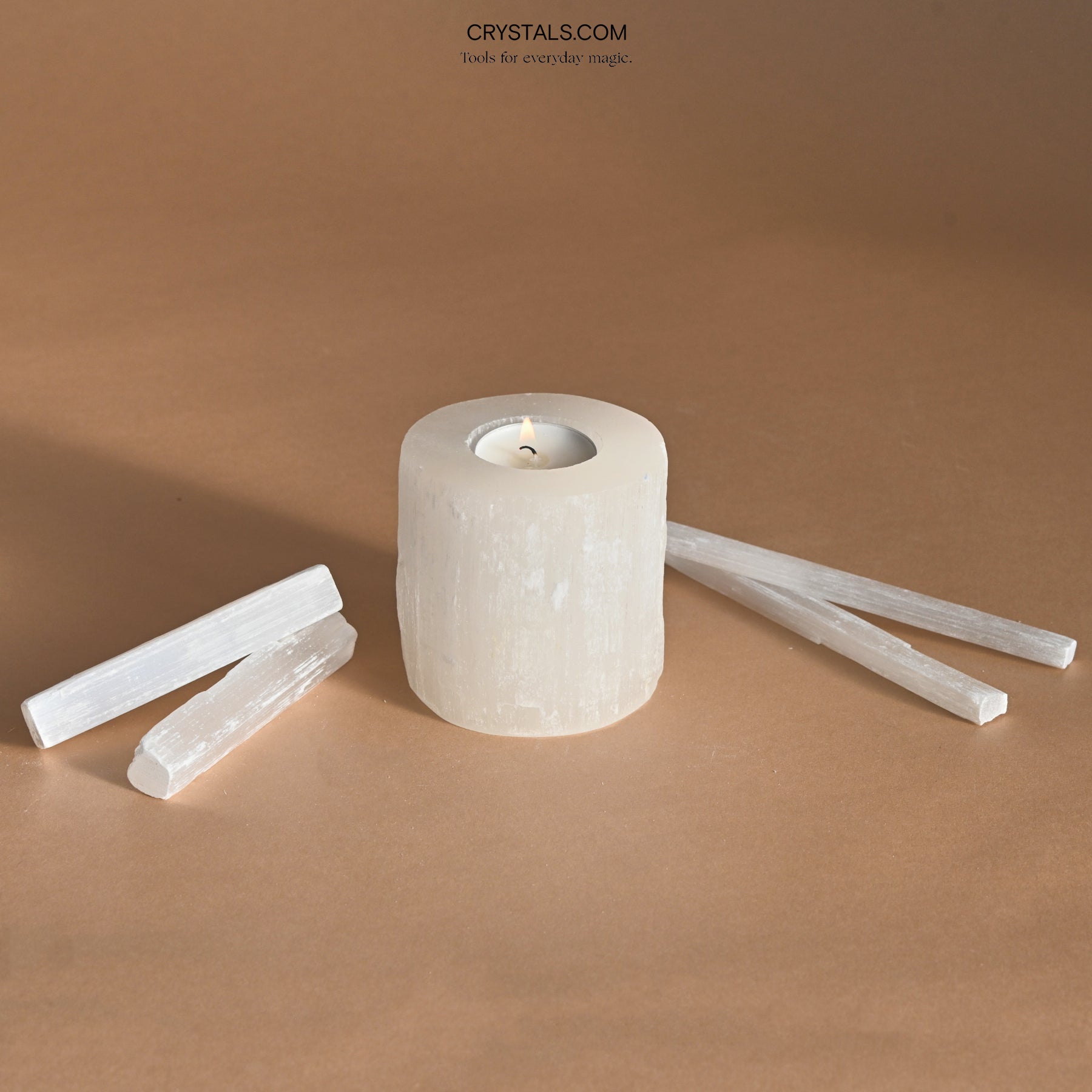
• Selenite — Named for Selene, the Greek moon goddess. Selenite's cleansing frequency helps process and release whatever the Cancer moon illuminates.
The Waning Phase: January 14-28
After the full moon peaks, the two-week waning period is ideal for releasing, completing, and clearing. This is when you take action on whatever the Cancer full moon revealed. Clean your house. Have the conversation you've been avoiding. Donate things that no longer belong in your space.

Waning moon crystals: Smoky Quartz for releasing emotional baggage, black tourmaline for protecting your energy as you clear, obsidian for honest self-reflection.
New Moon in Aquarius: January 29, 2025
The Aquarius new moon closes January with a completely different energy. Where Cancer is intimate and emotional, Aquarius is cerebral and collective. This new moon is ideal for setting intentions around innovation, community, and the systems you want to build in 2025.

Aquarius new moon crystals:
• Amethyst — Aquarius's traditional crystal. Amethyst supports the visionary, big-picture thinking that Aquarius energy requires.
• Fluorite — Aquarius loves systems. Fluorite's organized crystal structure supports systematic planning and intellectual clarity.
• Labradorite — For expanded perception. Aquarius new moons reward unconventional thinking, and labradorite opens the door to ideas you wouldn't normally consider.
January Crystal Care
The start of a new year is the perfect time to cleanse and reset your entire crystal collection. Place all your crystals outside or on a windowsill under the full moon on January 13. Clean display surfaces. Consider rearranging your collection to match your intentions for 2025. A fresh arrangement creates fresh energy.

Shop lunar ritual crystals in our full collection. Free shipping on orders over $150.
Discover Your Human Design
Crystals amplify energy — but do you know your unique energy type? Human Design reveals how you're wired to make decisions, work, and rest.
Explore Human DesignUnderstanding Lunar Phases: The Science
The Moon completes one orbit around Earth approximately every 29.5 days — this is the synodic period, or one complete cycle of lunar phases. The phases we see are determined by the Moon's position relative to both Earth and the Sun. At new moon, the Moon sits between Earth and the Sun, with its illuminated side facing away from us. At full moon, Earth sits between the Moon and Sun, and we see the Moon's entire illuminated face.
Between these two points, the Moon waxes (grows from new to full) and wanes (shrinks from full to new). The waxing phase is traditionally associated with building, growing, and initiating. The waning phase is associated with releasing, reflecting, and completing. This natural rhythm provides a built-in framework for personal intention cycles — something humans have recognized for at least 30,000 years, based on lunar notation marks found on prehistoric bone artifacts.
Cancer Full Moon: The Emotional Tide
Cancer is ruled by the Moon, making a Cancer full moon the most emotionally potent lunation of any year. The Moon is "at home" in Cancer — its energy is strongest and most natural here. Cancer governs the fourth house of the zodiac, which rules home, family, ancestry, emotional foundations, and the most private aspects of your inner life.
Under a Cancer full moon, emotions surface that have been stored in the body and subconscious. This is not always comfortable, but it is always clarifying. The key is to allow feelings to surface without immediately trying to fix, analyze, or suppress them. Like ocean tides (which are literally caused by the Moon's gravitational pull), emotional tides are natural and temporary.
Moonstone is the natural companion for any Cancer lunar event. This feldspar mineral displays adularescence — a soft, billowy internal glow caused by light scattering between microscopic layers of orthoclase and albite. The finest specimens from Sri Lanka show a blue sheen that seems to float inside the stone, while Indian moonstone often displays a warmer, peach-toned glow.
Aquarius New Moon: The Intellectual Reset
After Cancer's emotional intensity, the Aquarius new moon on January 29 provided a sharp contrast — shifting the energy from feeling to thinking, from private to collective, from past to future. Aquarius is fixed air: committed to ideas, innovation, and the betterment of community. New moons in Aquarius are ideal for setting intentions related to friendships, community involvement, humanitarian goals, and innovative projects.
The Cancer-Aquarius dynamic across January asked: how do you balance your private emotional needs with your desire to contribute to something larger? Both are valid. Neither should dominate at the other's expense.
Building a Monthly Lunar Practice
A sustainable lunar practice does not require elaborate rituals. Here is a simple framework you can use every month:
New Moon (setting): Write 1-3 intentions. Be specific. Place them under a crystal that matches the sign's energy. Leave them for two weeks.
Waxing Phase (building): Take one small action each day toward your intentions. Carry a piece of citrine or carnelian for motivation.
Full Moon (illuminating): Review what has become visible since the new moon. What is working? What needs adjustment? Journal by moonlight with selenite or clear quartz nearby.
Waning Phase (releasing): Let go of what is not serving your intentions. Declutter one area of your home. Work with smoky quartz for release and grounding.
This practice takes 10-15 minutes twice a month and creates a rhythm that compounds over time. Explore our new arrivals for monthly-aligned specimens. Free shipping on all orders over $150.
The Tidal Connection: How the Moon Moves Water
The Moon's gravitational pull creates the ocean's tides — a phenomenon that makes the lunar cycle one of the most physically tangible astronomical forces in daily life. The human body is approximately 60% water by weight, and while the Moon's tidal force on an individual human body is negligible from a physics perspective, the symbolic and experiential connection between lunar phases and emotional states has been recognized across virtually every human culture for millennia.
The word "lunatic" derives from the Latin luna (moon), reflecting the ancient belief that the Moon influenced mental states. While modern science has not confirmed direct physiological effects of lunar phases on human behavior, the Moon's cycle provides a genuinely useful framework for structuring reflection, intention-setting, and personal development — not because of supernatural influence, but because consistent rhythmic practices compound over time.
Think of the lunar cycle as a built-in project management framework: the new moon is your kickoff meeting, the waxing phase is execution, the full moon is your midpoint review, and the waning phase is optimization and release. Twelve cycles per year means twelve complete intention-action-review loops — a powerful rhythm for personal growth.
Moonstone: The Lunar Mineral in Depth
Moonstone deserves a closer look as January's lunar companion. This feldspar mineral displays adularescence — a phenomenon where light enters the stone, scatters between microscopic layers of two different feldspar species (orthoclase and albite), and exits as a soft, floating glow. The layers are incredibly thin — typically 0.5 to 0.7 micrometers — and their spacing determines the color of the adularescent glow: thinner layers produce blue adularescence (most valued), while thicker layers produce white or silver glow.
The finest blue moonstone historically comes from Sri Lanka's gem gravels, where it has been mined and traded for centuries. India produces abundant moonstone, often with a warm, peachy adularescence. Madagascar and Myanmar also contribute significant production. Rainbow moonstone — which shows multicolored flashes — is actually a variety of labradorite (a different feldspar species) rather than true moonstone, though both are beautiful and valuable in their own right.
Moonstone has a Mohs hardness of 6-6.5, making it suitable for jewelry but requiring more care than harder stones like quartz or garnet. Avoid ultrasonic cleaners and harsh chemicals. Clean with warm soapy water and a soft cloth.
Get 10% Off Your First Order
Plus early access to new arrivals, collector drops, and crystal guides. Join 15,000+ crystal lovers.
Discover Your Crystal Match
Select your sign and get personalized crystal recommendations delivered to your inbox.