Long before amethyst appeared on Pinterest mood boards, it was treasured by Roman nobles, placed in the tombs of Egyptian pharaohs, and collected by European royalty who understood that certain natural objects possess a quality no manufactured thing can replicate — the authority of geological time.
Amethyst geodes for home decor are not a trend. They are one of the oldest forms of interior sculpture, returned to prominence because discerning designers and collectors have rediscovered what earlier centuries never forgot: that a large, naturally formed amethyst geode changes a room in ways that furniture and art cannot.
This guide is for anyone who wants to understand the material — its formation, its varieties, its proper placement — before bringing one home. Whether you are furnishing a living room, a hotel lobby, or a private study, what follows will help you choose with confidence.

What Is an Amethyst Geode, Exactly?
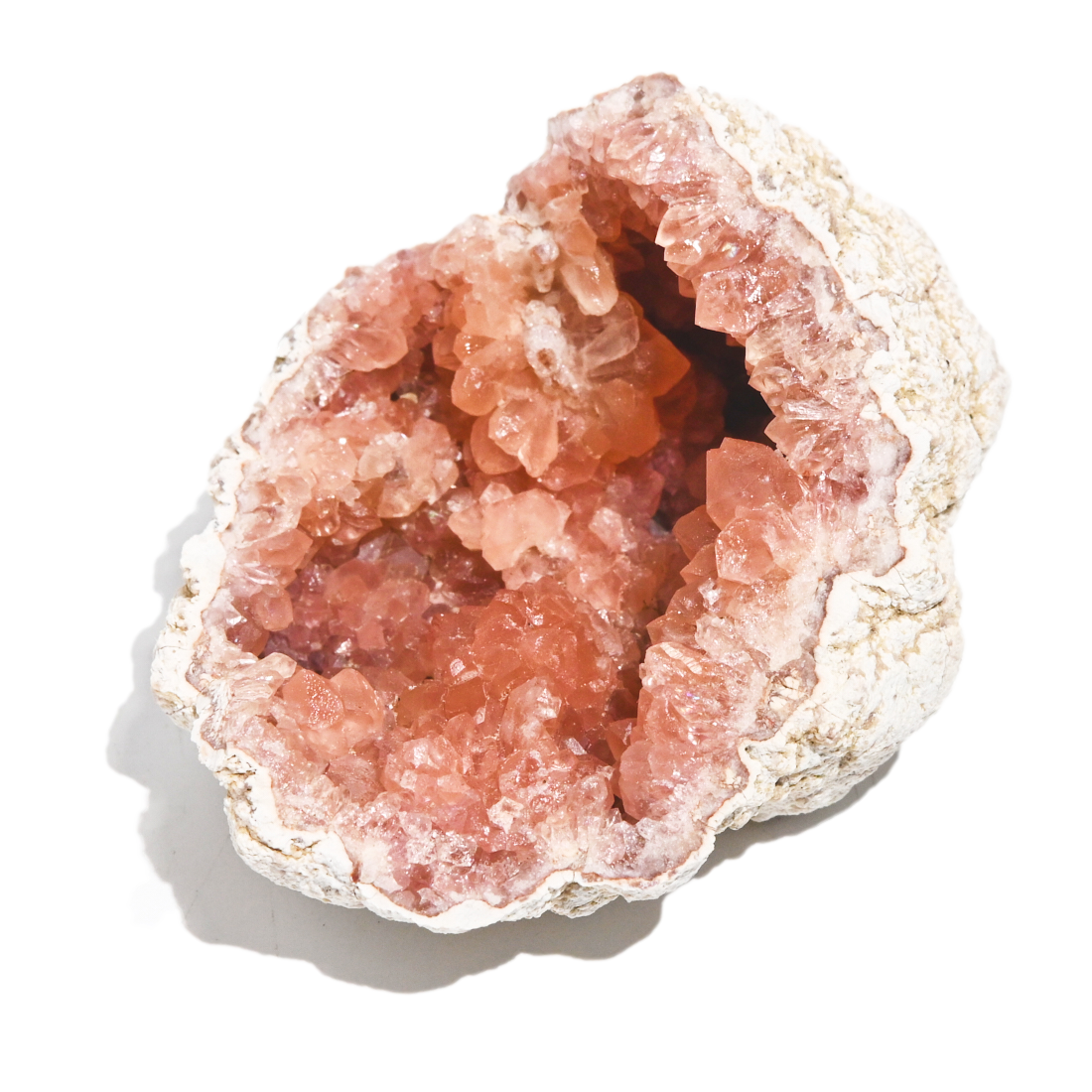
Before styling comes understanding. Amethyst geodes are hollow rock formations — typically basalt or limestone — whose interior cavities are lined with violet quartz crystals. The process unfolds over tens of millions of years: volcanic gas bubbles create the cavity, mineral-rich water slowly deposits silica along the interior walls, and trace amounts of iron within the silica oxidize over time to produce the distinctive violet color.
The intensity of that color — from pale lavender to deep Siberian purple — depends on the concentration of iron, the temperature during formation, and the specific region of origin. No two geodes are identical. This is not a selling point. It is geology.
The Three Most Significant Origins
Brazil (Rio Grande do Sul): The world's primary source of large amethyst geodes, particularly the dramatic cathedral-form specimens that can stand over two meters tall. Brazilian amethyst tends toward deep violet with strong saturation and the characteristic stepped crystal terminations that create their signature visual texture.
Uruguay: Smaller but exceptionally intense. Uruguayan amethyst geodes are prized by collectors for their near-black violet coloration and fine crystal formation. A Uruguayan specimen with high color saturation is among the most coveted mineral objects available.
Zambia: African amethyst is gaining recognition among serious collectors for its uniquely reddish-violet tone and exceptional clarity. Smaller than Brazilian specimens but remarkable in color depth.
Why Amethyst Geodes Work in Interiors
Interior designers who work with natural materials — stone, wood, unprocessed textile — understand something fundamental: objects that carry geological or biological history read differently in a space than manufactured objects. They anchor a room because they contain an irreducible factual presence.
An amethyst geode is not decorative in the conventional sense. It is architectural. The exterior — rough, dark, often covered in basalt matrix — contrasts with the interior's precision crystalline structure in a way that mirrors the tension that makes interesting interiors: the rough and the refined, the ancient and the contemporary.
Color. Violet occupies a particular position in color theory — simultaneously warm and cool, it works against white walls, dark plasters, warm neutrals, and rich wood tones without competing. It does not fight with other colors. It anchors.
Texture. The faceted interior surfaces of an amethyst geode catch and scatter light differently at different times of day. In natural light the crystals appear almost liquid. In the evening they hold depth.
Scale. Large amethyst geodes — cathedral-form specimens above 60cm — function as sculpture. They do not need a plinth to read as intentional. They simply are.

Choosing the Right Size and Form for Amethyst Geode Interior Design
Cathedral Geodes (Large Format)
Cathedral geodes are the tallest and most dramatic form — a complete geode cross-section that stands upright, often with one side flat and one side open to reveal the interior. Heights range from 30cm to over 2 meters. For statement interior use, specimens between 60cm and 120cm are the most versatile. A well-proportioned cathedral geode requires no additional styling — placed on a stone or wood plinth, on the floor beside a sofa, or in an architectural alcove, it functions as a completed design decision.

Geode Halves — Matched Pairs
Geodes split down the center and sold as matched pairs are the most interior-design-friendly form. Two halves placed as bookends on a bookshelf, console table, or fireplace mantle create bilateral symmetry with organic variation — the crystals on each half differ slightly in growth pattern while sharing the same origin and color depth.
Full Geodes (Closed Form)
The exterior of an uncut geode — a round or oblong basalt form — is a quieter, more architectural choice. Placed in a group with other natural objects, the closed geode adds weight and material history without the visual drama of an open crystal interior. These are particularly suited to minimalist interiors where restraint is the aesthetic.
Small to Medium Clusters
Cut amethyst clusters work as tabletop objects on coffee tables, nightstands, or shelving. Their scale is intimate rather than architectural, but they carry the same material authority as their larger counterparts.

Explore our hand-sourced amethyst collection →
Where to Place Amethyst Geodes for Home Decor
Placement determines whether a geode reads as interior design or as decoration. The distinction matters.
Living Room
The living room is the natural home for a large amethyst geode. Placed near the main seating arrangement — beside a fireplace, at the end of a console, or as a floor sculpture beside a sofa — a cathedral geode becomes the visual anchor point that orients the room. Interior designers often use the principle of "the found object" — a single extraordinary piece that exists outside the logic of furniture arrangement. A large amethyst geode does this naturally.
Home Office or Study
Amethyst has been associated with clarity and focused thought since antiquity. Whether or not you hold that belief, a remarkable natural object in a workspace provides something practically useful: a point of visual rest. In a room full of screens, the interior of an amethyst geode offers the eye somewhere genuinely different to land.

Entrance Hall and Foyer
The foyer sets the register of a home. A large amethyst geode in an entrance — on a plinth, on the floor, on a console table — tells guests something about the home's interior logic before they have seen a single room. This is the designer's use of amethyst: as a signal.
Dining Room
A single statement amethyst placed on a sideboard or credenza in the dining room adds color and material depth to what is often the most symmetrically arranged room in a home. The interplay between candlelight and amethyst crystal surfaces at a dinner table is worth considering as a deliberate design choice.
Bedroom
Smaller amethyst geodes or clusters on bedside tables bring the color and textural quality of the material into a more intimate scale. The violet palette works particularly well against white linen, warm-toned wood, and the deep neutrals that characterize well-considered contemporary bedrooms.

Shop our Home Decor collection →
How to Style Amethyst Geodes
Styling a geode means giving it appropriate context — not crowding it with objects that compete, and not isolating it so completely that it feels arbitrary.
The plinth principle. A large amethyst geode on a plinth — stone, raw wood, concrete, or lacquered black — reads as sculpture. The plinth elevates the object into the register of considered placement.
Material companions. Amethyst reads well beside raw materials: unpolished marble, textured ceramic, dark wood, raw linen. It does not need embellishment. The contrast between rough geological origin and refined interior context is the aesthetic.
Light source. Natural light is ideal — amethyst responds to the changing quality of daylight in a way that no artificial light replicates. If the piece is in a room with limited natural light, a focused warm-spectrum spotlight will reveal the crystal interior dramatically.
Restraint. A large amethyst geode does not need companion objects. It is the companion object.
View our Collectors Edition — rare and exceptional specimens →
The Collector's Perspective on Amethyst Geodes
For serious mineral collectors, quality in amethyst geodes is assessed across four factors: color saturation, crystal formation quality, matrix presentation, and origin documentation.
Color saturation. The most prized specimens show deep, even violet across the interior crystal surface — no significant fading at the tips, no pale or white zones. The depth of color is a function of iron concentration and formation conditions that cannot be replicated or enhanced legitimately.
Crystal formation. Evenly formed, well-terminated crystals with visible geometric structure indicate slow, undisturbed growth. Specimens with chaotic or partially formed crystals indicate interrupted growth conditions — still visually rich, but less prized from a collector standpoint.
Matrix. An intact, unaltered exterior matrix indicates the specimen was extracted carefully and has not been artificially cleaned or reconstructed. The matrix is part of the specimen's story.
Origin documentation. Provenance — knowing where a specimen came from, ideally down to the mine — is the foundation of serious collecting. At Crystals.com, every significant specimen is personally sourced by our founder from vetted dealers with confirmed mine-of-origin documentation.

Interior designers: explore our Trade Program →
Caring for Your Amethyst Geode
Amethyst is a seven on the Mohs hardness scale — harder than most metals, durable under normal conditions.
Light exposure. Direct, prolonged UV exposure can fade amethyst over time. A piece placed in direct sunlight for hours each day may gradually lose color intensity. Indirect natural light is ideal for both display and preservation.
Cleaning. Dust the interior crystal surfaces with a soft, dry brush. For deeper cleaning, a damp cloth on the exterior matrix is sufficient. Avoid chemical cleaners.
Placement. Amethyst is heavy — cathedral geodes particularly so. Ensure your chosen surface is structurally rated for the weight before placing a large specimen.
Frequently Asked Questions About Amethyst Geodes for Home Decor
What are amethyst geodes used for in home decor?
Amethyst geodes are used as natural sculptural objects in interior design — as statement floor pieces, mantle objects, bookshelf anchors, and foyer focal points. Their combination of rough exterior and faceted violet interior makes them uniquely effective as design objects that carry genuine geological authority. Browse our amethyst geode collection →
How large do amethyst geodes get?
Amethyst geodes range from small clusters of a few centimeters to cathedral geodes exceeding two meters in height and weighing over 100 kilograms. Most interior-design-suitable specimens range from 30cm to 120cm. View large amethyst geodes →
Where do the best amethyst geodes come from?
The three most significant origins are Brazil (Rio Grande do Sul), Uruguay, and Zambia. Brazilian specimens are the most common source for large cathedral geodes; Uruguayan specimens are prized for exceptional color depth; Zambian amethyst offers distinctive reddish-violet tones increasingly sought by collectors.
How do I know if an amethyst geode is authentic?
Authentic amethyst is characterized by natural color variation — deeper at the base of crystals, slightly lighter at the tips — and cannot be perfectly uniform throughout. Purchasing from dealers who can document mine-of-origin is the most reliable guarantee of authenticity.
Can amethyst geodes fade over time?
Extended direct UV exposure can gradually reduce color intensity in amethyst. Positioning your geode away from prolonged direct sunlight preserves the color depth. Indirect natural light is ideal for both aesthetics and long-term preservation.
How do I style a large amethyst geode?
Large amethyst geodes work best on a plinth or as floor sculptures beside furniture. Raw materials — stone, wood, unglazed ceramic — make the strongest pairings. Minimal companion objects let the specimen speak for itself. Explore our home decor styling guide →
Are amethyst geodes good investments?
Large, high-quality amethyst geodes — particularly Brazilian cathedrals with deep color and excellent crystal formation — have appreciated steadily in the mineral market. Exceptional specimens with documented provenance are increasingly sought by collectors and interior designers working at the luxury end of the market.
What size amethyst geode should I buy for my living room?
For a living room statement piece, cathedral geodes between 60cm and 100cm read architecturally without overwhelming the space. Smaller rooms are well suited to specimens in the 30–50cm range. Shop amethyst geodes by size →
Where can I buy authentic amethyst geodes for home decor?
Crystals.com offers a curated collection of hand-sourced amethyst geodes — from small desk clusters to large cathedral specimens — all personally selected with verified mine-of-origin documentation. Shop the amethyst collection →
Closing
An amethyst geode is one of those rare interior objects that resists trend. It was considered extraordinary by the ancient world, by Renaissance collectors, by the mineral hunters of the 19th century, and by the designers and collectors who seek it today. What has not changed across those centuries is the thing itself: a hollow cavity of rock, lined with violet crystal, formed in geological time and extracted with care.
For interior designers, the amethyst geode for home decor is a design decision that carries its own authority. For collectors, it is a specimen that rewards serious attention. For anyone who simply wants to change how a room feels — to introduce natural color, geological texture, and the quiet weight of something very old — it is one of the most effective objects available.
Explore our hand-sourced amethyst geode collection →
Discover Your Human Design
Crystals amplify energy — but do you know your unique energy type? Human Design reveals how you're wired to make decisions, work, and rest. It's the owner's manual you were born with.
Explore Human DesignGet 10% Off Your First Order
Plus early access to new arrivals, collector drops, and crystal guides. Join 15,000+ crystal lovers.
External references: Smithsonian National Museum of Natural History — Mineral Sciences · Mindat.org — Amethyst Mineralogy · Gemological Institute of America — Amethyst Guide
Explore our full Crystal Encyclopedia — meanings, healing properties, and chakra connections for 280+ crystals.
Not Sure Which Crystal Is Right for You?
Take our 60-second crystal quiz and get a personalized recommendation based on what you need right now.
Take the Crystal Quiz