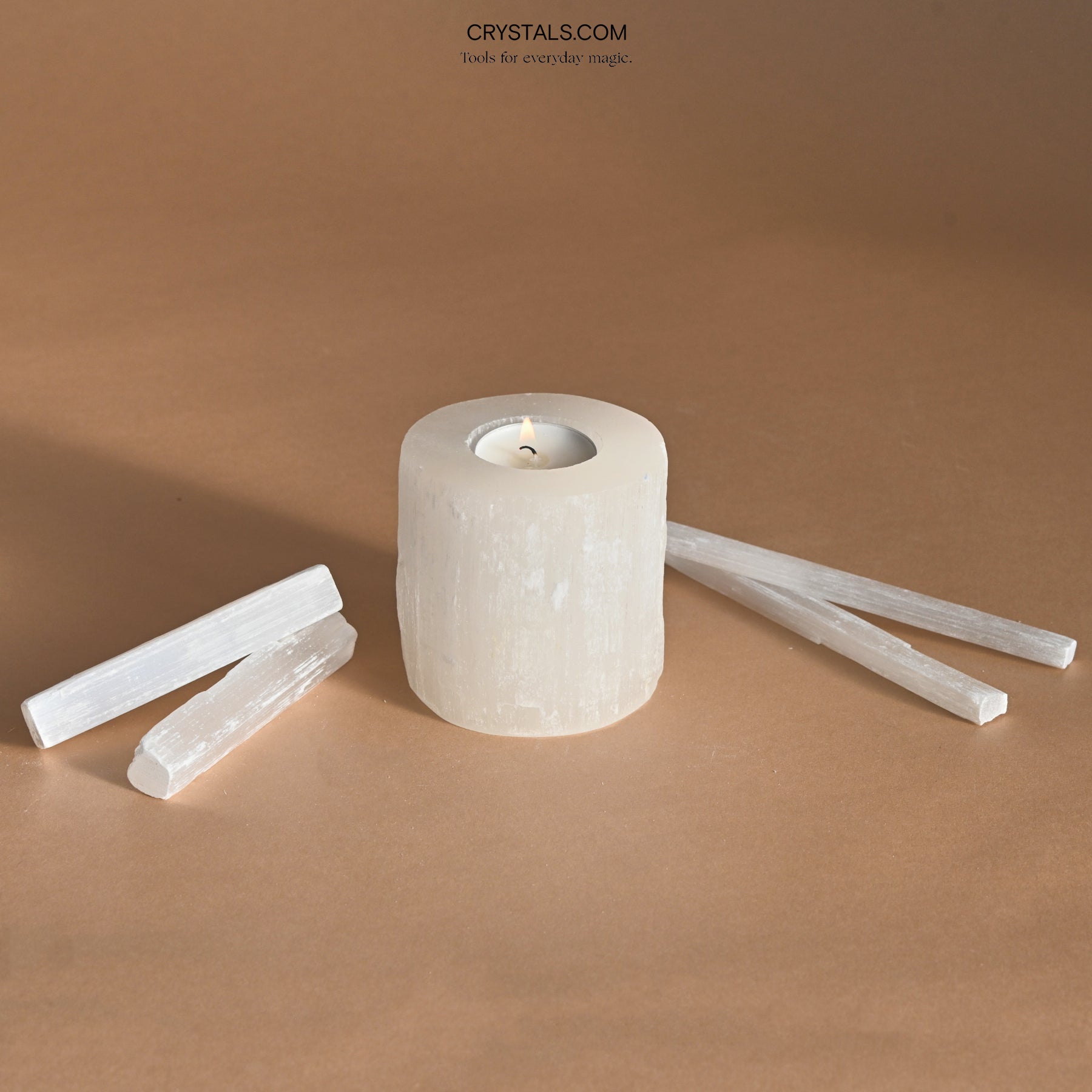
Selenite: Meaning, Properties & Cleansing Power
What Is Selenite? The Mineralogy
Selenite is a crystalline variety of gypsum, calcium sulfate dihydrate (CaSO4·2H2O), crystallized in the monoclinic system. Gypsum has four named varieties: selenite (transparent to translucent crystals), satin spar (fibrous, silky variety), alabaster (fine-grained massive form), and desert rose (sand-included rosettes). All four are chemically identical — the names describe habit and form, not different minerals.
Gypsum is one of the most abundant minerals on Earth. It forms in evaporite sequences where ancient seas evaporated and left behind concentrated mineral deposits, in caves through precipitation from calcium- and sulfate-rich groundwater, and as an alteration product of sulfide ore deposits. The mineral has been used by humans for thousands of years: ancient Egyptians used alabaster (massive gypsum) for sculpture and canopic jars, and gypsum plaster was used throughout the ancient Near East.
| Property | Value |
|---|---|
| Chemical formula | CaSO4·2H2O (calcium sulfate dihydrate) |
| Mineral class | Sulfates |
| Crystal system | Monoclinic |
| Hardness (Mohs) | 2 — extremely soft, scratched by a fingernail |
| Cleavage | Perfect in two directions |
| Luster | Vitreous to pearly (selenite), silky (satin spar) |
| Transparency | Transparent to translucent |
| Specific gravity | 2.31–2.33 |
| Color | Colorless, white, gray; rarely pale orange, peach, or blue |
| Water solubility | Slightly soluble — will dissolve and etch with prolonged water contact |
| Fluorescence | Some specimens fluoresce cream or white under UV |

Selenite vs Satin Spar: An Honest Distinction
This is something most sellers do not mention clearly: the overwhelming majority of "selenite" wands, towers, palm stones, and plates sold in the crystal market are actually satin spar — the fibrous variety of gypsum, not true selenite. Both are gypsum and chemically identical, but they look and behave differently.
True selenite forms in clear to translucent tabular or prismatic crystals, sometimes reaching extraordinary size. The Cave of Crystals (Cueva de los Cristales) near Naica, Chihuahua, Mexico contains selenite crystals up to 11 meters long and 1 meter in diameter, formed over approximately 500,000 years in a flooded, superheated cave chamber at around 58°C (136°F).
Satin spar, by contrast, is fibrous. Its parallel fiber structure creates a chatoyant, silky optical glow — the moving sheen of light that makes these wands and towers so visually striking. When light enters satin spar parallel to the fibers, it bounces along them and produces the characteristic luminescent band. This is why it photographs so beautifully and why it dominates the commercial market.
Neither is superior or inferior. The distinction is nomenclature, not quality. But being transparent about it is part of how we approach mineral education at Crystals.com.
Named After a Goddess: The Mythology of Selenite
The name selenite derives from the ancient Greek Selene (Σελήνη) — the goddess of the moon, daughter of the Titans Hyperion and Theia, sister of Helios (the sun) and Eos (the dawn). In Greek mythology, Selene drove a silver chariot across the night sky, her pale light illuminating the darkness. She was worshipped throughout the Greek world and later conflated with Artemis and Hecate in the Roman period.
The name was applied to this mineral because early observers found that the cold, pearlescent sheen of its polished surface — particularly in the fibrous satin spar variety — resembled moonlight. The etymology is one of the most poetic in mineralogy: you are holding a stone named for the moon goddess of the ancient world.
This lunar connection runs through every cultural use of selenite in modern crystal practice: association with cycles and rhythms, with the feminine principle, with the quieter, more reflective dimensions of consciousness.
Selenite Meaning and Traditional Associations
The following are traditional beliefs and spiritual associations in contemporary crystal practice, not medical or scientific claims:
Crown Chakra and Higher Consciousness
Selenite is most commonly associated with the crown chakra (Sahasrara) — the energy center located at the top of the head. In many traditions, this chakra governs connection to higher states of consciousness, universal awareness, and what might be described as clarity of mind beyond ordinary thought. Selenite's pale, luminous quality and its etymology both point toward this association naturally.
Cleansing and Clearing
In contemporary crystal practice, selenite is widely regarded as a cleansing stone — one that many practitioners believe can clear stagnant energy from other stones and from spaces. It is one of the few crystals commonly said not to require energetic cleansing itself, because its association is with clarity and light. Whether you approach this literally or as a meditative intention-setting practice, the role of selenite in cleansing rituals is well-established.
Mental Clarity and Calm
The visual stillness of selenite — that cool, still, glowing white — maps naturally onto mental states of calm and clarity. Many people use selenite during meditation for this reason: its quality supports the quality they are cultivating.
Protection and Space Clearing
Selenite is frequently placed at doorways, windowsills, and corners of rooms in intentional home arrangement. For more on working with crystals in your home environment, see our guide to crystal feng shui and where to place crystals in your home.
Where Selenite Is Found
- Mexico — Naica, Chihuahua: home to the world's most spectacular selenite crystals and a major source of commercial satin spar.
- Morocco — A dominant source of white and orange satin spar wands, towers, and bowls for the global crystal market.
- Madagascar — Produces notable selenite specimens including pale peach and white varieties.
- United States — Great Salt Lake basin (Utah), the "Selenite Crystal Cave" near Jet, Oklahoma, and deposits in New Mexico.
- Poland — The Wieliczka salt mine produces excellent gypsum specimens.
- United Kingdom — Nottinghamshire and Yorkshire have historically significant gypsum deposits.
- Australia and Russia also produce notable specimens.
Common Forms of Selenite
Wands
Long, smooth rods of satin spar — the most common form in the market. Used in energy work, laid alongside the body in healing practices, and used to sweep or trace in cleansing rituals. The Selenite Cleansing Wand is the classic starting point.
Towers and Pillars
Polished columns of satin spar that glow when backlit. Placed in rooms as both decor and intentional objects. Their upward form makes them natural choices for spaces where clarity or uplift is the intention.
Plates and Charging Slabs
Flat, polished slabs on which other crystals are rested for energetic cleansing. A staple of crystal practice — place tumbled stones or smaller pieces directly on the plate overnight.
Bowls
Carved selenite bowls serve the same function as plates while also functioning as beautiful containers. They are particularly striking as display pieces for tumbled stone collections.
Lamps
Hollow selenite cylinders fitted with a small bulb inside. When lit, satin spar glows with a warm, diffuse light that is unlike any other stone lamp. The fibrous structure distributes the light evenly through the entire form.

How to Use Selenite
Cleansing Other Crystals
Place tumbled stones or smaller pieces on a selenite plate or beside a selenite wand overnight. This is one of the most widely practiced uses in the crystal community — and because selenite does not require cleansing itself in this tradition, it is a low-maintenance anchor for any collection. For a full guide to safe crystal cleansing methods across different stone types, see: How to Cleanse & Charge Crystals: The Complete Safety Guide.
In the Home
Selenite towers and lamps make genuinely beautiful objects in a room. Place them on windowsills, bedside tables, or in corners as part of intentional home arrangement. For guidance on where to position crystals for specific energetic intentions, see our crystal feng shui guide.
Meditation
Hold a selenite palm stone or place a tower nearby during sitting practice. Its visual and tactile stillness supports meditative states. Many practitioners specifically use selenite during crown chakra meditations — holding it at the top of the head or placing it above the body while lying down.
Wands in Energy Work
Selenite wands are used in Reiki and other energy work modalities to sweep along the body in a releasing gesture. Their elongated form and smooth surface make them naturally suited to this. Their fragility means they require careful handling.
As a First Crystal
Selenite is one of the most commonly recommended introductory crystals, alongside clear quartz, amethyst, and black tourmaline. For a full beginner's framework, see: Best Crystals for Beginners.

How to Care for Selenite
- Cleaning: Use a soft, dry cloth. If absolutely necessary, a cloth barely moistened with water (not wet) may be used for a few seconds, followed by immediate, thorough drying.
- Storage: Keep away from harder stones that will scratch it. At Mohs 2, virtually every other common crystal — quartz (Mohs 7), amethyst (7), obsidian (5–5.5), even calcite (3) — is harder than selenite and will mark its surface.
- Fragility: Selenite has two perfect cleavage directions and will snap cleanly if dropped on a hard floor. Wands are particularly vulnerable. Handle with both hands and store them where they cannot roll or fall.
- Sunlight: Prolonged direct sunlight may cause gradual surface fading in some pieces over months of exposure. A shaded display position is safer.
- Humidity: Keep in a reasonably dry environment. A bathroom windowsill is not ideal for permanent placement.
Selenite and Protection Crystals
Selenite pairs naturally with grounding and protection stones — the contrast between selenite's crown-chakra brightness and the deep, anchoring quality of black tourmaline, obsidian, or shungite is one of the most visually and energetically balanced pairings in crystal practice. For a full guide to working with protective stones, see: Best Crystals for Protection.
Shop Selenite at Crystals.com
Free shipping on orders over $150.
Not Sure Which Crystal Is Right for You?
Take our crystal quiz to find the stone that matches your energy, intention, and moment.
Take the Crystal QuizStay in the Loop
New arrivals, care guides, and collector highlights — delivered to your inbox.