The Complete Guide to the Mohs Scale of Hardness
The Mohs scale is the single most practical tool a crystal collector can learn. Developed in 1812 by German mineralogist Friedrich Mohs, this scale ranks minerals from 1 (softest) to 10 (hardest) based on their ability to scratch one another. Understanding crystal hardness tells you how to store your collection, which specimens are safe for jewelry, and how to identify unknown minerals at home with nothing more than a fingernail and a pocket knife.
Whether you are searching for a Mohs scale chart, wondering about the ruby Mohs scale rating, or trying to determine Herkimer diamond hardness, this guide covers everything you need to know about mineral hardness in one place.
What Is the Mohs Scale of Hardness?
The Mohs scale of hardness is a qualitative, ordinal scale that measures scratch resistance between minerals. It works on a simple principle: a harder mineral can scratch a softer one, but not the other way around. The scale uses ten reference minerals, each assigned a whole number from 1 to 10.
One important detail that surprises many collectors: the Mohs scale is not linear. The actual (absolute) hardness difference between corundum (9) and diamond (10) is far greater than the difference between talc (1) and gypsum (2). Diamond is roughly four times harder than corundum in absolute terms, even though they sit just one number apart on the Mohs scale.
This matters for practical care. A jump from Mohs 6 to Mohs 7 represents a meaningful increase in durability, which is why Mohs 7 is widely considered the minimum hardness for stones that will be worn daily in rings.
The Full Mohs Scale: 1 Through 10
Below is every level of the Mohs hardness scale, from the softest minerals to the hardest substance found in nature. Each card includes the reference mineral, its hardness rating, and common crystals you will find at that level.
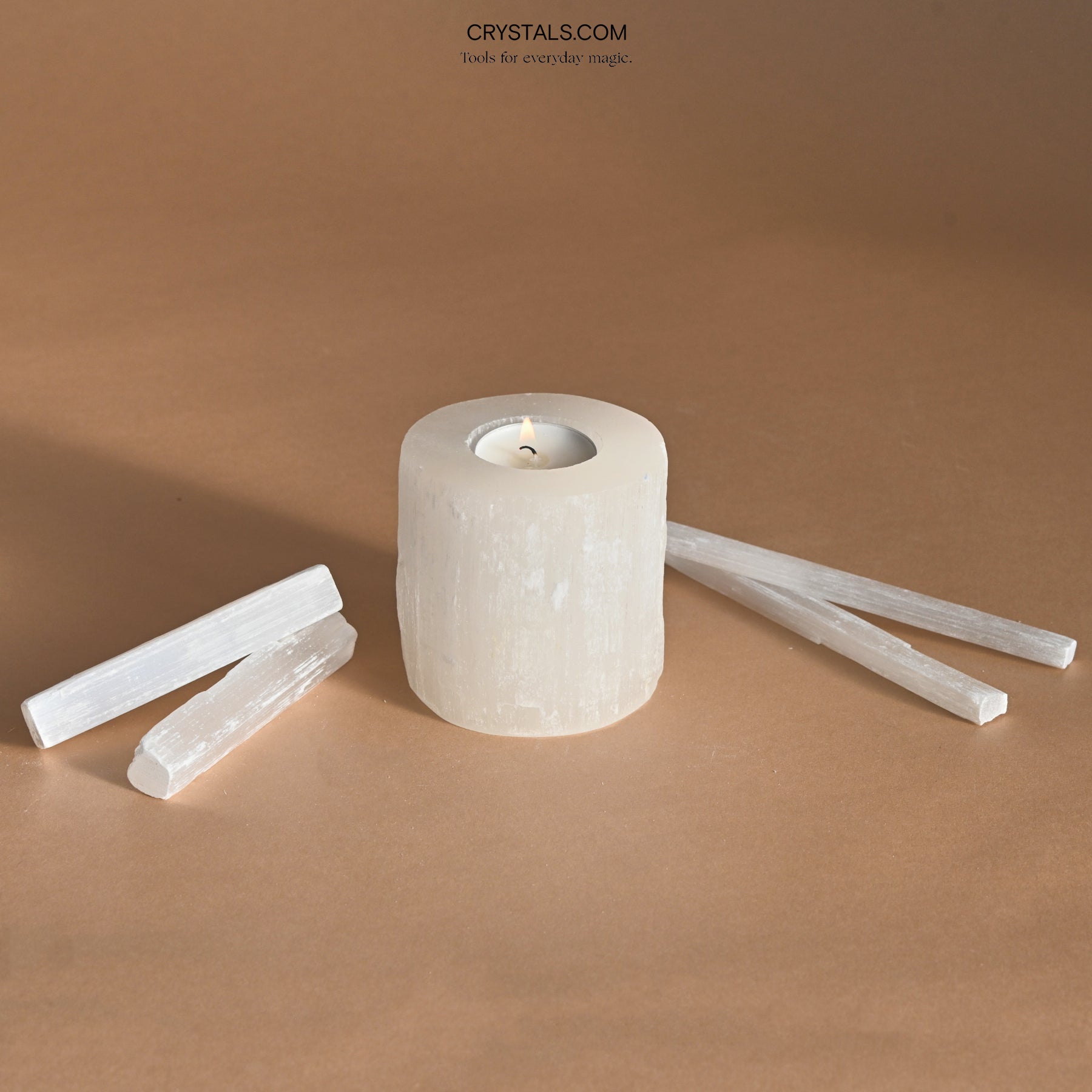
 (Selenite Cleansing Wand)


 (Amethyst Geode)

How to Test Crystal Hardness at Home
A Mohs scale test does not require a lab. With a few everyday objects, you can estimate the hardness of an unknown mineral. The principle is straightforward: if your test tool scratches the mineral, the mineral is softer than the tool. If the mineral scratches the tool, the mineral is harder.
Tips for Accurate Testing
Always test on an inconspicuous area. Scratch tests are destructive by nature. Use the back or base of a specimen, never the display face. For valuable pieces, skip the scratch test entirely and rely on other identification methods like specific gravity or optical properties.
Wipe the surface first. Dust or residue can give a false result. A clean, fresh surface is essential for accuracy.
Look for a true scratch, not a streak. Some softer minerals leave a powder trail on harder surfaces that looks like a scratch but wipes away. A real scratch catches your fingernail when you run it over the mark.
Test in both directions. If you think mineral A scratches mineral B, confirm by also trying B against A. The harder mineral should show no mark from the softer one.
Popular Crystals and Their Mohs Hardness
This reference table covers the crystals collectors search for most often. Bookmark this page as your go-to Mohs scale chart for crystal identification and care.


| Crystal | Mohs Hardness | Jewelry Safe? |
|---|---|---|
| Selenite | 2 | No — too soft |
| Calcite | 3 | No — scratches easily |
| Fluorite | 4 | Pendants only — not rings |
| Apatite | 5 | Earrings or pendants |
| Lapis Lazuli | 5 – 5.5 | Earrings or pendants |
| Moonstone | 6 – 6.5 | Earrings, pendants, protected rings |
| Amazonite | 6 – 6.5 | Earrings, pendants, protected rings |
| Jade (Nephrite) | 6 – 6.5 | Yes — very tough despite moderate hardness |
| Clear Quartz | 7 | Yes — all jewelry types |
| Amethyst | 7 | Yes — all jewelry types |
| Herkimer Diamond | 7 – 7.5 | Yes — all jewelry types |
| Tourmaline | 7 – 7.5 | Yes — all jewelry types |
| Garnet | 6.5 – 7.5 | Yes — most jewelry types |
| Topaz | 8 | Yes — highly durable |
| Ruby | 9 | Yes — exceptional durability |
| Sapphire | 9 | Yes — exceptional durability |
| Diamond | 10 | Yes — hardest natural substance |
A note on jade: While nephrite jade is only Mohs 6–6.5, it is one of the toughest gemstones due to its interlocking fibrous crystal structure. Toughness (resistance to breaking) and hardness (resistance to scratching) are different properties. Jade can withstand impacts that would shatter a harder but more brittle stone like topaz.
Why Crystal Hardness Matters for Collectors
Storage and Display
The number one rule: never store soft crystals with hard ones. A piece of quartz (7) tossed in the same pouch as selenite (2) will scratch the selenite beyond repair. Use individual soft cloth bags or lined compartments for any specimen Mohs 5 or below. For display shelves, keep softer minerals on upper shelves where they are less likely to be bumped by harder pieces.
Jewelry Suitability
Household dust often contains quartz particles (Mohs 7), which means any stone worn as jewelry will encounter micro-abrasion from dust over time. Stones below Mohs 7 will gradually lose their polish when worn daily in rings. For earrings and pendants, which see less abrasion, stones down to Mohs 5 or 6 can work well in protective settings.
Cleaning Guidelines by Hardness
Mohs 1–3 (Selenite, Calcite): Dry cloth only. Avoid water entirely. These minerals can dissolve, chip, or lose their polish with moisture or cleaning solutions.
Mohs 4–6 (Fluorite, Apatite, Moonstone): Lukewarm water with a very soft brush. No ultrasonic cleaners. Pat dry immediately.
Mohs 7+ (Quartz, Topaz, Corundum): Warm soapy water and a soft brush are generally safe. These stones resist most everyday cleaning methods well.
Build Your Collection with Confidence
Now that you understand crystal hardness, explore our curated collections. Every specimen is ethically sourced and hand-selected. Visit our crystal shop to begin your journey.
Shop Crystal Jewelry Shop All CrystalsShop Crystals by Durability
Looking for everyday wear? Crystals rated 7+ on the Mohs scale are perfect for jewelry and daily use.
Frequently Asked Questions
What is the hardest crystal?
Diamond is the hardest natural crystal, rated 10 on the Mohs scale of hardness. Among commonly collected colored gemstones, ruby and sapphire (both corundum, Mohs 9) are the hardest. In the quartz family, Herkimer diamonds reach Mohs 7–7.5.
What is the softest crystal?
Talc is the softest mineral at Mohs 1. Among popular collector crystals, selenite (Mohs 2) is one of the softest you will commonly encounter. It can be scratched with a fingernail.
Can selenite get wet?
Selenite should not get wet. It is a form of gypsum (Mohs 2), which is water-soluble. Prolonged contact with water will cause selenite to dissolve, become cloudy, or develop surface damage. Always clean selenite with a dry soft cloth only.
Is quartz harder than glass?
Yes. Quartz is Mohs 7, while glass is approximately Mohs 5.5. Quartz will easily scratch glass, which is actually one of the simplest field tests you can perform to identify quartz minerals.
What is a Herkimer diamond on the Mohs scale?
Herkimer diamonds rate 7 to 7.5 on the Mohs scale. Despite their name, they are not true diamonds (Mohs 10). They are double-terminated quartz crystals found in Herkimer County, New York, prized for their exceptional clarity and natural faceting.
Where does ruby fall on the Mohs scale?
Ruby rates 9 on the Mohs scale, making it the second hardest natural gemstone after diamond. Rubies are a variety of the mineral corundum (aluminum oxide). Their exceptional hardness makes them ideal for daily-wear jewelry, including engagement rings.
Can I do a Mohs hardness test at home?
Yes. You can perform basic hardness testing with common household items: a fingernail (2.5), copper penny (3.5), glass plate (5.5), and steel file (6.5). Test on an inconspicuous area of the specimen, as scratch testing is destructive. See our full testing guide above.
Shop Crystals by Durability
Choose stones that match how you'll use them.
Continue Learning
The Mohs scale is your foundation for understanding mineral identification and crystal care. Explore more of our educational guides and curated collections:
- Crystals 101: A Beginner's Guide
- Crystals from the USA — including New York Herkimer diamonds
- Crystal Jewelry Collection — curated pieces in durable, wearable stones
- Selenite Collection — beautiful specimens that require special care
- How to Cleanse & Charge Crystals: The Complete Guide
- Crystal Bracelet Meanings: How to Choose by Intention
Shop Crystals for This Energy
Free shipping on orders over $150