How to Care for Crystals: A Mineralogist's Guide to Cleaning and Storage
Crystal Care • Mineralogy • Collector's Guide
Every mineral has a story written in its chemistry. How it formed, what conditions it endured, what gives it color and structure. That same chemistry also determines exactly how it should, and should not, be cared for. Getting this wrong can permanently damage a specimen that took millions of years to grow.
Most crystal care advice circulating online is vague, inconsistent, or simply wrong. It tells you to "cleanse under running water" without noting that several common minerals dissolve in water. It recommends sunlight charging without mentioning that UV exposure permanently bleaches some of the most popular crystals. And it rarely distinguishes between the needs of different minerals, treating all stones as interchangeable when they are chemically and physically distinct.
This guide is different. It is organized by material science: Mohs hardness for water safety, chemical composition for light sensitivity, physical structure for cleaning technique. If you follow it, your collection will look as good in ten years as it does today.
Understanding Mohs Hardness and Water Safety
The Mohs hardness scale, developed by Friedrich Mohs in 1812, ranks minerals from 1 (talc, the softest) to 10 (diamond, the hardest). But hardness in this context refers specifically to scratch resistance, not to water solubility. These are different properties, and both matter for crystal care.
Water safety depends on two factors: the mineral's hardness (very soft minerals can be physically abraded by moving water) and its chemical solubility (some minerals simply dissolve in water, regardless of hardness). The Mohs scale is a useful starting point but not the whole picture.
Quick Reference: Water Safety by Mineral
Safe for brief rinsing (Mohs 6+, chemically stable): Quartz varieties (amethyst, citrine, rose quartz, smoky quartz, clear quartz), obsidian, labradorite, carnelian, jasper, agate, tourmaline
Avoid prolonged submersion (Mohs 3.5-5.5, or slightly soluble): Fluorite, calcite, malachite, azurite, pyrite, lapis lazuli, moonstone
Never in water (soluble, soft, or reactive): Selenite/gypsum (dissolves), halite (salt crystal, dissolves rapidly), lepidolite (soft mica, abrades), howlite (porous, absorbs), malachite (copper mineral, toxic in water)
The cardinal rule: when in doubt, do not use water. Dry cleaning methods work for every mineral without exception. Water introduces risk; dry methods do not.
Selenite: The Most Mishandled Mineral
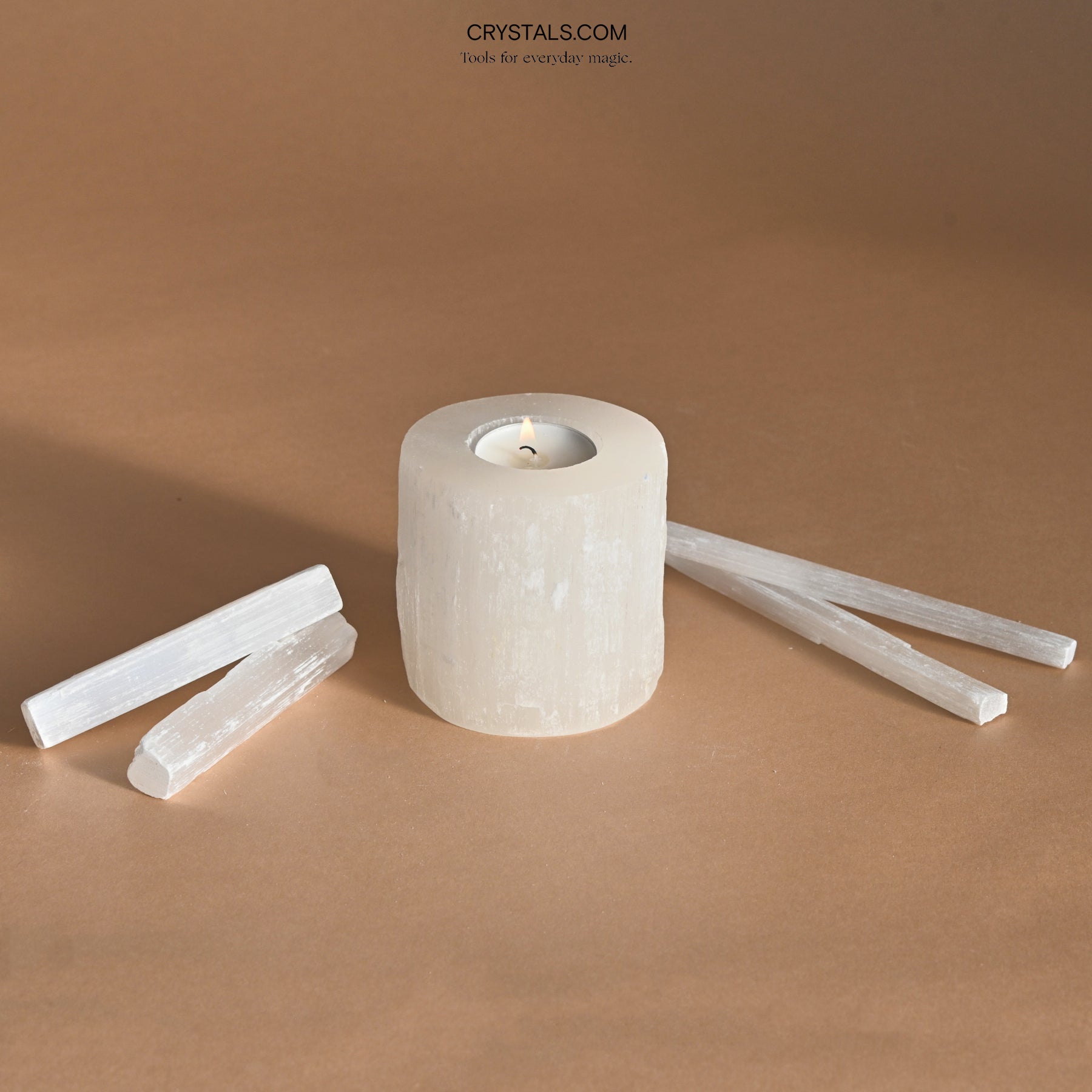
Selenite is calcium sulfate dihydrate with a Mohs hardness of 2. The "dihydrate" in its chemical name tells you everything you need to know about its relationship with water: it contains water molecules within its crystal structure. When you immerse selenite in water, the mineral does not simply get wet. It begins to dissolve.

The dissolution rate in room-temperature freshwater is slow for large specimens, so brief accidental contact will not destroy a piece. But sustained immersion, or leaving selenite in a bathroom where it is exposed to steam and humidity over months, will cause the surface to become cloudy, pitted, and rough. This damage is irreversible.
The correct way to clean selenite is with a dry, soft cloth. Microfiber works well. For more stubborn dust in crevices, a soft natural-bristle paintbrush (the kind used for watercolor painting) can get into the fibrous surface without scratching it. No liquid of any kind, including window cleaner or mineral oil, should be applied to selenite.
Salt water, which some sources recommend for cleansing crystals, is particularly destructive to selenite. Salt is corrosive to the mineral surface and accelerates dissolution. This advice, unfortunately common online, should be ignored entirely for selenite.
Sunlight Sensitivity: What Fades and What Does Not
UV light degrades color in minerals by the same mechanism it fades fabric and artwork: it breaks molecular bonds. In minerals, the bonds being broken are those that create "color centers," the quantum-level structures that absorb certain wavelengths of light and produce the color we see.
Amethyst: The violet color of amethyst is produced by iron color centers created by natural irradiation during formation. UV exposure reverses this process, restoring the iron to its pre-irradiation state. The result is that amethyst placed in a south-facing window will gradually lose its purple color, often within months in strong sunlight, becoming pale yellow or colorless. Keep amethyst out of direct sunlight entirely.

Rose quartz: The pale pink of rose quartz is produced by trace amounts of titanium, manganese, or dumortierite inclusions, depending on the source. These color agents are less sensitive to UV than amethyst's iron centers, but prolonged direct sunlight will still cause noticeable fading over time, particularly in lighter specimens.
Citrine: Natural citrine's golden color is produced by ferric iron (Fe3+) within the quartz lattice. UV exposure can cause this to shift, particularly in heat-treated citrine (former amethyst). The change may be toward a paler yellow or, in some cases, back toward purple if the original amethyst's color centers reassert. Direct sun is not recommended for citrine.
Fluorite: The vibrant colors of fluorite, purple, green, blue, yellow, are also color-center-dependent and sensitive to UV. Fluorite should never be displayed in a sunny window.
Stable in sunlight: Black tourmaline, obsidian (volcanic glass, no color centers to degrade), smoky quartz (the grey color is stable), labradorite, carnelian, and most opaque minerals are relatively stable in sunlight. Obsidian spheres in a sunny window will become very hot, which can cause thermal fracturing over time, but the color is unaffected.
Proper Dusting Technique for Raw Specimens
Raw crystal specimens, particularly clusters with many small terminations and matrix material, are dust traps. The crevices between crystals collect fine particulate matter that dulls the visual impact of the specimen over time. Removing this dust without damaging the crystals requires the right tools and some patience.

The best tool for dusting raw crystal clusters is a soft natural-bristle brush, 1/2 inch to 1 inch wide, of the kind sold for watercolor or acrylic painting. These brushes are soft enough not to scratch crystal faces but stiff enough to dislodge particulate from crevices. Work gently, with light strokes in the direction of the crystal terminations rather than against them.
A can of compressed air (the kind used for cleaning electronics) is effective for deep crevices in complex clusters where a brush cannot reach. Hold the can upright and use short bursts from a distance of 3 to 4 inches. Do not tilt the can, which can release liquid propellant.
For polished specimens (towers, spheres, freeforms), a clean microfiber cloth works best. Wipe in one direction rather than circular motions, which can introduce micro-scratches on softer minerals. For fingerprints on quartz varieties (Mohs 7), a small amount of water on the cloth is fine; dry immediately.
Never use: household glass cleaners (contain ammonia, which can damage some minerals), metal tools of any kind, abrasive cloths, or paper towels (which are surprisingly abrasive and will scratch soft minerals like selenite and howlite).
Storage: Protecting What You Are Not Displaying
Not every piece in a collection needs to be on display at once. Rotating specimens keeps the display feeling fresh and protects pieces from unnecessary light exposure and dust accumulation. How you store pieces when they are not displayed matters as much as how you display them.
Individual wrapping for raw specimens. Raw crystal terminations are fragile and will chip if specimens are stored in contact with each other. Wrap each raw piece individually in unbleached cotton muslin or tissue paper before storing. Never use newspaper, which leaves ink residue, or plastic bags, which trap moisture.
Flat, padded trays for clusters. A drawer lined with velvet or craft foam, with specimens laid in a single layer, is ideal. The velvet prevents movement and absorbs vibration that can chip delicate crystal points.
Dark, cool, and dry. Most minerals are stable in normal indoor conditions, but prolonged exposure to UV (sunlight through a storage container) can affect color-sensitive stones even in storage. Store in a drawer or opaque box rather than a glass-fronted display case placed in direct light.
Separate hard from soft. Quartz (Mohs 7) will scratch calcite (Mohs 3), fluorite (Mohs 4), or selenite (Mohs 2) if they are stored touching each other. Organize by hardness group or wrap each piece individually to prevent contact damage.
Control humidity for hygroscopic minerals. Some minerals, halite (table salt), selenite, and certain zeolites, are hygroscopic: they absorb moisture from the air. In humid climates, store these in containers with silica gel packets to keep relative humidity below 50 percent.
The Things Not to Do: A Summary
Common Mistakes That Damage Crystals
• Soaking selenite, howlite, malachite, or any soft or porous mineral in water
• Using salt water on any mineral (especially selenite, which it actively dissolves)
• Placing amethyst, rose quartz, fluorite, or citrine in direct sunlight
• Storing specimens in contact with each other without protection
• Using paper towels, coarse cloths, or abrasive materials to clean soft minerals
• Applying household cleaning sprays to any mineral without verifying compatibility
• Leaving any mineral near an ultrasonic diffuser where water mist will reach it
For guidance on displaying your cleaned and stored collection to its best advantage, read our complete crystal styling guide. For room-specific recommendations, including which minerals belong in which rooms, see our home protection and cleansing guide.
Discover Your Human Design
Crystals amplify energy — but do you know your unique energy type? Human Design reveals how you're wired to make decisions, work, and rest.
Explore Human DesignGet 10% Off Your First Order
Plus early access to new arrivals, collector drops, and crystal guides. Join 15,000+ crystal lovers.
Shop Crystals for This Energy
Free shipping on orders over $150