Six Minerals for the Bedroom: A Guide to Crystals for Rest
Bedroom Design • Mineralogy • Interior Styling
The bedroom is the most private room in a home, the one most deserving of intentionality. What you place there, what you look at last before sleep and first upon waking, shapes the quality of those transitions more than we tend to acknowledge.
The minerals most associated with rest share certain visual qualities: softer colors, gentle translucency, rounded or flowing forms rather than sharp geometric ones. These are not coincidences. The stones that have been placed in bedrooms across cultures and centuries tend to be visually quiet, not demanding attention but offering it a soft landing.
What follows is a mineralogically grounded tour of six specimens most suited to the bedroom environment, with notes on their chemistry, their visual character, and how to place them so the room feels considered rather than cluttered.
1. Amethyst: Iron, Violet, and the Science of Color
Amethyst is a macrocrystalline variety of quartz, silicon dioxide, colored by trace iron and natural irradiation within the earth. The violet color is produced when iron impurities in the crystal lattice are irradiated during formation, creating color centers that absorb the yellow-green portion of the visible spectrum and transmit violet. The specific shade depends on the concentration of iron and the intensity of natural irradiation: pale lilac specimens come from low-iron deposits, while deep Siberian-quality purple indicates higher iron concentration.
The finest amethyst historically came from the Ural Mountains of Russia, which is why the deep purple standard is called "Siberian." Today the major sources are Brazil, Uruguay, and Zambia, each producing recognizably different material: Brazilian amethyst tends toward medium violet with white matrix, Uruguayan specimens are often darker with tighter crystal growth, and Zambian material produces a distinctive bluish-violet with exceptional clarity.

For the bedroom, amethyst is among the most visually appropriate stones available. Its violet tones pair naturally with the soft whites, greys, and warm neutrals of most bedroom palettes. A large raw cluster on the nightstand has enough visual presence to anchor the space without overwhelming it. A tall tower on a dresser adds vertical interest. Both work; the choice depends on whether you prefer the wildness of a natural cluster or the architectural quality of a formed tower.
Critical care note: amethyst fades in sustained UV exposure. The iron color centers that produce the violet are sensitive to high-energy light, which can restore them to their pre-irradiation, colorless state. Keep amethyst out of direct sunlight, especially south-facing windows. Display in ambient or artificial light.
2. Lepidolite: Lithium-Bearing Mica
Lepidolite is one of the more chemically interesting minerals commonly available in the gem trade. It is a phyllosilicate mineral in the mica group, specifically a lithium-bearing potassium aluminum silicate with fluorine. The lithium content is real, measurable, and substantial: lepidolite is one of the primary commercial sources of lithium ore. The mineral's lavender to rose-lilac color is produced by manganese impurities within the sheet silicate structure.
The mica structure gives lepidolite its characteristic appearance: it grows in stacked, scaly sheets with a distinctive pearlescent luster that catches light differently at every angle. When lepidolite is polished into a freeform shape or sphere, the schiller effect, that shifting shimmer across the surface, makes it one of the most visually active stones in subdued light conditions. In low bedroom lighting, a lepidolite freeform looks almost iridescent.
The major sources are Brazil, Russia, and the state of Minas Gerais in particular, where lepidolite occurs alongside tourmaline and quartz in complex granite pegmatites. Specimens from California's Pala District are historically notable.
Lepidolite has a Mohs hardness of 2.5 to 3, which means it scratches easily. Keep it on a soft surface, a velvet tray or a fabric-lined dish, rather than directly on wood or marble where it can abrade. A polished lepidolite piece on the nightstand, catching the warm light of a bedside lamp, is among the most quietly beautiful things you can place in a bedroom.
3. Selenite: Softness and Light
Selenite, the crystalline variety of gypsum (calcium sulfate dihydrate), has a Mohs hardness of 2, which makes it among the softest minerals discussed here. What it lacks in hardness it compensates for in optical impact. The fibrous internal structure of selenite scatters and diffuses light in a way that no other common mineral replicates: a backlit selenite lamp produces a warm, even glow that is genuinely different from any artificial light source.

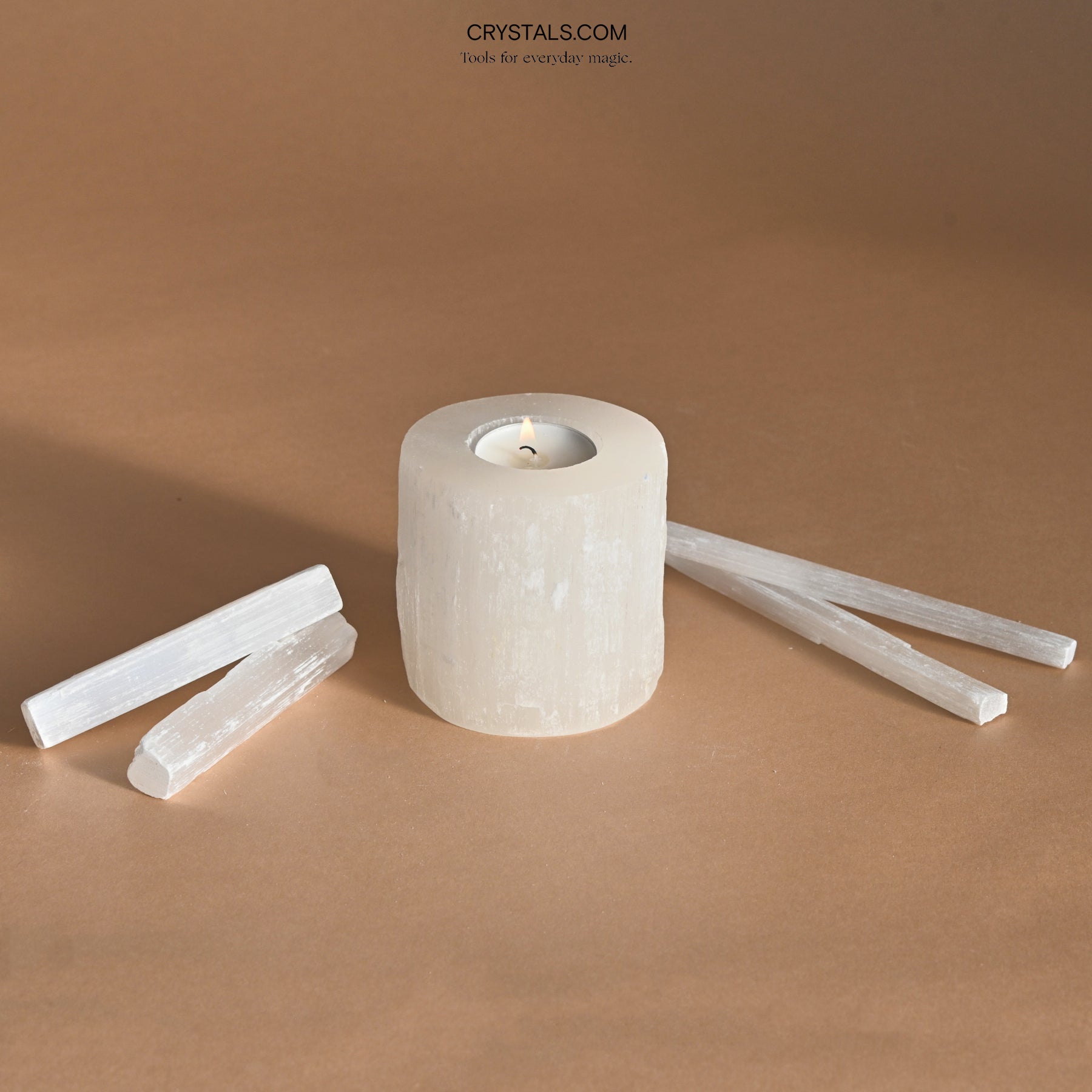
For a bedroom, selenite works particularly well in its larger forms: wands, towers, and flat slabs. A long selenite wand placed horizontally across a dresser is both sculptural and minimal. A selenite lamp beside the bed replaces a conventional bedside lamp with something that doubles as a display object during the day.
The critical care note applies here especially: selenite dissolves in water and is damaged by sustained humidity. Bathrooms are not suitable for selenite unless it is enclosed. In a bedroom with normal humidity, selenite requires nothing beyond occasional dry dusting with a soft cloth. Never use water or liquid cleaners on it.
4. Moonstone: Feldspathic Adularescence
Moonstone is a variety of orthoclase feldspar, potassium aluminum silicate, distinguished by its adularescence: a floating, billowing optical phenomenon caused by the diffraction of light between alternating layers of feldspar with slightly different compositions. As you move a polished moonstone cabochon, the blue or white sheen appears to roll across the interior of the stone, like light moving beneath a membrane. This is not a surface effect; it originates from within the stone's layered microstructure.
The finest moonstone historically came from Sri Lanka, where blue-sheened specimens with high transparency were mined for centuries. Indian moonstone tends to show a more white or silver sheen on a more opaque body. Rainbow moonstone, despite the name, is actually a variety of labradorite rather than true orthoclase moonstone, but it displays similar adularescence with occasional spectral flashes.
Moonstone's Mohs hardness is 6 to 6.5, which makes it durable enough for display without special precautions. In a bedroom context, a polished moonstone sphere or freeform on the nightstand catches lamp light in a way that is genuinely mesmerizing, the adularescence shifts with every small movement of the light source, making it one of the few minerals that is more interesting to observe indoors than in daylight.
5. Smoky Quartz: The Grounding Dark
In the bedroom, smoky quartz serves a different visual function than in a workspace. Here its translucent grey-brown tones act as a visual anchor, the dark counterpoint to the softer lavenders and whites of amethyst and selenite. A bedroom styled entirely in soft, pale minerals can feel slightly insubstantial. A smoky quartz tower or cluster provides the visual weight that makes the grouping feel grounded.

Smoky quartz is also one of the most stable minerals for indoor display: it does not fade in sunlight, is unaffected by humidity, and requires only occasional dusting. Its Mohs hardness of 7 means it is scratch-resistant and can sit directly on wood or stone surfaces without damage to either.
6. Howlite: Calcium Borosilicate and the Texture of Quiet
Howlite is a calcium borosilicate hydroxide mineral, typically white to grey with distinctive grey-black veining that resembles the grain pattern in white marble. It has a Mohs hardness of 3.5, a chalky, matte surface texture, and a specific gravity low enough that it feels almost light in the hand compared to quartz.
Howlite is frequently dyed blue to imitate turquoise, a common practice that is worth knowing about when purchasing, but undyed white howlite is a genuinely beautiful mineral in its own right. Its white and grey tones make it one of the most versatile bedroom minerals, pairing with virtually any color palette without asserting its own.
A polished howlite sphere on a white nightstand, in a room with white bedding, creates a tonal, textural composition that is calming precisely because it does not demand visual engagement. It is there, quiet and present, like a smooth stone from a riverbed.
Bedroom Placement: Nightstand, Dresser, and Shelf
The nightstand is the most considered surface in the bedroom. Whatever lives there is what you see first in the morning and last at night. One or two carefully chosen minerals work far better than a crowded collection. A single amethyst tower beside a lamp, or a selenite wand on a small tray with a candle, is a complete composition. Resist the urge to add more.
The dresser accommodates larger groupings. Three minerals of varying height, a tall amethyst cluster, a medium smoky quartz tower, a small moonstone sphere, arranged at slightly different depths from front to back, creates a satisfying three-dimensional composition that reads well from across the room.
On a shelf, consider the interplay with books and other objects. Minerals should not be segregated from the rest of the shelf's contents; they look best when integrated into the arrangement, where the contrast between the organic form of a crystal and the geometric spine of a book creates the kind of visual tension that makes a shelf interesting to look at.
For detailed care instructions for each of these minerals, including which can tolerate water and which cannot, read our complete crystal care guide. For the workspace equivalent of this guide, see our desk crystal guide.
Discover Your Human Design
Crystals amplify energy — but do you know your unique energy type? Human Design reveals how you're wired to make decisions, work, and rest.
Explore Human DesignGet 10% Off Your First Order
Plus early access to new arrivals, collector drops, and crystal guides. Join 15,000+ crystal lovers.
Shop Crystals for This Energy
Free shipping on orders over $150