Crystals have been collected, traded, and admired for thousands of years. From ancient civilizations who carved amulets from lapis lazuli to modern collectors who display museum-quality specimens, the fascination with crystals and minerals is timeless. But what draws people to specific stones? Often, it starts with meaning.
This guide covers the meanings and properties of 20 of the most popular crystals, organized alphabetically for easy reference. Each entry includes verified mineralogical data (color, Mohs hardness, and notable origins) alongside the qualities each stone is traditionally associated with. Whether you are building your first collection or looking for a specific stone, use this page as your starting point.
New to crystals? Start with our guide to the 11 best crystals for beginners, or take the Crystal Quiz to find the right stone for you.
Quick Jump: A-Z Index
Crystal Meanings: The Top 20 Stones
Amethyst

Amethyst Geode on Stand — Shop Amethyst
Amethyst is a variety of quartz that gets its purple color from trace amounts of iron and natural irradiation. It has been prized since antiquity and was once considered as valuable as diamonds. Today, amethyst is one of the most widely recognized crystals in the world, associated with calm, clarity, and mental focus.
Color: Purple to violet | Hardness: 7 | Notable Origins: Brazil, Uruguay, Zambia
Known for: Promoting calm and mental clarity. Amethyst is one of the most popular stones for meditation and is often placed in living spaces for its calming presence.
Aquamarine
Aquamarine is a blue to blue-green variety of beryl, the same mineral family as emerald. Its name comes from the Latin "aqua marina," meaning sea water. Historically, sailors carried aquamarine as a talisman for safe voyages. The finest specimens come from Brazilian pegmatites, where crystals can grow to impressive sizes.
Color: Light blue to blue-green | Hardness: 7.5-8 | Notable Origins: Brazil, Pakistan, Madagascar
Known for: Communication and courage. Aquamarine is associated with clear self-expression and is a traditional gift for milestone anniversaries.
Black Tourmaline
Black tourmaline (also called schorl) is the most common variety of tourmaline and one of the most popular protective stones. It is a boron silicate mineral that forms in prismatic crystals, often with distinctive vertical striations along its length. Black tourmaline is piezoelectric and pyroelectric, meaning it generates an electrical charge under pressure or temperature change.
Color: Black | Hardness: 7-7.5 | Notable Origins: Brazil, Sri Lanka, Africa
Known for: Protection and grounding. Black tourmaline is one of the most sought-after stones for creating a sense of security and stability in a space.
Carnelian

Carnelian Freeform — Shop Carnelian
Carnelian is a translucent variety of chalcedony (microcrystalline quartz) colored by iron oxide impurities. It ranges from pale orange to deep reddish-brown and has been used in jewelry and seal rings since the Bronze Age. Ancient Egyptians called it "the setting sun" and associated it with vitality and power.
Color: Orange to reddish-brown | Hardness: 6.5-7 | Notable Origins: India, Brazil, Uruguay
Known for: Motivation and creative energy. Carnelian is associated with confidence, bold action, and overcoming procrastination.
Citrine
Citrine is a yellow to golden-orange variety of quartz. Natural citrine is relatively uncommon; much of what is sold commercially is heat-treated amethyst or smoky quartz. True natural citrine tends to be a pale, smoky yellow and is found primarily in Brazil, Madagascar, and the Congo. Its name derives from the French word "citron," meaning lemon.
Color: Pale yellow to golden orange | Hardness: 7 | Notable Origins: Brazil, Madagascar, Democratic Republic of Congo
Known for: Abundance and optimism. Citrine is often called "the merchant's stone" and is traditionally associated with prosperity and positive energy.
Clear Quartz

Clear Quartz Tower — Shop Clear Quartz
Clear quartz is pure silicon dioxide (SiO2) and one of the most abundant minerals on Earth. It forms in a wide range of geological environments and can be found on every continent. Clear quartz is piezoelectric, which is why it has been used in watches, electronics, and radio transmitters for decades. Its clarity and versatility make it a foundational stone for any collection.
Color: Colorless, transparent | Hardness: 7 | Notable Origins: Brazil, Arkansas (USA), Madagascar
Known for: Amplification and clarity. Clear quartz is often called "the master crystal" because it is associated with enhancing the properties of other stones nearby.
Fluorite

Rainbow Fluorite Point — Shop Fluorite
Fluorite (calcium fluoride) is one of the most colorful minerals in the world, occurring in virtually every color of the spectrum. It is the defining mineral for a hardness of 4 on the Mohs scale. The word "fluorescence" actually derives from fluorite, as many specimens glow under ultraviolet light. Fluorite often forms in perfect cubes and octahedrons, making it a favorite among mineral collectors.
Color: Purple, green, blue, yellow, clear (all colors) | Hardness: 4 | Notable Origins: China, Mexico, South Africa, England
Known for: Focus and mental organization. Fluorite is associated with structured thinking and decision-making, and is a popular desk stone for students and professionals.
Garnet
Garnet is not a single mineral but a group of closely related silicate minerals that share a common crystal structure. The most familiar variety is almandine, the deep red garnet used in jewelry for centuries. Garnets also occur in orange (spessartine), green (tsavorite, demantoid), and even color-changing varieties. They have been found in Bronze Age jewelry and were widely traded along ancient routes.
Color: Red, orange, green, pink (varies by species) | Hardness: 6.5-7.5 | Notable Origins: India, Sri Lanka, Tanzania, Mozambique
Known for: Strength and perseverance. Garnet is the January birthstone and is traditionally associated with commitment and enduring energy.
Hematite
Hematite is an iron oxide mineral (Fe2O3) and one of the most important iron ores on the planet. When polished, it has a striking metallic silver-black luster, but in its raw or powdered form it is blood-red, which is how it got its name (from the Greek "haima," meaning blood). Hematite has been used as a pigment for cave paintings dating back over 40,000 years.
Color: Metallic silver-black to reddish-brown | Hardness: 5-6.5 | Notable Origins: Brazil, Australia, South Africa, Canada
Known for: Grounding and focus. Hematite is associated with staying centered and present, and is one of the most popular stones worn as crystal bracelets.
Jade
Jade actually refers to two distinct minerals: nephrite (a calcium magnesium silicate) and jadeite (a sodium aluminum silicate). Both are exceptionally tough due to their interlocking crystal structures, which made jade ideal for tools and weapons in prehistoric cultures. Jade holds enormous cultural significance in Chinese, Mesoamerican, and Maori traditions, where it has been carved for thousands of years.
Color: Green (also white, lavender, black) | Hardness: 6-7 | Notable Origins: Myanmar, Guatemala, Canada, New Zealand
Known for: Harmony and balance. Jade is traditionally associated with good fortune, wisdom, and longevity across many cultures. Learn more in our in-depth jade guide.
Labradorite

Labradorite Flat Polished — Shop Labradorite
Labradorite is a feldspar mineral known for its remarkable optical effect called labradorescence, a vivid play of iridescent blue, green, gold, and sometimes purple light that appears to float within the stone. This phenomenon is caused by light diffracting between layers of the mineral's internal structure. It was first formally described in 1770 from specimens found in Labrador, Canada.
Color: Gray with blue, green, gold iridescence | Hardness: 6-6.5 | Notable Origins: Canada, Madagascar, Finland
Known for: Transformation and intuition. Labradorite is associated with navigating change and discovering hidden potential.
Lapis Lazuli

Lapis Lazuli Sphere — Shop Lapis Lazuli
Lapis lazuli is a deep blue metamorphic rock composed primarily of lazurite, with inclusions of calcite (white) and pyrite (gold flecks). It is not technically a single mineral but a rock. Lapis has been mined in the mountains of Afghanistan for over 6,000 years and was ground into the pigment ultramarine, once more expensive than gold, by Renaissance painters.
Color: Deep blue with gold pyrite flecks | Hardness: 5-6 | Notable Origins: Afghanistan, Chile, Russia
Known for: Wisdom and truth. Lapis lazuli has been associated with royalty, knowledge, and honest communication since the time of the ancient Egyptians and Sumerians.
Malachite

Malachite Sphere — Shop Malachite
Malachite is a copper carbonate hydroxide mineral known for its vivid green color and distinctive banded patterns. It forms in the oxidation zones above copper deposits and has been mined as a copper ore and ornamental stone for thousands of years. The Winter Palace in Saint Petersburg features entire rooms lined with malachite columns and panels. Note: malachite contains copper and should never be placed in water or used to make elixirs. See our guide to crystals and water for more details.
Color: Green with banded patterns | Hardness: 3.5-4 | Notable Origins: Democratic Republic of Congo, Zambia, Australia
Known for: Transformation and positive change. Malachite is associated with growth, breaking old patterns, and embracing new beginnings.
Moonstone

Rainbow Moonstone Sphere — Shop Moonstone
Moonstone is a feldspar mineral known for its adularescence, a billowing, moonlight-like glow that moves across the stone's surface as it is turned. This optical effect is caused by light scattering between microscopic layers of orthoclase and albite within the crystal. Moonstone has been used in jewelry for millennia and was especially popular during the Art Nouveau period.
Color: White, peach, gray with blue or white sheen | Hardness: 6-6.5 | Notable Origins: Sri Lanka, India, Madagascar
Known for: New beginnings and intuition. Moonstone is associated with cycles, inner reflection, and embracing the natural rhythms of life.
Obsidian
Obsidian is a naturally occurring volcanic glass formed when lava cools rapidly with minimal crystal growth. It is not technically a mineral but a mineraloid. Obsidian was one of the first materials used for cutting tools and weapons, and obsidian blades can be sharper than modern surgical steel at the molecular level. Varieties include snowflake obsidian (with cristobalite inclusions), rainbow obsidian, and mahogany obsidian.
Color: Black (also with snowflake, rainbow, or mahogany patterns) | Hardness: 5-5.5 | Notable Origins: Mexico, Iceland, Italy, USA
Known for: Protection and self-reflection. Obsidian is associated with cutting through illusion and gaining honest perspective on oneself and one's surroundings.
Pyrite

Pyrite Tower — Shop Pyrite
Pyrite is an iron sulfide (FeS2) and the most common sulfide mineral on Earth. Its metallic gold luster earned it the nickname "fool's gold," though experienced collectors know pyrite is a remarkable mineral in its own right. It forms in perfect cubes, pyritohedrons, and massive clusters. Spanish pyrite from Navajun is famous worldwide for its naturally formed cubic crystals that look almost machine-cut.
Color: Metallic gold | Hardness: 6-6.5 | Notable Origins: Spain, Peru, Italy, USA
Known for: Confidence and willpower. Pyrite is associated with determination, shielding against negativity, and encouraging a strong sense of self-worth.
Rose Quartz

Rose Quartz Sphere — Shop Rose Quartz
Rose quartz is a pink variety of quartz that gets its color from trace amounts of titanium, iron, or manganese. It typically forms in massive habits (without visible crystal faces) rather than individual pointed crystals, though rare crystallized specimens do exist and are highly prized. Rose quartz has been used in love talismans and beauty rituals since 7,000 BCE, with beads found in ancient Mesopotamia.
Color: Pale pink to rose | Hardness: 7 | Notable Origins: Brazil, Madagascar, South Dakota (USA)
Known for: Love and compassion. Rose quartz is the most popular stone associated with love of all kinds, including self-love, friendship, and romantic connection.
Selenite
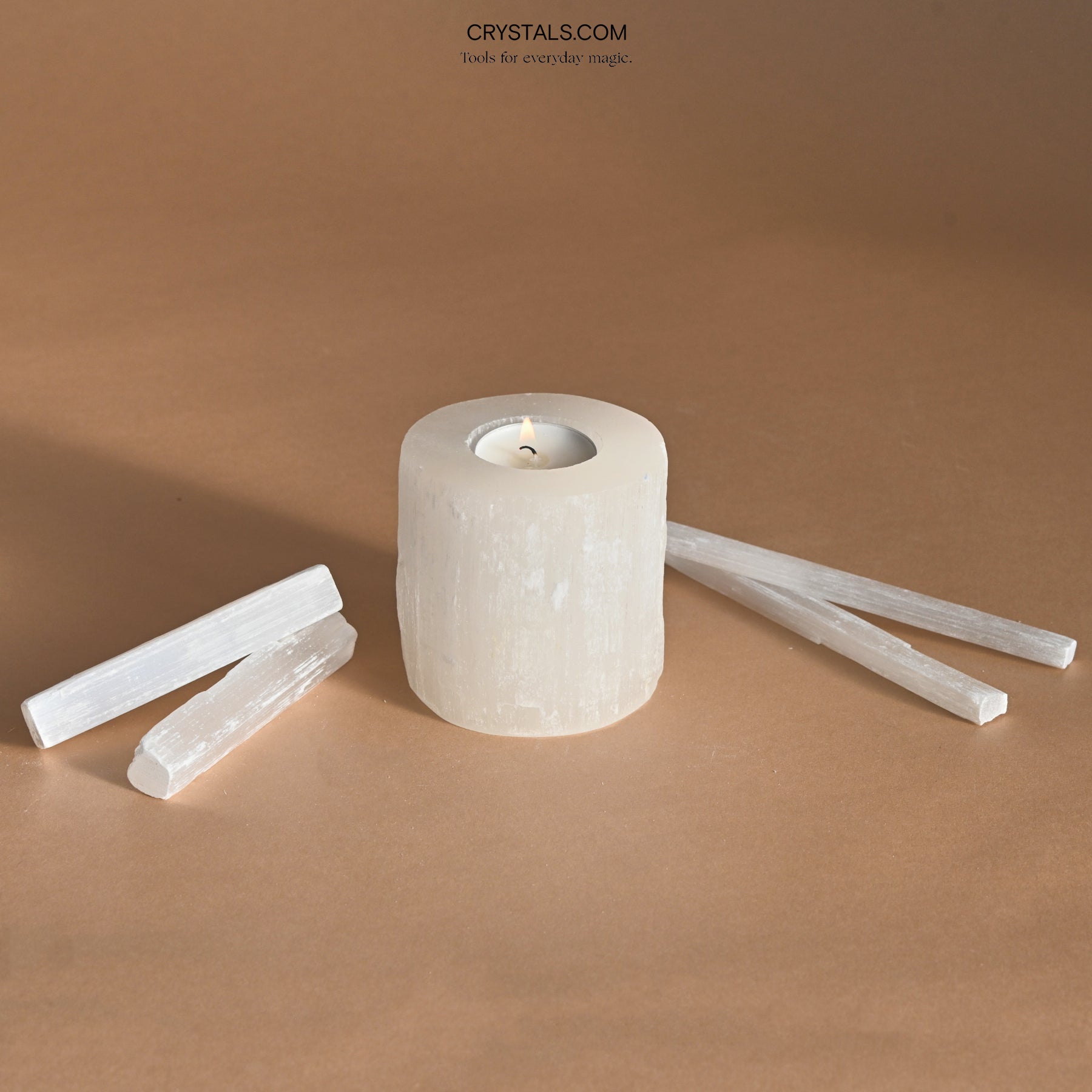
Selenite is a crystallized form of gypsum (calcium sulfate dihydrate) known for its translucent, pearly white appearance and distinctive fibrous structure. It is named after the Greek goddess of the moon, Selene. Selenite is very soft (just 2 on the Mohs scale) and water-soluble, so it should never be submerged. The Cave of the Crystals in Naica, Mexico, contains selenite crystals over 36 feet long, among the largest natural crystals ever found. For more on which stones to keep dry, see our crystals and water guide.
Color: White, translucent, pearly | Hardness: 2 | Notable Origins: Morocco, Mexico, Australia
Known for: Clarity and cleansing. Selenite is widely used to clear and reset the energy of a space and is a popular choice for charging plates and display pieces. Learn more about hardness levels in our Mohs Scale guide.
Smoky Quartz
Smoky quartz gets its brown to black color from free silicon formed by natural irradiation of silicon dioxide. It is the national gem of Scotland, where it has been set in brooches and kilt pins for centuries. Unlike artificially irradiated dark "smoky" quartz, natural specimens tend to have a warm, transparent brown tone and are found in alpine cavities, pegmatites, and granite formations.
Color: Light brown to nearly black | Hardness: 7 | Notable Origins: Brazil, Switzerland, Colorado (USA), Madagascar
Known for: Grounding and stress relief. Smoky quartz is associated with releasing tension and creating a sense of stability and calm.
Tiger's Eye

Tiger's Eye Sphere — Shop Tiger's Eye
Tiger's eye is a chatoyant gemstone, meaning it displays a silky band of light that moves across its surface (an effect called chatoyancy). It forms when crocidolite (blue asbestos) fibers are gradually replaced by silica while maintaining the fibrous structure. The result is the signature golden-brown stripes. Blue tiger's eye (hawk's eye) retains the original blue color of the crocidolite before iron oxidation changes it to gold.
Color: Golden-brown with banded chatoyancy | Hardness: 6.5-7 | Notable Origins: South Africa, Australia, India
Known for: Courage and personal power. Tiger's eye is associated with confidence, clear decision-making, and staying grounded under pressure.
How to Choose the Right Crystal
With so many options, choosing a crystal can feel overwhelming. Here are three practical approaches:
1. Start with intention. Think about what you want to invite into your life. Looking for calm? Consider amethyst or selenite. Need motivation? Carnelian or citrine might be a good fit.
2. Go with what you are drawn to. Many collectors find that the stone they are most attracted to visually is the one they connect with most. Trust your instinct.
3. Take the quiz. Our Crystal Quiz asks a few simple questions and recommends a stone based on your answers. It takes about 60 seconds.
If you are just getting started, our beginner's guide breaks down the best entry-level stones and how to use them. You can also browse the full Crystal Archive for detailed entries on hundreds of minerals.
All orders over $150 ship free within the US. Every crystal at Crystals.com is genuine and sourced directly from mines and trusted dealers worldwide.
Frequently Asked Questions
What are the most popular crystals and their meanings?
The most popular crystals include amethyst (calm and clarity), rose quartz (love and compassion), clear quartz (amplification), black tourmaline (protection), and citrine (abundance). Each stone has unique mineralogical properties and cultural associations that have developed over centuries.
How do I know which crystal is right for me?
Start with your intention or the quality you want to bring into your life. You can also go by visual attraction, as many people find they are drawn to the stone they need most. For a guided approach, try our Crystal Quiz.
Can crystals go in water?
Some can, but many cannot. Stones with a Mohs hardness below 5 (like selenite at 2) or those containing copper (like malachite) should never be submerged. Read our full guide to crystals and water for a complete breakdown.
What is the Mohs hardness scale?
The Mohs scale ranks minerals from 1 (talc, softest) to 10 (diamond, hardest) based on scratch resistance. It is important for knowing how to care for your crystals and which stones are durable enough for jewelry. See our complete Mohs Scale guide for details.
How do I tell if a crystal is real?
Genuine crystals usually feel cool to the touch, are heavier than glass imitations, and have natural imperfections. Uniform color, air bubbles, and extremely low prices are warning signs of fakes. We have a full article on how to tell if a crystal is real.
Are the crystals at Crystals.com genuine?
Yes. Every crystal sold at Crystals.com is genuine and sourced directly from mines and established dealers around the world. We do not sell synthetic, lab-created, or imitation stones. All orders over $150 ship free within the US.