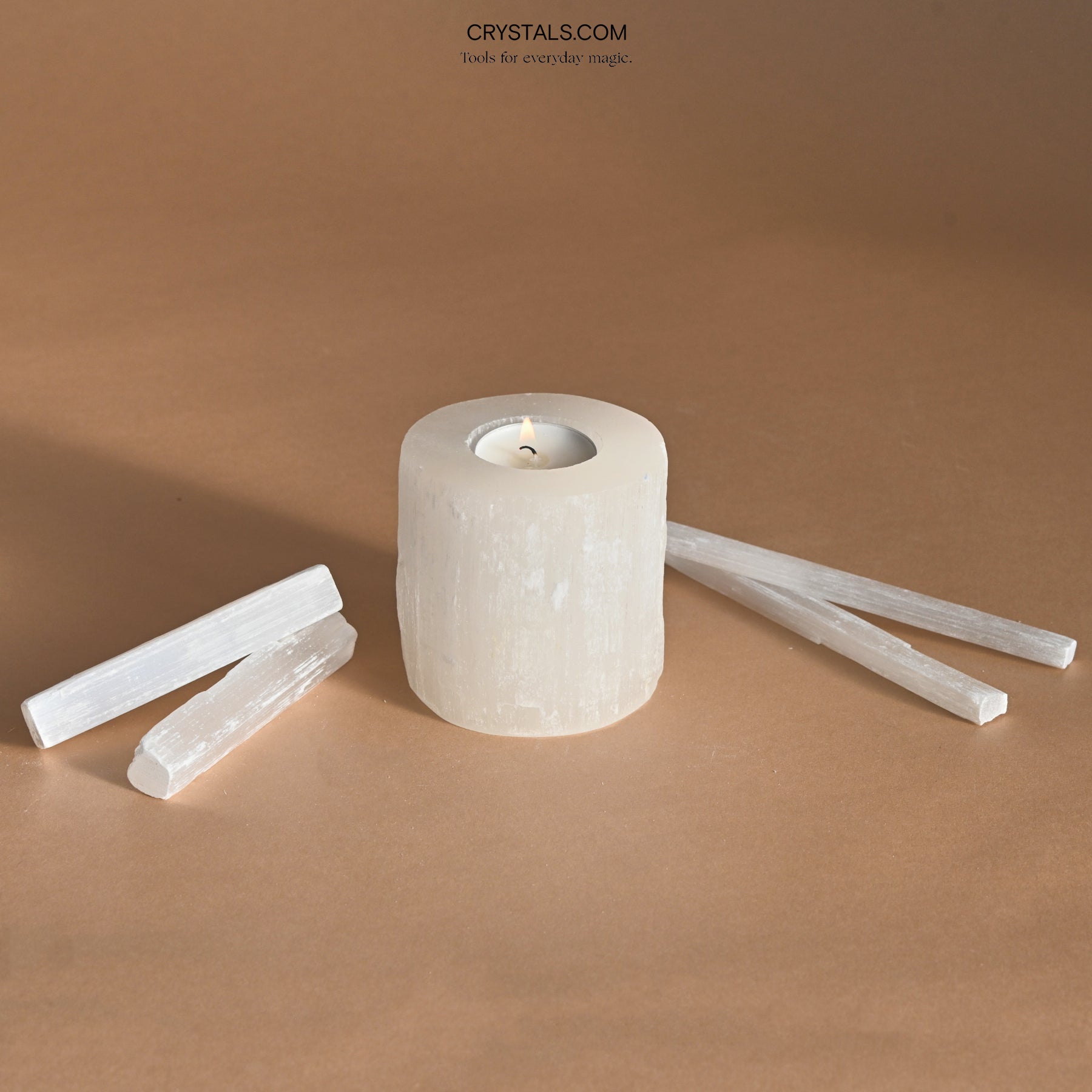
You found a beautiful stone at a gem show, inherited a collection, or picked up a tumbled stone that caught your eye. Now you want to know: what crystal is this?
Crystal identification is part science, part practice. Geologists and gemologists use a combination of physical properties to narrow down thousands of mineral species to a single match. The good news is that you do not need a geology degree to get started. With a few simple tests and a trained eye for color, luster, and form, you can confidently identify the most common crystals and minerals.
This guide covers the five key properties used in crystal identification, walks through 30+ popular stones organized by color, highlights common look-alikes, and shares the tools that make identification faster and more accurate.

Amethyst Cluster — Shop Collection
Why Crystal Identification Matters
Knowing what you have is the first step to caring for it properly. A selenite specimen will dissolve in water, while clear quartz is perfectly safe to rinse. Fluorite scratches easily and needs gentle handling. Pyrite can oxidize if left in humid conditions. Proper identification protects your collection.
Identification also protects your wallet. The mineral market includes a significant amount of mislabeled, dyed, and synthetic material. Understanding how to evaluate a stone on its own merits gives you the confidence to make informed purchases and spot imitations before you buy.
If you are just starting your collection, our beginner's guide to crystals is a helpful companion to this article.
The 5 Key Properties for Crystal Identification
Professional mineralogists rely on a consistent set of physical properties to identify specimens. These five are the most practical for collectors to use at home.
1. Color
Color is the first thing most people notice, and it is a useful starting point. However, color is the least reliable single identifier. Many minerals share the same color. Amethyst, fluorite, and lepidolite can all appear purple. Green stones include everything from aventurine to malachite to jade. Trace elements, inclusions, and even lighting conditions can shift a mineral's apparent color.
Use color to narrow the field, then confirm identity with additional properties.
2. Hardness (Mohs Scale)
The Mohs scale of mineral hardness ranks minerals from 1 (talc) to 10 (diamond) based on their resistance to scratching. This is one of the most definitive identification tools available to collectors.
| Mohs Hardness | Reference Mineral | Quick Test |
|---|---|---|
| 1 | Talc | Scratched by fingernail |
| 2 | Gypsum | Scratched by fingernail |
| 3 | Calcite | Scratched by a copper coin |
| 4 | Fluorite | Scratched by a steel knife (easily) |
| 5 | Apatite | Scratched by a steel knife (with effort) |
| 6 | Orthoclase Feldspar | Scratches glass |
| 7 | Quartz | Scratches glass easily |
| 8 | Topaz | Scratches quartz |
| 9 | Corundum | Scratches topaz |
| 10 | Diamond | Scratches everything |
A simple scratch test can immediately separate soft minerals like selenite (Mohs 2) from harder ones like quartz (Mohs 7). For a deep dive, read our complete Mohs scale guide.
3. Luster
Luster describes the way light interacts with a mineral's surface. It is independent of color and provides strong identification clues.
- Vitreous (glassy): The most common luster. Quartz, garnet, and fluorite all display vitreous luster.
- Waxy: A soft, slightly greasy sheen. Common in jade (nephrite), chalcedony, and some agates.
- Metallic: A mirror-like reflectiveness seen in pyrite, hematite, and galena.
- Pearly: A soft iridescence similar to the inside of a shell. Moonstone and some micas exhibit pearly luster.
- Silky: A fibrous, thread-like sheen seen in tiger's eye and satin spar selenite.
- Adamantine: An exceptionally brilliant, diamond-like sparkle. Rare in common collecting minerals but seen in zircon and some sphalerite.
- Earthy/Dull: No reflectiveness at all. Common in clay minerals and some hematite varieties.
4. Crystal System and Habit
Minerals form in one of seven crystal systems, and their external shape (habit) reflects this internal atomic arrangement. Recognizing crystal habit is especially useful when working with raw specimens.

Labradorite — Triclinic crystal system — Shop Collection
- Hexagonal: Six-sided prismatic crystals. Quartz, amethyst, and aquamarine (beryl) grow in hexagonal prisms.
- Cubic (Isometric): Cube-shaped crystals. Pyrite, garnet, and fluorite commonly form cubes or dodecahedrons.
- Monoclinic: Prismatic or tabular crystals with an inclined axis. Moonstone (orthoclase) and gypsum belong here.
- Triclinic: Kyanite and labradorite form blade-like or tabular triclinic crystals.
- Orthorhombic: Short prismatic or tabular forms. Topaz and some sulfur crystals are orthorhombic.
- Tetragonal: Elongated or stubby prisms with square cross-sections. Zircon is a classic example.
- Trigonal: Often grouped with hexagonal. Calcite, rhodochrosite, and tourmaline crystallize in the trigonal system.
Tumbled and polished stones lose their external crystal shape, making habit less useful for those specimens. In those cases, rely more on hardness, luster, and specific gravity.
5. Transparency
How much light passes through a specimen is a quick diagnostic. Minerals fall into three categories:
- Transparent: You can see clearly through the stone. Clear quartz, citrine, and gem-quality amethyst are transparent.
- Translucent: Light passes through but objects are not visible. Rose quartz, moonstone, and carnelian are typically translucent.
- Opaque: No light passes through. Obsidian, malachite, pyrite, and hematite are opaque.
Transparency can vary within a single mineral species depending on quality and inclusions. A high-clarity amethyst point is transparent, while a massive amethyst cluster may be translucent.
Identify Crystals by Color
The following color-by-color breakdown covers 30+ of the most commonly collected minerals. For each stone, pay attention to the distinguishing features that separate it from similar-looking minerals.
Purple Crystals
Amethyst Cluster — Shop Collection
| Mineral | Hardness | Luster | Key Feature |
|---|---|---|---|
| Amethyst | 7 | Vitreous | Hexagonal points, color zoning, transparent to translucent |
| Fluorite | 4 | Vitreous | Cubic crystals, often banded or multi-colored, softer than quartz |
| Lepidolite | 2.5-3 | Pearly | Micaceous (flaky) texture, soft, lavender-pink to violet |
| Charoite | 5-6 | Vitreous to silky | Swirling fibrous patterns, found only in Siberia, Russia |

Rainbow Fluorite Point — Shop Collection
Pink Crystals

Rose Quartz Tower — Shop Collection
| Mineral | Hardness | Luster | Key Feature |
|---|---|---|---|
| Rose Quartz | 7 | Vitreous | Massive form (rarely forms individual crystals), milky translucent pink |
| Rhodonite | 5.5-6.5 | Vitreous | Pink with distinctive black manganese oxide veining |
| Rhodochrosite | 3.5-4 | Vitreous to pearly | Banded pink and white concentric rings, softer than rhodonite |
| Kunzite | 6.5-7 | Vitreous | Transparent, prismatic spodumene crystals, strong pleochroism |
Blue Crystals

Lapis Lazuli Sphere — Shop Collection
| Mineral | Hardness | Luster | Key Feature |
|---|---|---|---|
| Lapis Lazuli | 5-5.5 | Dull to waxy | Deep blue with gold pyrite flecks and white calcite inclusions |
| Sodalite | 5.5-6 | Vitreous | Royal blue with white veining (calcite), no pyrite flecks |
| Blue Lace Agate | 6.5-7 | Waxy | Pale blue with delicate white lace-like banding |
| Aquamarine | 7.5-8 | Vitreous | Transparent light blue-green, hexagonal prismatic crystals (beryl) |
| Kyanite | 4.5-7* | Vitreous to pearly | Blade-shaped crystals, *variable hardness depending on direction (unique property) |
Green Crystals

Malachite Sphere — Shop Collection
| Mineral | Hardness | Luster | Key Feature |
|---|---|---|---|
| Aventurine | 6.5-7 | Vitreous | Green quartz with sparkly mica inclusions (aventurescence) |
| Malachite | 3.5-4 | Silky to dull | Vivid green banded concentric rings, copper carbonate |
| Jade (Nephrite) | 6-6.5 | Waxy to greasy | Extremely tough, interlocking fibrous structure, ranges from creamy to deep green |
| Moldavite | 5.5 | Vitreous | Translucent olive green, textured "wrinkled" surface, a tektite (natural glass from meteorite impact) |
| Green Fluorite | 4 | Vitreous | Cubic crystals, softer than quartz, often deeply saturated |
Black Crystals

Black Obsidian Palm Stone — Shop Collection
| Mineral | Hardness | Luster | Key Feature |
|---|---|---|---|
| Obsidian | 5-5.5 | Vitreous | Volcanic glass with conchoidal fracture, very sharp edges, smooth surface |
| Black Tourmaline | 7-7.5 | Vitreous | Striated prismatic crystals, triangular cross-section |
| Shungite | 3.5-4 | Semi-metallic | Carbon-rich, lightweight, dull to semi-metallic luster, found primarily in Karelia, Russia |
| Onyx | 6.5-7 | Waxy | Banded chalcedony variety, smooth polished surface, parallel banding |
White and Clear Crystals

Clear Quartz Sphere — Shop Collection
| Mineral | Hardness | Luster | Key Feature |
|---|---|---|---|
| Clear Quartz | 7 | Vitreous | Hexagonal prismatic points, transparent, extremely common |
| Selenite | 2 | Vitreous to pearly | Very soft, translucent, can be scratched with a fingernail, water-soluble |
| Moonstone | 6-6.5 | Pearly | Adularescence (floating blue-white glow beneath the surface), feldspar family |
| Howlite | 3.5 | Sub-vitreous | White with grey veining, soft, often dyed to imitate turquoise |
Yellow and Orange Crystals

Citrine Point — Shop Collection
| Mineral | Hardness | Luster | Key Feature |
|---|---|---|---|
| Citrine | 7 | Vitreous | Transparent yellow quartz, natural citrine is pale and smoky; deep orange often indicates heat-treated amethyst |
| Carnelian | 6.5-7 | Waxy | Translucent red-orange chalcedony, warm toned, smooth when polished |
| Amber | 2-2.5 | Resinous | Fossilized tree resin (not a mineral), lightweight, warm to the touch, may contain insect inclusions |
| Tiger's Eye | 6.5-7 | Silky | Golden-brown chatoyant bands (cat's eye effect) from fibrous crocidolite replacement |
Red Crystals
| Mineral | Hardness | Luster | Key Feature |
|---|---|---|---|
| Garnet | 6.5-7.5 | Vitreous | Deep red dodecahedral or trapezohedral crystals, high specific gravity |
| Red Jasper | 6.5-7 | Waxy to dull | Opaque, fine-grained quartz, solid brick red, no transparency |
| Carnelian | 6.5-7 | Waxy | Translucent red-orange (lighter than garnet, less opaque than jasper) |
Metallic Crystals

Pyrite Sphere — Shop Collection
| Mineral | Hardness | Luster | Key Feature |
|---|---|---|---|
| Pyrite | 6-6.5 | Metallic | Brassy gold, cubic crystals, produces sparks when struck against steel, greenish-black streak |
| Hematite | 5.5-6.5 | Metallic to earthy | Steel grey to black, very heavy, distinctive red-brown streak |
| Galena | 2.5 | Metallic | Lead grey, very heavy (high specific gravity of 7.6), perfect cubic cleavage, contains lead |
Common Look-Alikes: How to Tell Them Apart
Some of the most common identification mistakes involve minerals that share a color but differ in key properties. Here are four pairs that frequently cause confusion.
Citrine vs. Heat-Treated Amethyst
Natural Citrine Point — natural citrine is pale and smoky, not deep orange — Shop Collection
The majority of citrine on the market is actually amethyst that has been heated to turn it yellow or orange. Natural citrine is relatively rare and tends to be a pale, smoky yellow to light champagne color. Heat-treated amethyst shows a burnt orange to reddish tone, often with a white base where the color abruptly changes. If a citrine specimen looks like a deep orange geode point, it is almost certainly heat-treated. For a detailed breakdown, see our natural citrine vs. heat-treated guide.
Clear Quartz vs. Glass
Clear quartz and glass can look similar at a glance, but they differ in several ways. Quartz is harder (Mohs 7) and will scratch glass. Natural quartz almost always contains inclusions, veils, or internal fractures (called wisps). Glass tends to be perfectly flawless with tiny air bubbles visible under magnification. Quartz also feels cooler to the touch and takes longer to warm in your hand because it conducts heat differently.
Howlite vs. Dyed "Turquoise"
Howlite is a soft white mineral with grey veining that is commonly dyed blue and sold as turquoise. The giveaway is in the details: dyed howlite feels lighter than genuine turquoise, and the dye tends to accumulate in the veining, producing an unnaturally uniform blue. Real turquoise has a Mohs hardness of 5 to 6, while howlite is only 3.5. A scratch test on an inconspicuous area can help. Under magnification, dye residue is often visible in surface cracks.
Real Jade vs. Serpentine
"New jade," "olive jade," and other marketing terms are frequently applied to serpentine, which is a completely different mineral from true jade (nephrite or jadeite). Serpentine is softer (Mohs 2.5 to 5.5 depending on variety) and lighter in weight than nephrite jade (Mohs 6 to 6.5). Real nephrite jade has an exceptionally tough, interlocking fibrous structure that makes it very difficult to break. Serpentine tends to feel slightly greasy rather than waxy and may show more variation in translucency.
Tools for Crystal Identification
A few inexpensive tools can significantly improve your identification accuracy.
Streak Test
Rubbing a mineral across an unglazed porcelain plate (a streak plate) reveals the color of its powdered form. Streak color is often different from the mineral's external color and is far more consistent. Hematite, for example, appears steel grey to black but leaves a distinctive red-brown streak. Pyrite looks gold but produces a greenish-black streak. This test works best for minerals with a Mohs hardness below 7 (harder minerals will scratch the plate without leaving a streak).
Hardness Test (Scratch Test)
Using common reference objects, you can quickly estimate a mineral's position on the Mohs scale. A fingernail scratches anything below Mohs 2.5. A copper coin tests up to Mohs 3. A steel knife blade reaches about Mohs 5.5. A piece of quartz (Mohs 7) scratches most common collecting minerals. Always test on an inconspicuous area to avoid damaging display faces.
UV Light (Shortwave and Longwave)
Some minerals fluoresce under ultraviolet light, producing dramatic visible color changes. Fluorite (the mineral that gave fluorescence its name) often glows blue or purple under UV. Selenite may fluoresce blue-white. Some calcite glows bright red or orange. UV response is not universal within a species, so a lack of fluorescence does not rule out an identification, but a positive response is a helpful data point.
Magnification
A 10x jeweler's loupe or hand lens reveals details invisible to the naked eye: crystal faces, internal inclusions, dye residue, air bubbles (indicating glass), and growth patterns. This is one of the most cost-effective identification tools available and essential for distinguishing natural stones from synthetics or glass.
Crystal Identification Apps
AI-powered identification apps are becoming increasingly useful as a starting point. The Crystals.com app uses your phone's camera and a trained AI model to help identify minerals from photos. It also includes a comprehensive crystal encyclopedia with detailed mineralogical data for hundreds of species.
Identify Crystals with Your Phone
The Crystals.com app features AI-powered crystal identification, a full mineral encyclopedia, and collecting tools. Available for iOS and Android.
When to Ask an Expert
Home identification methods cover the vast majority of common collecting minerals. However, some identifications require professional equipment:
- Gemstone grading: Precise quality assessments for faceted gems require calibrated instruments and trained graders.
- Species-level distinction: Some mineral groups (tourmaline, garnet, feldspar) contain multiple species that look identical without advanced testing such as X-ray diffraction (XRD) or electron microprobe analysis.
- Origin verification: Determining geographic origin (important for provenance and value) typically requires laboratory analysis.
- Synthetic detection: High-quality synthetic gems can be virtually indistinguishable from natural stones without specialized equipment like a refractometer, spectroscope, or microscope with immersion lighting.
Reputable gem labs, mineral clubs, and university geology departments are excellent resources. Many local gem and mineral societies offer free identification at their meetings.
For a deeper look at evaluating authenticity, our guide to spotting fake crystals covers the topic in detail. And for large raw specimens, our geode guide offers additional pointers.
Browse by Type
Ready to explore? Browse some of our most popular crystal collections:
Free shipping on orders over $150.
Frequently Asked Questions
How can I identify a crystal I found?
Start by observing color, then test hardness using the Mohs scale (try scratching with a fingernail, coin, or knife). Check the luster, transparency, and crystal shape. Compare your observations against reference charts or use a crystal identification app. If you are still unsure, take the specimen to a local gem and mineral society for help.
What is the easiest way to identify crystals at home?
The scratch test (Mohs hardness) combined with visual observation of color and luster will identify most common minerals. A fingernail (2.5), copper coin (3), steel knife (5.5), and a piece of quartz (7) give you four reference points that cover the majority of collecting minerals.
Can you identify crystals by color alone?
Color is a helpful starting point but is not reliable on its own. Many minerals share the same color. Purple stones could be amethyst, fluorite, or lepidolite. Always confirm with at least one additional property such as hardness, luster, or crystal habit.
How do I tell if a crystal is real or fake?
Check for natural imperfections. Real crystals almost always contain some inclusions, color zoning, or internal fractures. Perfect clarity with tiny air bubbles usually indicates glass. Temperature is another clue: genuine minerals feel cool to the touch and warm slowly, while glass and plastic reach skin temperature quickly.
What is the Mohs scale of hardness?
The Mohs scale ranks minerals from 1 (softest, talc) to 10 (hardest, diamond) based on their ability to scratch one another. It was developed by German mineralogist Friedrich Mohs in 1812 and remains the standard field test for mineral identification.
How can I tell citrine from heat-treated amethyst?
Natural citrine is typically a pale, smoky yellow to light champagne. Heat-treated amethyst turned citrine shows a deep burnt orange color, often with a white base and an abrupt color transition. If the stone looks like an orange-tipped geode point, it is very likely heat-treated.
Is there an app that can identify crystals?
Yes. The Crystals.com app uses AI-powered image recognition to help identify minerals from photos. It also includes a detailed crystal encyclopedia with mineralogical properties, images, and collecting information for hundreds of species.
What tools do I need to identify crystals?
The essentials are a streak plate (unglazed porcelain tile), a steel knife or nail, a 10x jeweler's loupe, and a UV flashlight. These four tools, combined with a reference guide, will handle the majority of common mineral identifications at home.